EMMS vs. CMMS Software: Control for Critical Fleets
Discover how integrating EMMS software with a robust CMMS revolutionizes the management of critical fleets and medical equipment. Learn how iGromi centralizes your operations with WhatsApp, QR Codes, and Kanban boards.
Hassle-free automation?
Checklist: 10 Steps to Digitize Your Plant
Avoid costly implementation errors
What is an EMMS Software and why your operation needs to integrate it with a CMMS? #
In the highly demanding and competitive B2B maintenance landscape, asset management terminology can become complex. The acronym EMMS (Equipment Maintenance Management System or Enterprise Maintenance Management System) refers to platforms designed with a hyper-specific focus on telemetry, lifecycle tracking, and the direct management of heavy or specialized equipment. However, when we talk about mission-critical operations, such as ambulance fleets, fire trucks, or hospital infrastructure, an EMMS alone can create information silos if it is not backed by a comprehensive and omnichannel CMMS (Computerized Maintenance Management System).
The fundamental difference lies in the operational scope. While the EMMS can tell you exactly what is happening to the engine of an emergency unit at a micro-data level, the CMMS is the true operational brain that coordinates human capital, spare parts inventory, suppliers, and work orders. The lack of integration between these two forces is the leading cause of prolonged downtime and compliance failures in healthcare facilities and emergency bases.
The challenge of technological silos in critical operations
Imagine a critical scenario: an advanced life support ambulance fleet. The EMMS detects an anomaly in the oxygen system or the drivetrain of a unit. If this system is not integrated with a dynamic CMMS, the data remains stagnant on a dashboard that an analyst checks only once a day. By the time the repair order is issued, the vehicle is already out of service at the exact moment it is needed most. This is where the traditional approach fails, and where intelligent integration becomes a matter of life and death.
To resolve this bottleneck, your B2B operation needs an unbreakable bridge between fault detection and solution execution. This bridge is built through data centralization and asynchronous yet immediate communication.
The iGromi Solution: Unifying the maintenance ecosystem
It is at this critical intersection that iGromi completely transforms the landscape. Not only does it act as the most agile CMMS on the market, but it also absorbs the needs of the traditional EMMS and elevates them through massive adoption tools and zero friction:
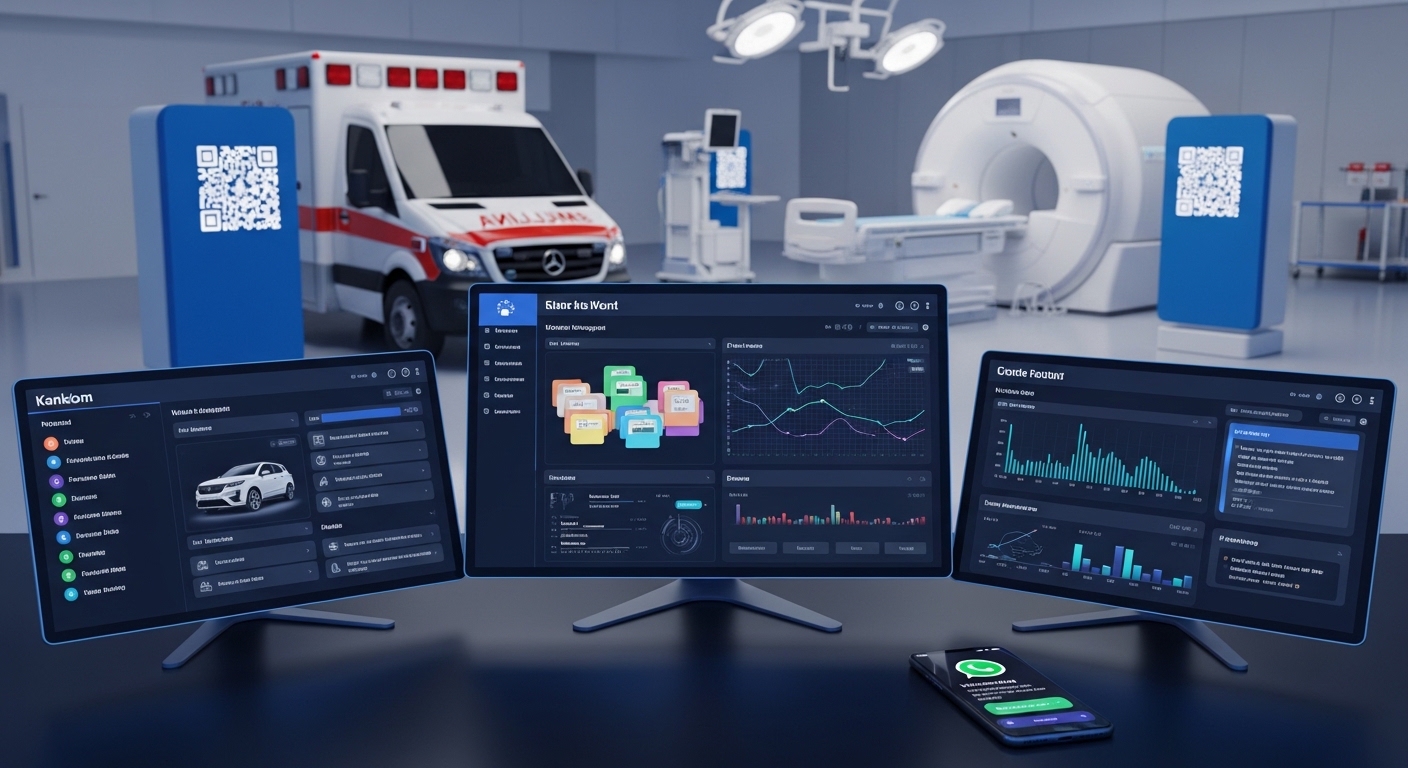
- Immediate reporting via WhatsApp: Paramedics, drivers, or nurses do not need to install heavy applications or train on complex software. If a vital signs monitor fails or an ambulance makes an unusual sound, they simply send a WhatsApp message. iGromi processes this message using Artificial Intelligence and automatically generates a maintenance ticket in the central system.
- Digitalization with QR Codes: Every critical asset (from a defibrillator to a rescue truck) has a unique QR Code. By scanning it, staff immediately access the equipment's clinical history, procedural manuals, and the ability to report a new fault in seconds, eliminating paperwork and human error.
- Agile management with Kanban Boards: Maintenance managers visualize all EMMS alerts and WhatsApp reports on an intuitive Kanban board. They can drag and drop work orders from Backlog to In Progress and Completed, assigning technicians and spare parts in real time with 100% visibility of the workload.
Move beyond restrictive licensing
See why iGromi OS is a modern alternative to legacy SCADA and MES systems.
The New Standard: Edge AI
The industry no longer buys expensive per-tag licences or depends on slow clouds. Modern plants process data locally at < 5ms with full autonomy, even with no internet.
View Architecture MatrixMaintenance of Fleets and Critical Assets: Always ready to operate #
The concept of operational readiness reaches its highest expression when we manage emergency fleets and life support equipment. In traditional manufacturing, Downtime means lost money; in the healthcare and emergency sector, it means lost lives and public health crises. Therefore, preventive and corrective maintenance cannot be reactive or based on assumptions.
The financial and operational impact of Downtime
The cost of keeping an emergency vehicle off the road is not calculated solely by the mechanic's hours or the cost of spare parts. It is calculated by the breach of SLAs (Service Level Agreements) with hospitals, the risk of lawsuits for operational negligence, and the accelerated wear and tear of the rest of the fleet that must overcompensate for the absence of the damaged vehicle. An integrated EMMS/CMMS system allows predicting these failures based on mileage, engine hours, and the asset's stress history.
Absolute traceability and stress-free audits
Government regulations and ISO standards for medical equipment and emergency fleets demand immaculate traceability. Every oil change, every calibration of a mechanical ventilator, and every brake inspection must be documented with the date, time, responsible technician, and photographic evidence.
With iGromi, this traceability is automatic. When a technician scans an asset's QR Code and marks the task as finished on their mobile Kanban Board, the system generates an immutable timestamp. During an audit by health or transport authorities, operations managers can export an asset's complete lifecycle in a couple of clicks, demonstrating absolute compliance with safety protocols.
Hybrid Maintenance Strategies
Keeping a fleet always ready requires a combination of strategies:
- Condition-Based Maintenance (CBM): Using EMMS data to intervene in a vehicle only when indicators (pressure, temperature, vibration) show signs of degradation.
- Usage-Based Preventive Maintenance (UBM): Automatically scheduling work orders in iGromi every time an ambulance reaches 10,000 kilometers or a backup electrical generator hits 500 hours of operation.
- Ultra-Fast Corrective Maintenance: Thanks to the integration with WhatsApp, the Mean Time To Report (MTTR) is reduced from hours to seconds, immediately activating response teams.
From Inventory to IoT: A Connected Ecosystem for your Facilities #
Fleet and mobile equipment management does not happen in a vacuum. These assets have a home base; they operate out of hospitals, clinics, firehouses, and logistics hubs. This is where comprehensive Facilities management comes into play. A truly modern CMMS must be capable of managing both the vehicle on the street and the automatic base gate that allows it to exit on time.
The IoT (Internet of Things) revolution in Facilities
The definitive qualitative leap in maintenance management is the adoption of IoT sensors. We are talking about temperature sensors in cold chains for medications, humidity monitors in operating rooms, and vibration sensors in hospital water pumps. When these sensors detect a reading outside normal parameters, they don't just send an alert to an isolated EMMS; they communicate directly with the brain of the CMMS.
By integrating this technology with iGromi, the IoT sensor acts as just another operator. It can autonomously trigger a card on the maintenance Kanban Board, alerting the on-call team to a potential failure in the HVAC (Heating, Ventilation, and Air Conditioning) system before the operating room has to be shut down due to contamination. It is the ultimate expression of predictive maintenance.
Just-in-Time Inventory Management
Nothing delays a critical repair more than lacking the right spare part. The convergence of the EMMS and the CMMS enables precise and connected inventory management. As a work order advances on the Kanban Board, iGromi's system automatically deducts the used spare parts from the central warehouse.
Procurement managers can set minimum stock alerts for particulate filters, high-performance brake pads, oxygen valves, and defibrillator batteries. This guarantees a Just-in-Time model that reduces capital tied up in warehouses while ensuring technicians always have what they need to return critical equipment to the front line.
The virtuous cycle of Continuous Improvement
Finally, a connected ecosystem provides the most valuable asset for a Director of Operations: Structured data. By having all human interaction channeled through WhatsApp, all asset identity centralized in QR Codes, and all workflow orchestrated on Kanban Boards, an operational heat map is generated. You can identify which ambulance brand fails the most, which spare parts supplier delays deliveries, and which technicians are the most efficient. iGromi is not just maintenance software; it is the business intelligence engine your critical operation needs to scale safely, profitably, and above all, reliably.