Food and BeverageDec 17, 2025
The Digital Cold Chain: Food Traceability That Holds Up
A 20-minute temperature break can ruin a whole container of salmon. Real-time cold chain monitoring with GPS tracking is the export business's insurance.
The Brutal Fragility of Fresh Food #
Exporting fruit or fish from Chile to the world is a grueling logistics feat. A reefer container of blueberries travels 21 days from Chillán to Shanghai. That's 21 days in which a faulty compressor, a poorly sealed door or a configuration error can turn a container of premium fruit into compost.
A rejection at destination for temperature is paid in full: the cargo, the return freight or the destruction, and the relationship with the buyer. And to file a claim with the insurer or the carrier, you need exactly what exporters rarely have: a record of when and where the chain broke.
Regulation is heading the same way. In the United States, the FSMA (Section 204) traceability rule requires electronic, sortable records that can be handed to the FDA within 24 hours; it applies to foreign exporters and has a deadline of July 20, 2028. In the EU, Regulation 178/2002 requires traceability one step back and one step forward. Neither asks for a particular technology: they ask you to be able to show the record.
USB Data Loggers: A Useless Autopsy #
The classic method is to drop a USB temperature logger into the pallet. It records temperature every 15 minutes. The problem:
- You only see the data AT THE END: When the cargo reaches its destination, you download the USB. If there was a temperature excursion on day 3 of the trip, you find out on day 22. It's too late. The fruit is ruined.
- No context: If the temperature went up, was it a reefer failure? Or did someone open the door at an intermediate port? You don't know.
- Easy to tamper with: A USB file can be altered. It isn't solid forensic evidence in a high-stakes legal dispute.
Active Real-Time Monitoring: The 2025 Shift #
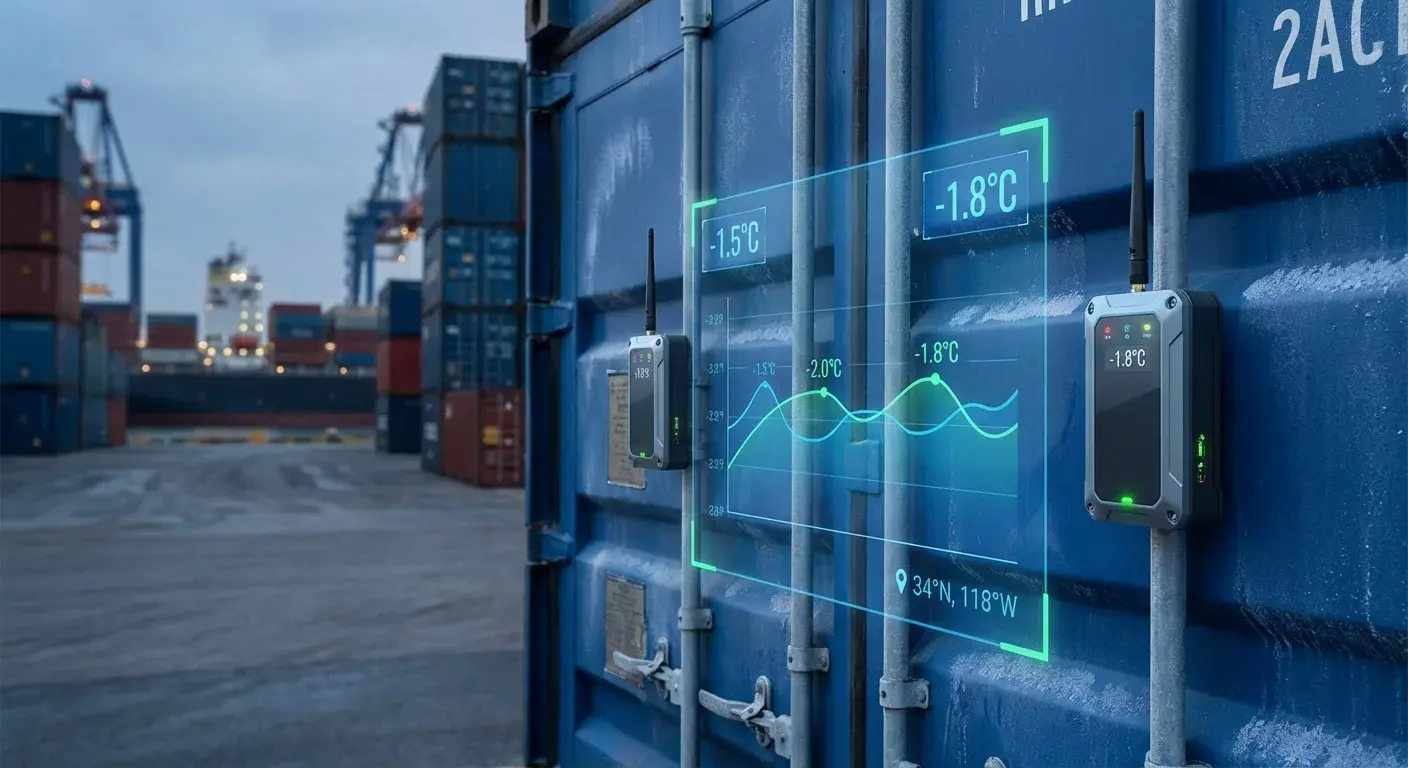
The new generation of onboard IoT devices travels WITH the cargo, transmitting live data over cellular (NB-IoT/Cat-M1) or even satellite (Iridium/maritime Starlink).
Components of a Modern System
- Multi-variable sensor: Not just temperature. It measures relative humidity (critical for fruit), barometric pressure (detects whether the door was opened), GPS (exact location) and shock/vibration (detects impacts that damage the cargo).
- Cellular/satellite gateway: Sends data to the cloud every 15-30 minutes. If it detects a temperature excursion, it switches to IMMEDIATE alerts (every minute).
- Predictive cloud platform: It doesn't just log; it predicts. If the temperature is rising 0.5 °C per hour, the ML model predicts it will be out of range in 4 hours and raises the alert BEFORE the problem happens.
What a Rejection Costs: The Math You Need to Do #
There's no generic return that fits everyone, because it depends on two numbers only the exporter has: how much the cargo is worth and how many loads are lost to temperature today. The math is:
- Expected loss per trip = cargo value × temperature rejection rate.
- Monitoring cost per trip = device (or its rental) + connectivity + platform, divided by the number of trips it makes.
If the first is larger than the second, monitoring pays for itself. With a 1% rejection rate, every trip puts on average one hundredth of the cargo's value at risk.
Where the Chain Breaks (and Where iGromi Measures) #
Some excursions don't happen at sea but at the handoffs: the freezing tunnel that didn't reach temperature, the wait on the loading dock, the loading of the container. That part happens inside the plant, and it's the part a pallet tracker sees too late.
That's where iGromi works. In the IQF freezing tunnel of a customer plant, we measure temperature continuously with a 0.05 °C difference against a calibrated reference, so the product's record begins before it leaves the plant.
Tamper-Evident Records #
Food certification standards such as BRCGS and IFS are moving toward digital records, and an auditor trusts a record nobody can edit retroactively more than a spreadsheet. There are several ways to get there:
- Recording at the source: the sensor writes directly, with nobody transcribing.
- Append-only: the system lets you add records and correct with a new entry, never overwrite.
- Signing each record: if someone changes a value, the signature no longer matches and it shows.
Blockchain is one more way to do it, useful when several companies that don't trust each other share the same record. To show an auditor or the FDA that the chain didn't break, it isn't a requirement.
Connectivity: NB-IoT vs Satellite #
NB-IoT (Cellular)
- Cost: Very low per device.
- Coverage: Excellent on land, in ports and along overland routes.
- Limitation: No coverage in the middle of the ocean.
- Best for: Overland transport, air cargo, port transit.
Satellite (Iridium/Starlink)
- Cost: High (monthly plan per device).
- Coverage: Global, including the oceans.
- Latency: Messages every 30-60 min (not true real time).
- Best for: Long-haul maritime shipping.
Conclusion: From "I Hope It Arrives OK" to "I KNOW It Arrived Right" #
The digital cold chain isn't "nice tech"; it's life insurance for the export business. In a world of shrinking margins and tightening regulation, NOT having full visibility of your chain is betting the company on luck.
Run the numbers with your own figures: the value of a load and your rejection rate, against what it costs to monitor each trip. If you don't know your temperature rejection rate, that's the first number you're missing.
Inside the plant, which records HACCP, BRCGS and FSMA 204 require is covered in the guide to traceability in food plants, and how to measure cold storage for an audit in temperature monitoring for cold rooms.
Topics
- cold chain monitoring
- food traceability
- fsma 204 traceability
- reefer container monitoring
- gps tracking system
- cold chain iot
- haccp temperature records

About the author
Bárbara RuzCTO
iGromi's CTO. Leads the architecture of iGromi OS and the platform's technical direction, turning messy industrial processes into elegant data flows.