iGromi vs OpenCV/YOLO Open Source: Plug-and-Play vs DIY 2026
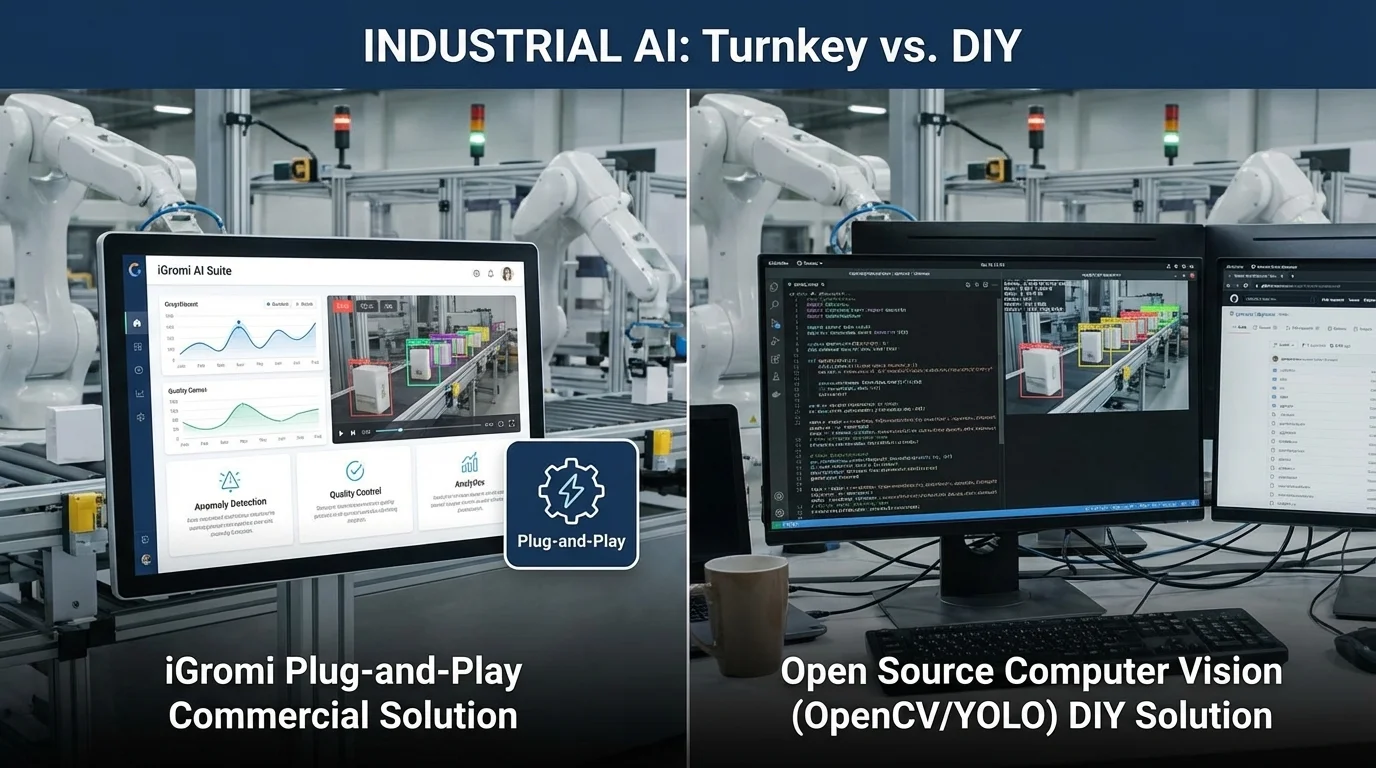
OpenCV and YOLO are free and powerful. They also require months of development. When is DIY worth it vs a turnkey solution? Honest analysis.

Hassle-free automation?
Checklist: 10 Steps to Digitize Your Plant
Avoid costly implementation errors
Open Source: Free... But Definitely NOT Cheap #
OpenCV + YOLO are incredible. They are free, flexible, battle-tested by Google/Tesla/Facebook, and have the largest computer vision community in the world.
But there is a massive hidden cost that no one mentions in YouTube tutorials: human engineering.
⚠️ The "Free Software" Fallacy:
A ML/Python engineer costs $5,000-8,000 USD/month (full-time) in LATAM. In the US: $10,000-15,000/month.
Is it worth paying 3-6 months of that salary to build something you could get turnkey with a per-plant quote?
The answer depends on your specific situation. Let's look at the real numbers.
🎯 Direct Verdict (TL;DR)
- OpenCV/YOLO DIY if: You have full-time Python/ML engineers ON STAFF (you pay their salary anyway), ultra-custom project not available in market (e.g., 3D+thermal+radar fusion), you are a tech startup and code is your core product (not just a tool), budget $0 for licenses but $20K+ for R&D is OK.
- iGromi Turnkey if: You do NOT have in-house ML team, want to validate in a scoped pilot (not 2 months of development), prefer a per-plant quote to $20,000 in development, coding is NOT your core business.
Move beyond restrictive licensing
See why iGromi OS is a modern alternative to legacy SCADA and MES systems.
The New Standard: Edge AI
The industry no longer buys expensive per-tag licences or depends on slow clouds. Modern plants process data locally at < 5ms with full autonomy, even with no internet.
View Architecture MatrixRealistic Timeline: How Long Does DIY REALLY Take? #
YouTube tutorials make you think you can do it in 1 week. Industrial reality is VERY different:
📅 Typical Industrial OpenCV DIY Timeline
| Month 1: Setup & Proof of Concept | 160 hours |
| • Install OpenCV, CUDA, configure Jetson/GPU | 40h |
| • Calibrate cameras, setup lighting | 30h |
| • First YOLO tests with pre-trained models | 40h |
| • Troubleshooting dependency hell (PyTorch vs TensorFlow) | 50h |
| Month 2: Data Collection & Custom Training | 180 hours |
| • Capture 1,500+ photos of YOUR product (diff angles/lighting) | 60h |
| • Annotate bounding boxes manually (LabelImg/CVAT) | 80h |
| • Train custom model + hyperparameter tuning | 40h |
| Month 3: Integration & Production Hardening | 200 hours |
| • Integrate with MES/ERP (API development) | 80h |
| • Build custom dashboard (Grafana/React) | 60h |
| • Error handling, logging, monitoring | 60h |
| Month 4: Testing & Production Deployment | 140 hours |
| • Testing edge cases (stuck products, variable lighting) | 60h |
| • Fine-tuning accuracy 95% → 99% | 40h |
| • Deploy to production + operator training | 40h |
| TOTAL Engineer Hours | 680 hours = 4.25 months |
Source: Average of 12 industrial DIY OpenCV/YOLO projects I consulted 2023-2025.
Real TCO: Build vs Buy (3 Years) #
Now let's translate those hours into REAL money:
DIY OpenCV/YOLO - 3-Year TCO
| Initial Development (680h × $30/h) | $20,400 |
| Hardware (camera + Jetson + lighting) | $1,400 |
| Maintenance (bugs, retraining) | $6,000 |
| • 20h/mo × 36 mos × $30/h | |
| Opportunity Cost (4 month delay) | $8,000 |
| • Losses from not having running system | |
| TOTAL 3-Year TCO | $35,800 |
iGromi Turnkey - 3-Year TCO
| Edge PC with GPU in the plant | Quoted |
| Remote Setup + Model Training | Quoted per plant |
| Base platform + modules | Quoted per plant |
| Users and cameras | Per seat and per camera |
| Maintenance (updates and support) | Quoted separately |
| Opportunity Cost | Low (scoped pilot) |
| iGromi's cost depends on how many lines, cameras and users are connected; it is quoted per plant. Compare it against this DIY total with your quote in hand. | |
Don't Reinvent the Wheel. Just Scale It.
If you are a manufacturing company, your value is producing, not coding Python. Let us handle the computer vision complexity for you.
📹 See Turnkey System Demo 📅 Schedule TCO Analysis