MiningDec 15, 2025
Mining 4.0 Automated Processes: An Innovation Guide
Driverless haul trucks, remote drilling and fatigue sensors: how mining technology is moving people out of the danger zone and raising productivity.
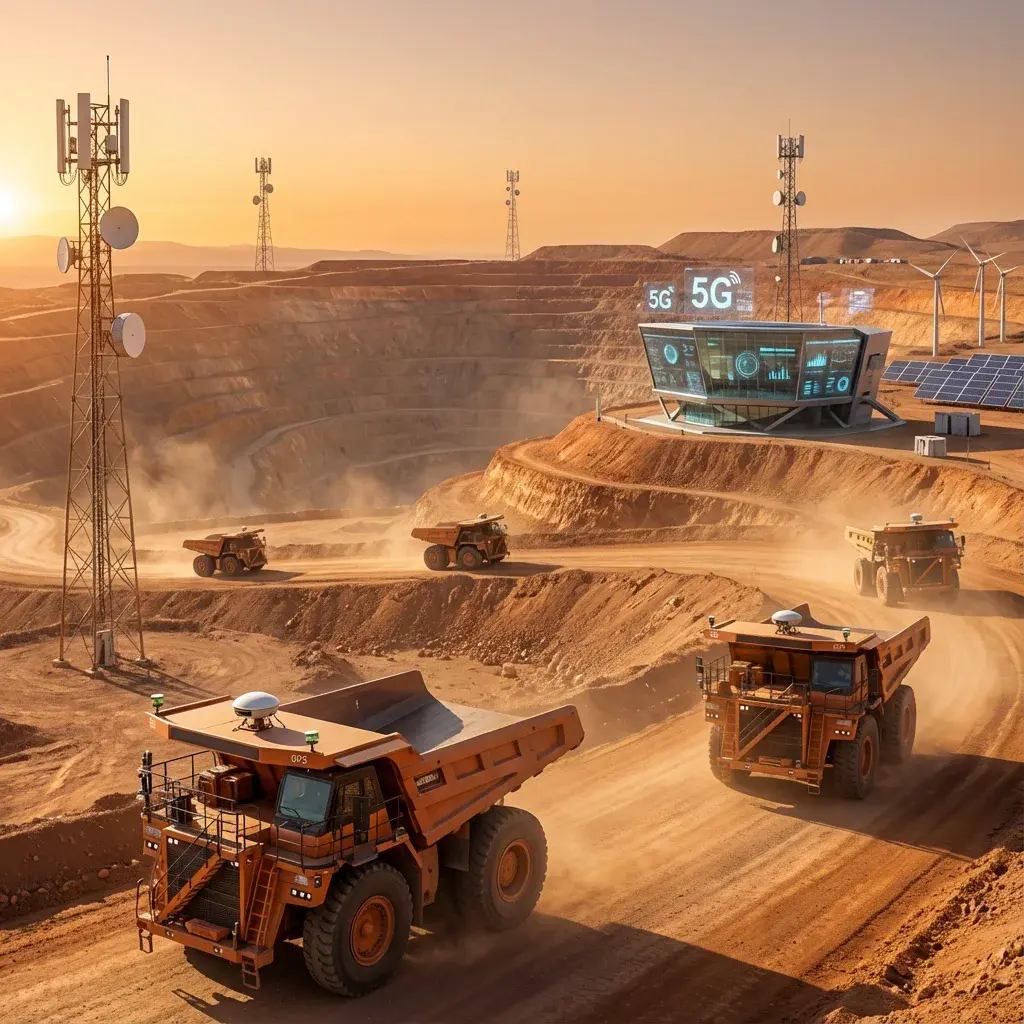
The End of the Era of Human Risk #
Mining has always been synonymous with risk: collapses, vehicle strikes, fatigue and exposure to toxic substances. In Chile, where large-scale mining contributes more than 10% of GDP, every fatality is not only a human tragedy but a national scandal that halts operations for weeks while it's investigated.
Mining 4.0 isn't just about "optimizing"; it's about redefining the human presence in the mine. The end goal is the "autonomous mine": an operation where machines do the dirty, dangerous work and people make strategic decisions from a climate-controlled control room hundreds of kilometers away.
Major mining companies already run fleets of driverless trucks in Chile. And this is only the beginning.
Autonomy: Beyond the Haul Trucks #
Autonomous trucks (AHS, Autonomous Haulage System) are the visible face of the mine of the future. These 400-ton beasts run 24/7 with no shift changes, no fatigue and no lunch breaks. An autonomous truck can operate 1,000 more hours a year than a crewed one, raising productivity by 15-30%.
But the shift goes much deeper:
Autonomous Drilling (Precision Drilling)
Robotic drill rigs guided by RTK GPS (±2 cm accuracy) position themselves and drill perfect patterns without human intervention. This has two massive impacts:
- Safety: Zero exposure to silica dust (the cause of silicosis) and extreme noise (the cause of occupational hearing loss).
- Quality: Millimeter precision reduces overdrilling and improves post-blast fragmentation, which cuts crushing costs by up to 12%.
Smart Blasting
A blasting engineer used to calculate the explosive charge from generic "average rock hardness" tables. Today, sensors in the blast holes (digital drill monitoring) measure the exact hardness meter by meter using vibration.
An AI algorithm correlates that data with the 3D geological model of the deposit and calculates the optimal charge for each individual hole. Result:
- A 40% reduction in oversize (boulders that jam the crusher).
- Less dilution (ore mixed with waste rock), raising the average grade of the processed material.
- Explosive savings of up to 8% a year.
Invisible Safety: IoT That Saves Lives #
For workers who still have to be in the field (geologists, surveyors, maintenance crews), IIoT adds an invisible layer of protection that reacts faster than any human supervisor:
Technologies That Save Lives
- Smart helmets: Equipped with EEG sensors that detect microsleeps (cognitive fatigue) even before the worker is aware of them. If they detect drowsiness on a night shift, they vibrate and alert the supervisor. Some models integrate gas sensors (CO, SO₂, NOₓ) that alert instantly when dangerous concentrations are detected, which is critical in underground mining.
- Collision Avoidance Systems (CAS): Every worker carries an active UWB (ultra-wideband) or RFID tag. Vehicles have readers that create a 10-50 meter "safety bubble." If a pedestrian enters the danger zone, the system:
- Triggers a visual/audible alarm in the cab.
- If the operator doesn't react within 2 seconds, applies the brakes automatically.
- Logs the event for near-miss analysis.
- Virtual geofencing: Restricted zones are defined in software (e.g., an active blast area, an unstable slope, a subsidence zone). If a worker crosses the perimeter:
- Their vest vibrates hard (haptic alert).
- Their radio sounds an emergency beep.
- The control room sees their position in real time on a map.
- A record is created for auditing.
- Physiological monitoring: Vests with heart-rate and body-temperature sensors detect heatstroke or extreme cardiovascular stress. In the Atacama Desert (50 °C in the sun), this is critical to prevent fatal heat stroke.
The Connectivity Challenge in the Open Pit #
None of this works without a robust network. Traditional WiFi fails badly in mining for three reasons:
- Pit geometry: An open pit 1 km across and 500 m deep is a brutal challenge for WiFi. Line of sight is lost constantly.
- Interference: Diesel engines, blasting and high-power electrical equipment generate electromagnetic noise that saturates the 2.4 GHz and 5 GHz bands.
- Mobility: A truck climbing and descending the ramp crosses dozens of WiFi cells. Handover (switching antennas) causes disconnections of up to 500 ms, unacceptable for real-time control.
The Solution: Private LTE/5G Networks
Mining is leading the adoption of private LTE/5G: dedicated cellular networks, not shared with the public, operating on clean licensed spectrum (CBRS bands in the US, 3.5 GHz in Chile).
Critical advantages:
- Ultra-low latency: under 20 ms. Vital for teleoperating equipment (e.g., shovels controlled remotely from Santiago).
- Seamless handover: The cellular protocol was designed for mobility. A truck at 60 km/h switches cells without losing a single data packet.
- Penetration: Cellular radio waves (low bands such as 700 MHz) bend around obstacles and get through dust and rain better than WiFi.
- Massive density: A single 5G tower can handle 100,000 simultaneous IoT devices (vibration, pressure and level sensors).
- Security: Because it's private, there's no outside traffic. Everything is encrypted with standard 3GPP algorithms.
Is the Investment Worth It? #
Digitizing a mine isn't cheap: a complete AHS system is one of the largest investments a mine site makes. What justifies it:
Illustrative example: a copper mine
Investment: a fleet of 40 autonomous haul trucks + private 5G infrastructure.
Where the return comes from:
- Fewer operators on high-risk shifts.
- Higher equipment utilization (+18%): more ore moved with the same fleet.
- Fewer accidents: lower insurance and stoppage costs.
- Lower diesel consumption (AI-optimized driving).
The Human Factor: What Happens to the Workers? #
The biggest concern is job loss. The reality is nuanced:
- Haul truck operator jobs are eliminated (repetitive, dangerous work with brutal rotating shifts that wreck people's health).
- Highly skilled jobs are created: systems engineers, robotics technicians, data analysts, OT cybersecurity specialists. These jobs pay better and are safer.
- Upskilling: Leading mining companies are retraining operators as supervisors of autonomous fleets (one human operator supervises 10 robotic trucks from a control room).
Conclusion: The Mine of the Future Is Here #
The technology exists and is proven. Autonomous mining isn't science fiction; it's operating today at Rio Tinto (Australia), Fortescue Metals (Australia), major mines in Chile and Anglo American (South Africa).
The only limits are the willingness to invest and the ability to manage cultural change. Mining companies that don't digitize simply won't be able to compete on cost with those that do.
Topics
- mining 4.0
- automated mining processes
- autonomous haulage system
- smart mining
- private lte mining
- mining safety iot

About the author
Sebastián CarrilloLead Hardware Engineer
Translates code into tightened screws. Leads on-site installations and designs iGromi's industrial gateways, solving problems where dust and vibration come into play.