Mastering Modbus: Industry's Immortal Grandfather
Why does a protocol from 1979 still run the plant floor? The definitive technical guide to Modbus RTU vs TCP, register mapping and physical troubleshooting.

Hassle-free automation?
Checklist: 10 Steps to Digitize Your Plant
Avoid costly implementation errors
Why are we still using Modbus in 2026? #
Modicon (now Schneider Electric) invented Modbus in 1979. In technology years, that is the Stone Age. And yet 90% of industrial sensors, variable frequency drives and power meters still speak Modbus today.
The reason? Brutal simplicity. It is open, it is free, and it runs over two twisted copper wires.
Protect your PLCs from ransomware
iGromi Edge isolates Modbus equipment behind an industrial zero-trust boundary.
The key difference: Modbus RTU vs Modbus TCP #
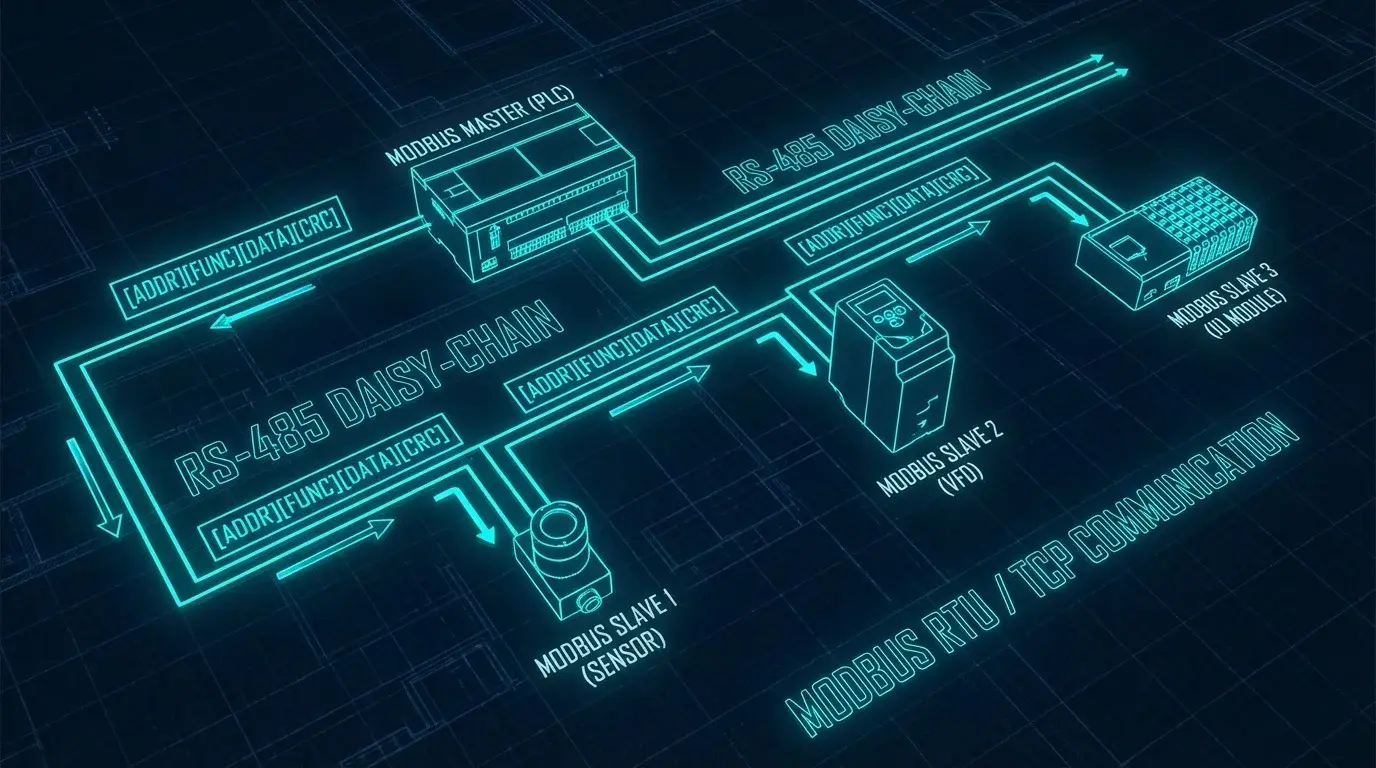
Modbus RTU (serial)
- Physical layer: RS-485 (usually).
- Wiring: 2 wires (A+, B-) plus ground.
- Topology: Daisy chain.
- Common failure: Electrical noise and missing termination resistor.
Modbus TCP (Ethernet)
- Physical layer: Ethernet (RJ45).
- Wiring: Standard Cat5e/Cat6.
- Topology: Star (switch).
- Advantage: Much faster, and free of electrical noise problems.
The memory map: understanding registers #
Modbus organizes data into tables. If you do not understand this, you will never read a value correctly.
| Type | Access | Address range | Typical use |
|---|---|---|---|
| Coils (0x) | Read/Write | 00001 - 09999 | Digital outputs (relays, LEDs) |
| Discrete Inputs (1x) | Read only | 10001 - 19999 | Digital inputs (buttons, ON/OFF sensors) |
| Input Registers (3x) | Read only | 30001 - 39999 | Analog data (temperature, pressure) |
| Holding Registers (4x) | Read/Write | 40001 - 49999 | Configuration, setpoints. |
RS-485 troubleshooting guide (90% of all problems) #
If your Modbus RTU link will not communicate, check these in order:
- Swapped wires: Is A going to A and B to B? Some manufacturers label A as "+" and others as "-". If it does not work, swap them — nothing burns out.
- Common ground: ALWAYS run the third ground wire (GND or COM) between every device to equalize potentials.
- Termination resistor: On the first and last device in the chain, fit a 120 Ohm resistor between A and B to prevent signal reflections.
- Duplicate slave ID: Every device needs a unique address (Slave ID).
💡 Pro tip: Use a USB-to-RS485 converter ($20 USD) and free software such as "Modbus Poll" on your laptop to test each sensor individually before wiring it to the PLC.