AgribusinessDec 16, 2025
Precision Agriculture: How IoT Saves Irrigation Water
Irrigate by need, not by schedule. LoRaWAN soil moisture sensors and automatic valves can save up to 40% of water. How it works in the field.
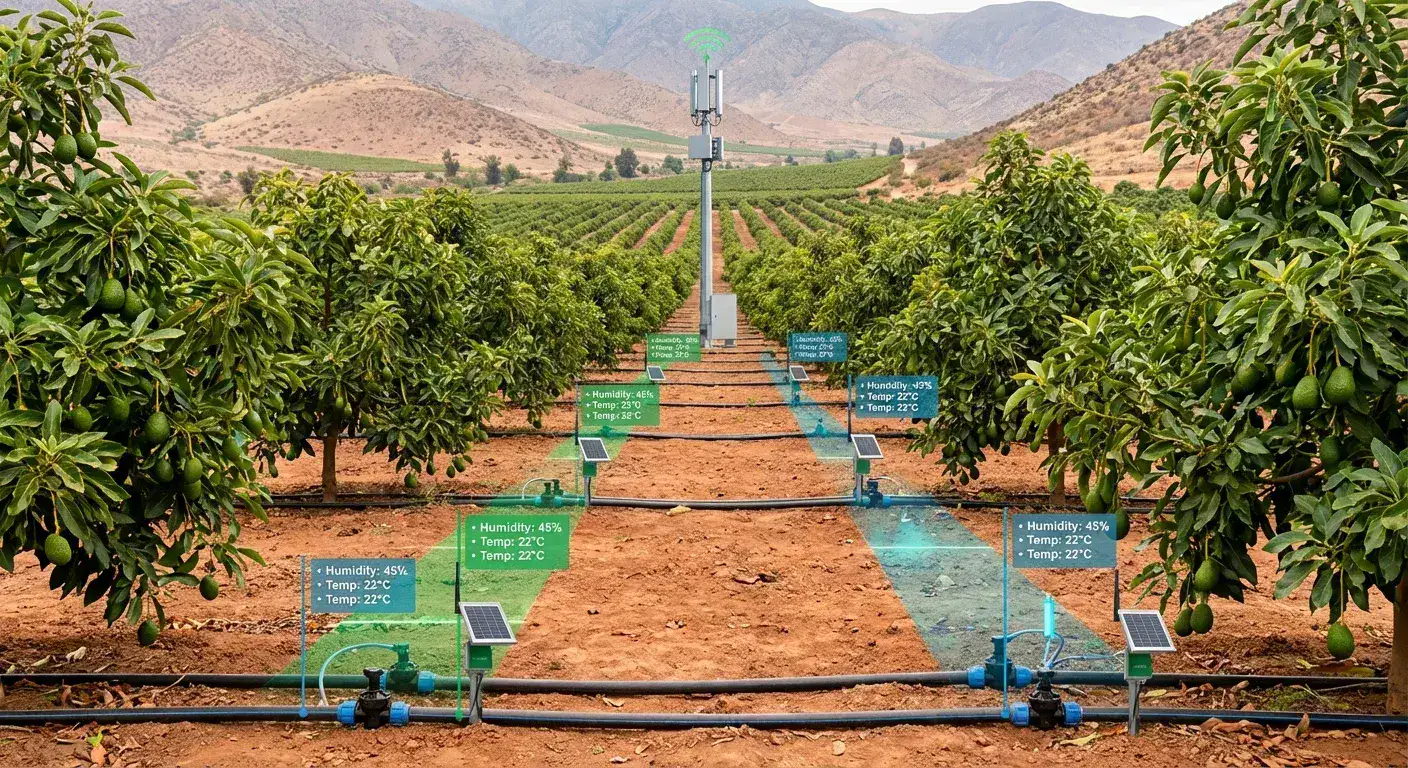
The Water Dilemma: Chile in a Permanent Water Crisis #
Agriculture uses 70% of the world's fresh water. In Chile the situation is dramatic: the country is in its 14th year of megadrought. Reservoirs in the Coquimbo region are at 8% of capacity. A mature avocado tree needs 120-150 liters a day. If you irrigate "by the calendar" or "just in case," you're pouring out water that doesn't exist.
In many valleys, water rights are worth more than the land. Water efficiency has gone from "good practice" to a requirement for economic survival.
From Eyeballing It to Real-Time Data #
The three traditional methods are catastrophically inefficient:
- Fixed calendar: "Irrigate Monday/Wednesday/Friday." It ignores whether it rained, whether a hot, dry Puelche wind doubled evaporation, or whether the plant is flowering or setting fruit.
- Visual judgment: By the time the human eye sees wilting, the plant has already lost size and sugars it won't get back. An avocado stressed during fruit set drops to the ground. That fruit doesn't recover.
- Class A evaporation pan: It measures atmospheric evaporation, but NOT how much water is available to the roots. It's a very poor proxy.
Result: 30-50% over-irrigation (nitrate leaching, root asphyxia, an absurd power bill) or under-irrigation (small fruit that doesn't make export grade).
The Shift: Irrigation Based on Real Physiological Demand #
1. FDR Probes (Frequency Domain Reflectometry)
Sensors buried at 20, 40 and 60 cm measure volumetric water content every 15 minutes and send the data over LoRaWAN. You see a "3D profile" of soil moisture. If it's perfect at 20 cm but dry at 60 cm, the deep roots aren't drinking. You adjust irrigation time for deeper penetration.
Illustrative example: a vineyard
120 FDR probes across 80 ha of Carmenere. The grower found they were irrigating for 8 hours when only 4.5 hours were needed to reach field capacity.
- Water savings: 44%
- Electricity savings: 44%
2. Dendrometers: The Tree's Lie Detector
A micrometer-precision sensor (±0.001 mm) that wraps around the trunk. It measures contractions and expansions of the xylem. During the day the tree "draws in" water (transpiration). If the soil is short of water, the tree can't replenish it and the trunk CONTRACTS. At night it expands.
A machine learning model analyzes the daily curve. If the maximum contraction exceeds the species threshold, the tree is stressed. The alert comes 4 days before the stress is visible.
Illustrative example, avocados: Pre-visual stress was detected and irrigation applied preventively, avoiding the drop of set fruit. Fruit retention: +12%.
3. Satellite and Drone NDVI
The NDVI index measures "greenness" with multispectral cameras (near-infrared vs. red). Sentinel-2 (ESA, free) provides images every 5 days at 10 m resolution. Survey drones with multispectral cameras get down to 5 cm resolution.
Workflow:
- The platform processes the image → NDVI heatmap of the orchard block.
- It flags red zones (low NDVI = stress).
- The agronomist checks on the ground: irrigation? pests? drainage?
- Irrigation is adjusted sector by sector.
Illustrative example, cherries: NDVI showed a yellow sector (clogged drippers). It was fixed within 24 hours, avoiding the loss of about 2 tons of fruit.
Full Automation: Set and Forget #
The expert level is taking the human out of the decision loop:
- FDR sensors → cloud platform every 15 min.
- The algorithm decides: IF moisture < 15% THEN irrigate (or a more complex ML model that predicts future ET from the weather forecast).
- It sends a command to the local controller (a PLC or an Arduino with 4G).
- The controller opens the sector's solenoid valve.
- It irrigates for X minutes (calculated to hit the target).
- It closes the valve. Done.
Pulse irrigation: 4 one-hour irrigations spaced 2 hours apart (instead of a single 4-hour irrigation). Water infiltrates gradually and stays in the root zone. Uptake efficiency: 60% → 85%.
What You Invest and What You Save #
Illustrative example: blueberries, Maule Region (35 ha)
Investment: FDR probes per sector, solenoid valves, a LoRaWAN gateway and the data platform.
Where the savings come from:
- Water: -38%
- Pumping electricity: -38%
- Premium-size fruit: +8%
Compare the cost of the equipment against those three lines using your own farm's prices.
LoRaWAN: Invisible Connectivity #
An orchard block has no WiFi and no power. LoRaWAN solves all of that:
- Range: 5-15 km in open country. One gateway covers an entire farm.
- Battery: 2 AA batteries last 5-10 years (ultra-low power).
- Cost: Your own network. No monthly plans (unlike cellular, which charges per sensor).
- Penetration: 868 MHz goes through dense foliage better than WiFi or cellular.
Conclusion: Adapt or Go Extinct #
In a Chile with permanent drought, digitizing irrigation isn't "nice-to-have tech"; it's survival. Those who don't digitize face 40% higher costs, fines from the DGA (Chile's water authority, which is now inspecting water extraction with drones) and lost export competitiveness.
Run the numbers with your own water and energy consumption before you decide.
Topics
- precision agriculture iot
- smart irrigation
- soil moisture sensors lorawan
- iot water savings agriculture
- dendrometer irrigation
- ndvi irrigation

About the author
Sebastián CarrilloLead Hardware Engineer
Translates code into tightened screws. Leads on-site installations and designs iGromi's industrial gateways, solving problems where dust and vibration come into play.