Industrial automation
without replacing anything.
iGromi OS connects to your existing PLCs, sensors, cameras, and ERP. No reprogramming. No replacing your machines, cameras or PLCs. One platform that gives your entire plant a shared understanding of what's happening — in real time.
The Stack
One platform.
Every protocol. Every machine.
PLC & sensors
Modbus RTU/TCP, OPC-UA, Siemens S7, Rockwell, Mitsubishi. Read registers without modifying ladder logic.
ERP & MES
Structured JSON output to SAP, Oracle, Microsoft Dynamics. Bidirectional sync. Events flow from the plant floor to the business.
Cameras & vision
RTSP/ONVIF camera integration. Computer vision models run on the edge. People counting, object detection, quality inspection.
What you can automate
1 · What your plant already has
- Existing PLCs and drives
- Ovens, cold rooms and tanks
- Sensors and meters
2 · The iGromi node on site
- Translates Modbus, S7 and EtherNet/IP into one format
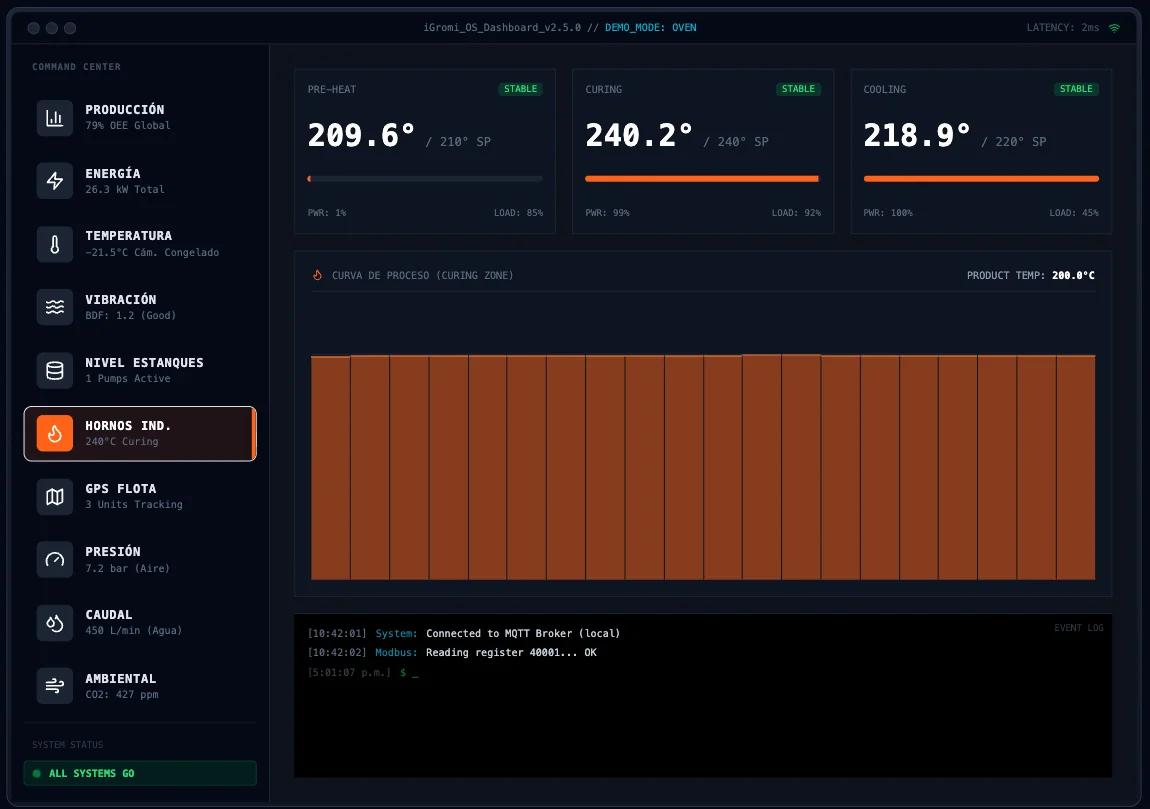
- Compares each variable with its setpoint
- Raises alarms with the cause
3 · What your team gets
- One dashboard for the whole process
- Continuous record of every variable
- Data ready for your systems
Automate your plant
without replacing anything.
Show us what PLCs and cameras you have. We'll show you what iGromi OS can measure. 30 minutes, no commitment.
Book a diagnosticHow is this rolled out in a plant that is already running?
The same five questions come up in every meeting, whichever solution is on the table. The answers depend on how the system works, not on the module.
Do I have to replace my PLC or my SCADA?
No. The system connects to what is already installed and reads from it; it does not replace the control layer and does not write to it unless that is explicitly defined. If the PLC does not expose its parameters, the iGromi Bridge discovers them by trying combinations until it gets a response, and if the machine speaks no protocol at all it is read by a sensor on the electrical signal.
Does it work if the internet goes down?
Yes. Processing happens at the Edge, inside the plant, so capture, rules and inference keep running with the link down. What stops is remote access and outbound synchronisation, which resumes on its own when the connection returns.
Does my data leave the plant?
Not by default. Video and telemetry are processed on the customer's Edge device. What leaves, and where it goes, is defined when the system is configured. That is the same property that underpins compliance with Chile's Ley 21.719 and what makes this viable in mining and in food.
How long until the first data point?
It depends on how many machines there are and what they expose. A line with equipment that speaks Modbus is read in days; a line of silent machines needs sensors installed and panel shutdowns coordinated, and that is set by the plant's maintenance calendar, not by us. The usual sequence is assessment, pilot, expansion.
What happens to what we already measure by hand?
It runs alongside during commissioning. For the first weeks the manual record keeps going in parallel as a validation counterpart: it is how you find out whether the automatic figure beats the handwritten one, and the habit is dropped on its own once that is demonstrated.
Related solutions
Industrial IoT gateway
Hardware and software that connects legacy machines to edge or cloud systems.
Real-time OEE
Availability, performance and quality calculated automatically from PLCs and cameras.