ProductivityDec 21, 2025
5S Methodology: The Foundation of Operational Excellence
You can't run advanced processes in a chaotic environment. 5S isn't cleaning: it's discipline and visible standards. The five steps, explained.
Beyond Sweeping and Mopping #
Many managers see 5S as a cleaning campaign: "Let's clean up the plant for the owner's visit." Wrong.
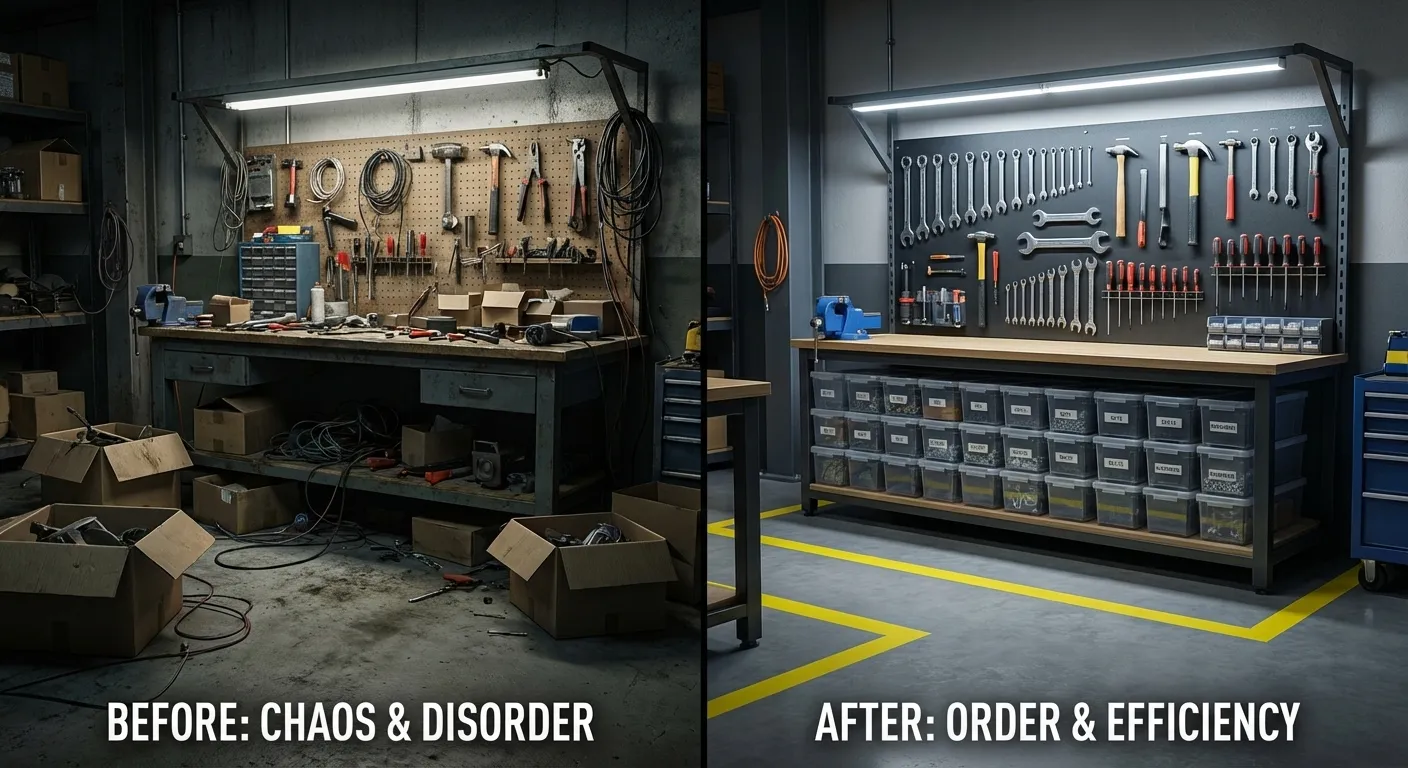
5S is a system for exposing problems. In a plant with 5S, any anomaly (a leak, a missing tool, material out of place) jumps out at you in under 3 seconds.
1. SEIRI (Sort) #
The art of throwing things away. Separate what's needed from what isn't.
- Criterion: Has it been used in the last 30 days?
- Action: If not, remove the item from the work area. Move it to a "quarantine" area (red tag).
Typical result: 30-50% of floor and workbench space is freed up.
2. SEITON (Set in Order) #
A place for everything, and everything in its place.
Making it look neat isn't enough. The point is to organize for the workflow.
- Frequency: What you use every hour, within arm's reach. What you use once a day, a few steps away.
- Visual management: Shadow boards for tools. If the hammer is missing, its outline shouts "I'M GONE!"
- Labeling: Marked floors, shelves labeled with maximums and minimums.
3. SEISO (Shine and Inspect) #
Cleaning with a purpose.
You don't clean so it looks good. You clean to inspect. When you wipe down a machine with a rag, your hands feel vibration, pick up early oil leaks and spot loose bolts.
Cleaning is the most basic form of preventive maintenance.
4. SEIKETSU (Standardize) #
Make the first 3S the norm, not the exception.
How do we make sure the chaos doesn't come back?
- Photos of the "standard state" at every station.
- 5-minute visual checklists.
- Universal color codes (e.g., red = scrap, blue = WIP).
5. SHITSUKE (Sustain) #
The hardest one: building the habit.
It's the difference between doing 5S once a year and living 5S every day.
- Weekly cross-audits (one team audits another).
- Public recognition for the best areas.
- Leading by example (the manager does 5S too).
Tangible Benefits #
| Indicator | Real Impact |
|---|---|
| Time spent searching for tools | 60% reduction |
| Quality defects | 40% reduction (less contamination) |
| Accidents | Sharp reduction (trips, bumps) |
| Team morale | Visible increase (pride of ownership) |
If you can't sustain 5S, don't try to implement Six Sigma or TPM. It won't work. Start by putting your house in order.
Topics
- 5s methodology
- 5s lean
- 5s in manufacturing
- seiri seiton seiso seiketsu shitsuke
- 5s workplace organization
- shadow board

About the author
Víctor RuzCEO
Automation and Robotics Engineer (Universidad Andrés Bello, 2012). More than twelve years in robotics and industrial automation. Founder and CEO of iGromi, where he connects machines, systems and plant people with secure industrial AI.