ProductivityDec 23, 2025
The End of Paper: Digital Maintenance and Quality Rounds
Paper checklists are dead data. How rugged tablets and digital work instructions give technicians back time and make inspection data usable.
A Useless "Library of Alexandria" Made of Paper #
In many plants, inspection rounds are carefully filled out on paper. The technician writes: "Pump 3: Normal vibration. Temperature OK. No leaks." Signs it. Files the sheet in a binder. The binder goes into a metal filing cabinet.
Problem: That data is DEAD. Nobody reads it again until the pump blows up. If the technician wrote "slightly elevated vibration" six weeks in a row, nobody connected the trend because the data was trapped on disconnected paper.
It's like having expensive human sensors generating valuable data and throwing it in the trash.
The Connected Worker #
Equipping technicians with rugged tablets or smart glasses changes the game completely:
1. Mandatory, Smart Digital Checklists
The system won't let you tick "OK" and move on. It has to capture evidence:
- If you mark "Leak detected": the system REQUIRES a photo + a severity level + a description.
- Work orders generated on the spot: the CMMS immediately creates a work order assigned to corrective maintenance.
- Geolocation: the app knows WHERE you are. If you fill out the Building C checklist while standing in Building A, it flags it (preventing fraud).
2. Instant Access to Critical Information
Before: the technician walks 15 minutes to the office to find the manual. Now: they scan a QR code on the machine and instantly see:
- The full equipment data sheet (model, specs, installation date).
- The PDF operating manual + interactive 3D drawings.
- Maintenance history (the last 10 interventions).
- Available spare-parts stock (ERP integration).
- A video tutorial: "How to replace the mechanical seal."
Total time: 30 seconds. Savings: 39.5 minutes. × 8 technicians × 5 events/day × 250 days = 3,950 hours recovered per year = 2 full-time technicians.
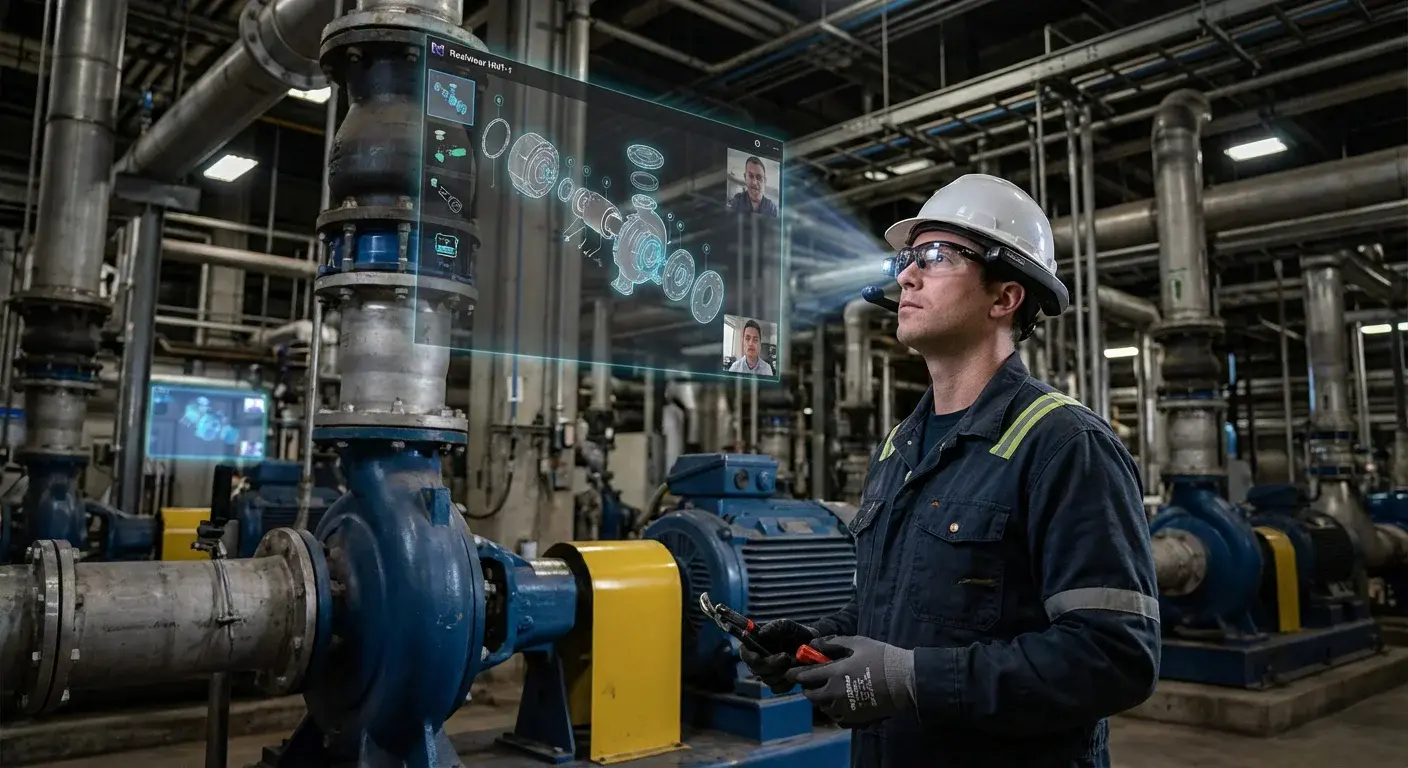
3. Remote Assistance with AR (Augmented Reality)
A junior technician faces a failure on an unfamiliar compressor. Before: they wait 2 days for the senior expert.
Now (with hands-free smart glasses and a video call):
- They start a video call. The glasses stream what they see (hands-free).
- The senior expert (at home, 200 km away) sees the SAME image on screen.
- The expert draws AR arrows that the junior SEES overlaid: "Turn that red valve 90°."
- Problem solved in 20 minutes (vs. 2 days).
Illustrative example, a pulp mill: with AR for 15 technicians, a plant that pays for every OEM technician visit can recover the investment within months if it cuts those visits.
Metrics: Before and After #
Illustrative example: food plant (120 operators)
| KPI | Before (paper) | After (digital) | Improvement |
|---|---|---|---|
| Round time | 45 min | 28 min | -38% |
| Wrench time* | 32% | 51% | +59% |
| SOP errors | 3.2/month | 0.3/month | -91% |
| Data transcription | 2.5 hrs/day | 0 (automatic) | -100% |
*Wrench time = % of time the technician spends actually fixing things (vs. looking for information, walking, filling out paperwork)
Resistance to Change #
"My technicians are 55 years old. They don't know how to use tablets. This won't work."
Reality: industrial tablets have interfaces designed for tech-averse workers: big buttons (usable with gloves), guided flows and voice control ("Navigate home," "Take photo").
Illustrative example: at a refinery where technicians average 52 years old, tablet adoption can be high within a few weeks if the most experienced technician becomes the internal champion.
Conclusion: From Operator to "Productive Cyborg" #
The connected worker doesn't replace the human. It AMPLIFIES them. It takes away the crushing administrative load (transcribing, walking, hunting for manuals) and frees them to do what only a human can: think critically, solve problems and apply expertise.
The typical result: higher technician productivity, far fewer errors, full traceability and HAPPIER workers (less bureaucracy = more job satisfaction).
Download the iGromi Lean Audit Toolkit 2026 #
A strategic asset for turning theory into cash flow. What do you get when you download this professional Excel workbook?
Severity score (1-5) for each of the 7 wastes with automatic traffic-light conditional formatting.
Calculates how much money you're losing TODAY to waiting and defects. Puts a dollar figure on operational pain.
Automatically generates the TOP 3 wastes to attack first to maximize ROI.
A digital maturity assessment. Are you ready to automate, or do you need to fix manual processes first?
⚡ Want to digitize this today?
Excel is for analysis. iGromi OS is for ACTION. Our MES captures these wastes in real time and takes paper out of the process.
When you request your demo, we send you the Lean Toolkit 2026 configured for your industry.
Paper won't die by decree. It will die because technicians with tablets are simply BETTER at their jobs.
Topics
- digital inspection rounds
- connected worker
- digital checklists maintenance
- paperless maintenance rounds
- wrench time
- remote assistance ar

About the author
Sebastián CarrilloLead Hardware Engineer
Translates code into tightened screws. Leads on-site installations and designs iGromi's industrial gateways, solving problems where dust and vibration come into play.