ProductivityDec 21, 2025
The 7 Wastes of Lean: Plant Examples and a Free Excel
The 7 wastes of Lean Manufacturing (muda) with plant-floor examples, the 8th waste almost nobody measures and a free Excel audit template.
Locked file
plantilla-7-desperdicios-lean-en.xlsx (34 KB)
Leave your work email to download this spreadsheet and hear about the next one.
🎁 Free Resource: iGromi Lean Audit Toolkit 2026 #
It isn't just theory. We built an Excel tool that automates waste detection and calculates the financial impact on your plant.
See the Lean Toolkit DetailsThe Crisis That Gave Birth to a Revolution: Postwar Toyota #
It was 1950. Japan was in ruins after World War II. Eiji Toyoda visited Ford's Rouge plant, which was producing about 7,000 cars a day; Toyota had built 2,685 in thirteen years (Womack, Jones and Roos, The Machine That Changed the World).
But he spotted something crucial: Ford's gigantic assembly lines were designed for massive volume of a single model. Toyota had neither that capital nor that market. It needed flexibility with minimal resources.
💡 The Insight That Changed the World: Taiichi Ohno, chief engineer of the TPS (Toyota Production System), realized: "80% of what we do in the factory does NOT add value for the customer." He spent 30 years hunting down and classifying those wastes.
That obsession gave birth to the 7 Wastes (Muda), which today are the DNA of Lean Manufacturing. And the brutal truth: in Latin America, 70 years later, we're still committing the same 7 deadly sins.
The 7 Wastes: The Complete Taxonomy #
Ohno ranked them by how often they appeared at Toyota. The order matters because #1 (overproduction) sets off a cascade that triggers all the others.
1. OVERPRODUCTION: The Mother of All Wastes #
Definition: Producing more than the customer needs, or before they need it.
Ohno called it "the worst crime" because it creates all the other wastes. If you produce 1,000 units when you only need 800:
- ✗ Those 200 extra units take up space (→ Inventory)
- ✗ You have to move and organize them (→ Transportation)
- ✗ They need extra inspection (→ Overprocessing)
- ✗ They can get damaged or become obsolete (→ Defects)
- ✗ Workers handle them for no reason (→ Motion)
- ✗ They take up machine time that could go to another product (→ Waiting)
🇨🇱 Illustrative example: a bottling plant
Problem: The plant produced 20% more beverages than it sold "in case demand goes up." The result was a disaster:
- • 3 extra rented warehouses
- • 15% of the product expired before it was sold
- • Panic sales at 40% off so as not to lose everything
- • Annual cost: the plant's single biggest waste
Typical fix: pull production in short runs, with real demand in plain sight. In a case like this, the savings come from eliminating warehouses and spoilage.
Key indicator: the stock-to-sales ratio. If you have more than 45 days of finished-goods inventory, you have chronic overproduction.
2. WAITING: The Silent Productivity Killer #
Definition: Any idle time in which resources (people, machines, materials) aren't actively adding value.
The scary number: in many plants a product spends most of its time waiting and only a small fraction being transformed. An order with 8 hours of real work takes 3 weeks to complete because it spends days in queues.
Types of Waiting (The 5 Villains):
- Waiting for material: Operators standing idle because the warehouse doesn't deliver on time
- Waiting for a machine: Product queued until the next piece of equipment frees up
- Waiting for setup: The line stopped for 2 hours changing from SKU A to SKU B
- Waiting for information: Work orders stuck waiting for "management approval"
- Waiting for maintenance: A machine down for 8 hours waiting for the technician or the spare part
🇨🇱 Illustrative example: a metal fabrication shop in Santiago
Problem: An 18-day lead time for simple parts. A desperate customer.
VSM (Value Stream Mapping) analysis:
- • Actual work time (cutting + bending + welding): 6.2 hours
- • Time in queues: 17 days 18 hours
Solution: Manufacturing cells: cutter + press brake + welder together, plus dropping the "approval" step for minor orders. Result: lead time fell to 3 days. The customer doubled its orders.
How to measure it: cycle time vs. lead time. If your lead time is 10x your cycle time, 90% of it is pure waiting.
3. TRANSPORTATION: Miles the Customer Doesn't Pay For #
Definition: Moving materials without transforming them. Every meter a forklift travels is time, fuel, CO₂ and risk of damage that the customer will never value.
📐 Exercise: The Spaghetti Diagram
Take a floor plan of your plant. Draw the path of ONE product from raw material to shipping. Measure the total distance.
Benchmark: "Normal" plants = 2-4 km. Lean plants = under 500 meters.
In an illustrative audit, a pallet traveled 8.7 km (to the warehouse and back 6 times), costing 47 minutes of forklift time for a product with 12 minutes of real manufacturing.
Practical fix: a U-shaped flow layout, satellite stores (supermarkets) close to the point of use, and milk runs every 2 hours instead of trips to the central warehouse.
4. OVERPROCESSING: Perfection Nobody Asked For #
Definition: Any effort, step or resource the customer isn't willing to pay for.
It's the most insidious waste because it looks like "professionalism." Examples we see again and again in Chile:
- 🔧 Absurd tolerances: Requiring ±0.01 mm when the customer accepts ±0.1 mm (3x the machine time)
- 📋 Epic reports: 40-page reports with 20 charts nobody reads
- ✅ Redundant inspections: 3 quality checks when 1 done right would be enough
- ✍️ Endless signatures: A small purchase order needs 5 approvals and 12 days
- 💅 Unnecessary finishes: Mirror polishing on parts that end up hidden inside the product
The golden question: "Would the customer pay $X more if we told them we did this?" If the answer is NO → it's overprocessing.
5. INVENTORY: Money Sleeping on Shelves #
Definition: Any material or product that isn't actively being processed or sold.
Inventory is an anesthetic. It hides the real problems:
- • If you have 3 months of stock, you feel no pain when a machine fails (→ you don't fix it)
- • If you have excess raw material, you don't care when the supplier falls short (→ you keep a bad supplier)
- • If you have finished goods in 2 warehouses, you don't improve your process (→ stagnation)
The Real Cost of Inventory (The Hidden Tax)
| Item | % of Value per Year |
|---|---|
| Cost of capital (bank interest or opportunity cost) | 8% - 15% |
| Storage (rent, power, insurance, staff) | 4% - 8% |
| Obsolescence, damage, theft (shrinkage) | 5% - 12% |
| Real Annual Cost of Carrying Inventory | 17% - 35% of its value |
Example: If you keep inventory in warehouses "just in case," carrying it costs you roughly a quarter of its value every year.
6. MOTION: Steps That Tire People and Sell Nothing #
Definition: Any movement of people or machines that adds no value. (Different from transportation, which is moving materials.)
It's the ergonomics of inefficiency:
- 🚶♂️ Walking 30 meters for a tool that should have been on the bench
- 👁️ Spending 15 minutes digging through drawers for a specific spare part
- 🖥️ Clicking 12 times across 4 ERP screens to print a label
- 📄 Going to the boss's office to get a piece of paper signed
💡 5S and Shadow Boards: The cheapest, most powerful tool there is. Every wrench and every screwdriver should have a "shadow" drawn on the wall. If one is missing, the operator knows in 1 second. Reduction in search time: 95%.
7. DEFECTS: Throwing Money in the Trash #
Definition: Production that doesn't meet the customer's specifications. It creates rework or outright scrap.
The worst case isn't making a bad part. The worst case is making a bad part, moving it, storing it, packing it and having the customer reject it 3 months later. At that point the cost of the defect is 100x the manufacturing cost.
The 1-10-100 Rule (Cost of a Defect)
- 1×: The cost if you catch the error right when the machine made it.
- 10×: The cost if Quality Control catches it at the end of the line.
- 100×: The cost if the customer catches it (returns, penalties, brand damage, audits).
The 8th Waste: Wasted Human Talent #
Definition: Not using the skills, creativity or intelligence of frontline employees.
If you pay a CNC machine operator (who knows the machine better than you do) to push buttons for 8 hours and you never ask how to improve the process, you're throwing away the most valuable consulting in the world.
🤖 How iGromi Technology Helps Eliminate the 7 Wastes #
Lean theory dates from the 1950s. Applying it today with pencil and paper is ironic. Industry 4.0 automates the detection of these wastes in real time. This is how iGromi OS and our ecosystem attack the problem at the root:
Overproduction
iGromi MES shows production against the shift quota in real time and alerts when it's met, preventing the chronic "just in case" excess.
Waiting and Idle Time
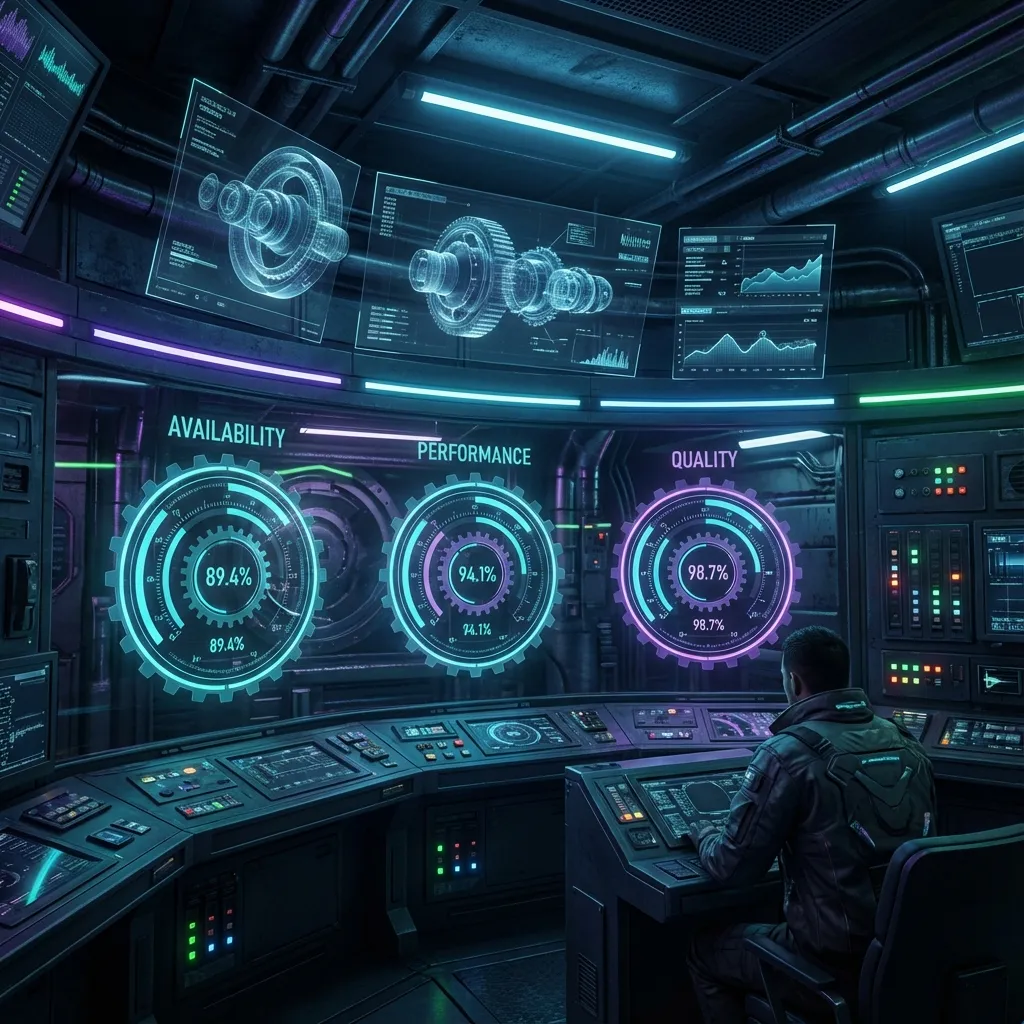
Our AI agent detects the dreaded 30-second micro-stops nobody writes down. It builds live OEE dashboards at 60 FPS so managers can see where the time goes and apply real SMED.
Defects (Scrap)
Computer vision can inspect inline if it's trained on images of your product's defects. Catching the defect at the station costs 1 and keeps it from becoming a problem that costs 100.
Let technology audit your wastes automatically.
Request a Plant AssessmentThe 8th Waste: Unused Talent #
Toyota defined seven. Industry 4.0 added the eighth, and it's the most expensive one: underused human talent.
Having a process engineer fill out Excel sheets to calculate OEE is one of the biggest modern wastes. Not because the spreadsheet is wrong, but because that person should be interpreting the data, not collecting it. A sensor does the collecting better; the judgment, it doesn't.
It's the only waste you can't see on the gemba: there's no piled-up inventory or defective parts to give it away. It shows up as projects that never get started and improvements nobody had time to implement.
Conclusion: Lean Isn't a Project, It's a Habit #
Don't try to eliminate all 7 wastes at once. Pick a pilot line. Open your audit spreadsheet (or better, install an iGromi Edge sensor) and look for the bottleneck. When you find it, destroy it. Then look for the next one.
World-class manufacturing doesn't happen in management meetings. It happens on the gemba (the plant floor), hunting down stolen millimeters and seconds.
Related Reading #
Topics
- 7 wastes of lean
- 7 wastes of lean manufacturing
- muda lean
- lean waste examples
- 8th waste lean
- lean audit template excel
- toyota production system

About the author
Víctor RuzCEO
Automation and Robotics Engineer (Universidad Andrés Bello, 2012). More than twelve years in robotics and industrial automation. Founder and CEO of iGromi, where he connects machines, systems and plant people with secure industrial AI.