Artificial IntelligenceMar 21, 2026
Autonomous AI Agents: What They Are and What They Can Do in a Plant
What an autonomous AI agent is, the five levels of autonomy in a plant, and why it should never write to the PLC.

Locked file
preparacion-agentes-ia-planta-en.xlsx (9 KB)
Leave your email to download this free spreadsheet and hear about the next one.
An autonomous AI agent is a program that receives a goal, decides the steps to reach it, uses tools —querying a database, reading a document, creating a record— and checks the result before taking the next step. That is the difference from a chatbot: a chatbot answers; an agent pursues a goal and acts.
Most guides explain what an agent does in an office. This one is about a plant, where the question that matters is different: what can an agent do without anyone getting hurt or a line stopping.
What an autonomous agent is made of #
- A goal, not step-by-step instructions: "explain why line 2 OEE dropped yesterday".
- A reasoning model: a language model that decides what to look up and in what order.
- Tools: what the agent is allowed to use. Reading shift stops, finding the procedure, drafting a work order.
- Memory: what the plant knows and wrote down. Without it, the agent answers with what it believes, not with what is on record.
- Limits: what it may do alone, what needs approval and what it may never do.
Any platform provides the first four. The fifth has to be decided by the plant, and it is what separates a useful pilot from a risk.
How Are Autonomous Agents Different from Conventional AI Agents? #
The word "agent" gets used for almost everything. The practical difference is who takes each step:
| Conventional assistant or agent | Autonomous agent | |
|---|---|---|
| How it starts | With a question | With a goal |
| How many steps it takes | One: it answers and waits | Several, chained on its own |
| Tools | The ones the person asks it to use | It chooses which ones and in what order |
| When it stops | When it delivers the answer | When it decides the goal is met |
| Typical error | A wrong answer | A chain of steps built on a wrong premise |
| What it demands | Checking the answer | Written limits and a log of every step |
To answer with what is on record rather than what it believes, the agent first searches the plant's documents and records and only then writes. That technique is called retrieval-augmented generation; it is explained in what is RAG.
Levels of autonomy in a plant #
"Autonomous" is not yes or no. It is a scale, and in industry it pays to climb it one step at a time:
| Level | What the agent does | Example |
|---|---|---|
| 0 | Nothing yet: reliable data or documents are missing. | First connect one line's signals and put the procedures in order. |
| 1 | Answers citing the source. Does not act. | "Line 2 lost 47 minutes in three stops on the night shift; the longest was a jam at labelling." |
| 2 | Prepares actions and a person approves. | Drafts the bearing work order; the maintenance lead approves or discards it. |
| 3 | Executes low-risk tasks outside process control. | Creates the order and notifies the shift on the usual channel. |
| Never | Writing to the PLC or changing setpoints on its own. | Machine control stays with the PLC and authorised people. |
Most plants today sit between level 0 and 1, and that is fine: level 1 already saves hours every week, because the question that used to be answered by "asking John" is now answered with evidence.
Why an agent should not write to the PLC #
It is the obvious temptation —if the agent sees the temperature drifting, let it correct it— and it is the one to refuse. Three reasons:
- The PLC already has control loops that were designed, tested and signed off. A second controller moving setpoints from outside competes with them.
- A language model can be wrong with complete confidence. In an answer, the error is fixed by reading the source. In a setpoint, it is fixed with lost product or damaged equipment.
- Responsibility needs a name. When something changes on the machine, an authorised person must have decided it.
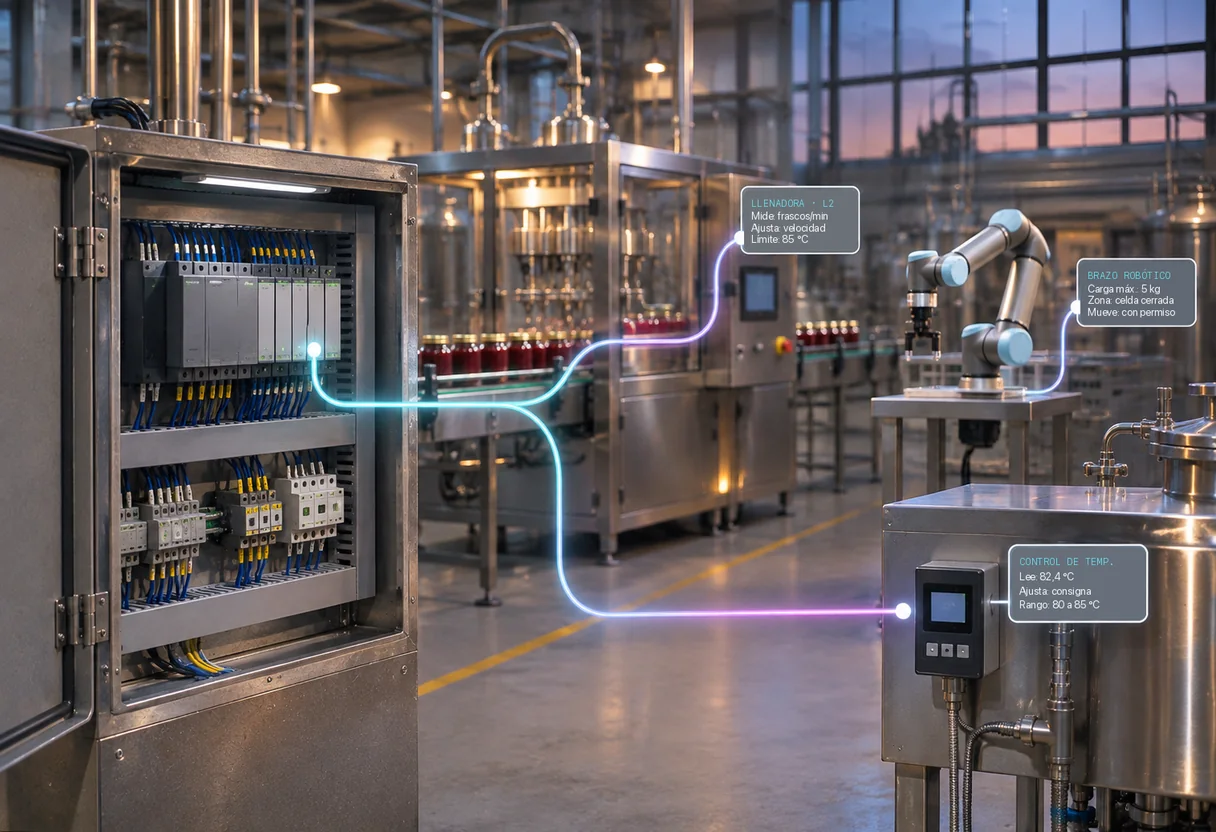
That is why iGromi reads the PLC read-only: zero changes to the program and no writes. Agents observe, query and prepare; people decide and execute.
What an agent can do in a plant today #
- Explain an OEE drop by crossing stops, shifts and counts, with every number traceable to its record.
- Write the shift report from the data, instead of someone assembling it by hand at the end of the day.
- Draft work orders with the asset, the observed failure and the matching procedure.
- Answer with the current procedure: the torque, the start-up sequence, the spare part, with its source and date.
There are more cases, with plant examples, in agentic AI in manufacturing.
An Autonomous Agent in a Jam Plant, Step by Step #
Carla, the plant manager, starts the day with a question: "why did line 2 produce less yesterday?". A level 2 agent works it out like this:
- It checks the shift count. Line 2 finished below plan. The figure comes from counting with the cameras, not from what someone wrote down.
- It cross-checks the stops. It finds three stops on the night shift; the longest at the filling machine.
- It reviews the filler's motor. Vibration on motor M-204 rose during the two hours before the stop.
- It searches what the plant knows. It finds a note from Luis, the technician, from a month ago: same bearing, same signal.
- It prepares the action. It drafts the work order, with the procedure and the spare part, for Pedro, the maintenance lead.
- It stops. Pedro approves or discards it. Matías, the shift operator, gets the notice. The agent does not touch the PLC or the line speed.
Every figure in the answer is cited to its record. If Carla doubts a number, she opens the source.
What Types of Autonomous Agents Are There? #
They differ in how you talk to them and in what sets them off:
- Text agents: you type to them in a chat. The most common and the easiest to audit, because everything is written down.
- Voice agents: you speak to them. In a plant this helps when your hands are busy or gloved, but what was dictated has to be kept as text with author and time; otherwise there is no record to review.
- Workflow agents: they do not wait for a question. They start on their own from a trigger, such as the end of a shift or an alarm, and leave the result ready for someone to review.
All three share the same limits. A voice agent can do no more to a machine than a text agent.
What an agent needs before a model #
- Data that arrives on its own. If stops are written down by hand at the end of the shift, the agent reasons about what someone remembered, not what happened.
- Written knowledge with an owner and a date. An agent quoting an outdated procedure is worse than one that says "I don't know".
- Access separated from the control network. The agent queries a copy, not the machine.
- A responsible person who reviews what the agent proposes and answers for what gets approved.
Assess your plant in ten minutes #
We prepared a spreadsheet with fifteen questions across five areas: data, written knowledge, access, limits and people. Once you answer them, it tells you what level of autonomy is safe today and which area is holding you back.
Download the assessment (Excel)
Frequently asked questions #
Does an autonomous agent replace the operator?
No. In a plant, the agent takes search and writing work off the person who decides. The decision about the machine stays with a person.
How is an agent different from SCADA or MES?
SCADA and MES record and display what happens. An agent uses those records to answer questions and prepare actions. They complement each other: without MES or PLC data, the agent has nothing to reason about.
Where should a plant start?
With a single question that takes hours to answer today and has an owner. When that one is answered well and with a source, add the next.
What is an autonomous voice agent?
It is an agent you speak to instead of typing: it transcribes what the person says, acts with its tools and answers. In a plant it helps log an event with your hands busy, but what was dictated must be kept as text with author and time so it can be reviewed.
What is an agent in artificial intelligence?
It is a system that combines a language model with tools and a goal. The more steps it can take without a person stepping in, the more autonomous it is; that is why autonomy is measured in levels rather than as yes or no.
Context: this article is part of the guide to industrial artificial intelligence: what it is, where it works and four production deployments in Chile.
Topics
- autonomous agents
- autonomous ai agents
- what is an autonomous agent
- levels of autonomy
- ai agents in manufacturing
- industrial ai

About the author
Víctor RuzCEO
Automation and Robotics Engineer (Universidad Andrés Bello, 2012). More than twelve years in robotics and industrial automation. Founder and CEO of iGromi, where he connects machines, systems and plant people with secure industrial AI.