ProductivityDec 21, 2025
Find Your Bottleneck: Theory of Constraints in Practice
Improving everything improves nothing. The Theory of Constraints, its 5 focusing steps and Drum-Buffer-Rope show exactly where to focus.
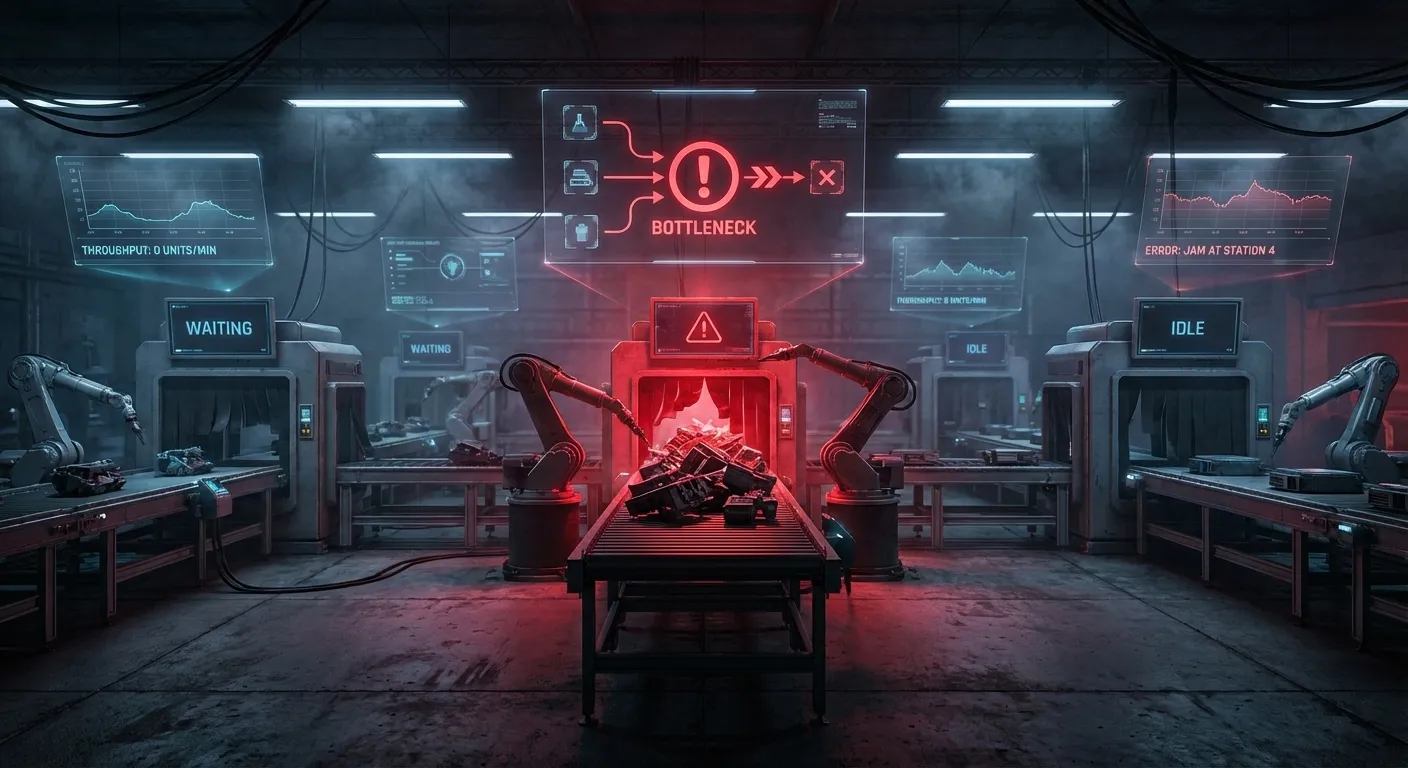
The Theory of Constraints (TOC) #
Popularized by Eliyahu Goldratt in his business novel "The Goal" (required reading).
The principle is simple: a chain is only as strong as its weakest link.
In a factory, the plant's TOTAL capacity equals the capacity of the bottleneck. Period. If you improve a machine that is NOT the bottleneck, you haven't improved total output (throughput) at all.
The 5 Focusing Steps #
Step 1: Identify the Constraint (the Bottleneck)
How do you find it?
- Where work-in-process (WIP) piles up BEFORE the machine.
- Where the machine is always running while the others stop.
- Where the expediters are always yelling.
Step 2: Exploit the Constraint
Before buying another machine, squeeze everything out of the one you have WITHOUT spending money.
- No lunch-break stops: Rotate operators. The machine doesn't eat.
- Perfect incoming quality: Inspect parts BEFORE they enter the bottleneck. Don't waste its precious time processing junk.
- Priority maintenance: If the bottleneck fails, the whole plant loses money.
Step 3: Subordinate Everything Else
This is the hard part for managers' egos.
Non-constraint machines MUST stop if the bottleneck is full. If you run them at 100%, all you create is inventory (cost) the bottleneck can't process.
Golden rule: An hour lost at the bottleneck is an hour lost for the entire factory. An hour gained at a non-constraint is a mirage.
Step 4: Elevate the Constraint
If, after exploiting it to the max, it's still holding back sales, then invest.
- Buy another identical machine.
- Automate loading and unloading.
- Add a third shift for that machine only.
Step 5: Go Back to Step 1
Beware of inertia. Once you elevate a constraint, the bottleneck will move somewhere else. The improvement process never ends.
Drum-Buffer-Rope (DBR) #
The TOC method for scheduling production:
- Drum: The bottleneck sets the pace for the whole factory.
- Buffer: Safety stock placed RIGHT BEFORE the bottleneck so it never runs out of work because of upstream problems.
- Rope: A signaling mechanism that tells the raw-material warehouse when to release material, synchronized with the drum.
Topics
- theory of constraints
- bottleneck analysis
- production bottleneck
- 5 focusing steps
- drum buffer rope
- goldratt the goal

About the author
Víctor RuzCEO
Automation and Robotics Engineer (Universidad Andrés Bello, 2012). More than twelve years in robotics and industrial automation. Founder and CEO of iGromi, where he connects machines, systems and plant people with secure industrial AI.