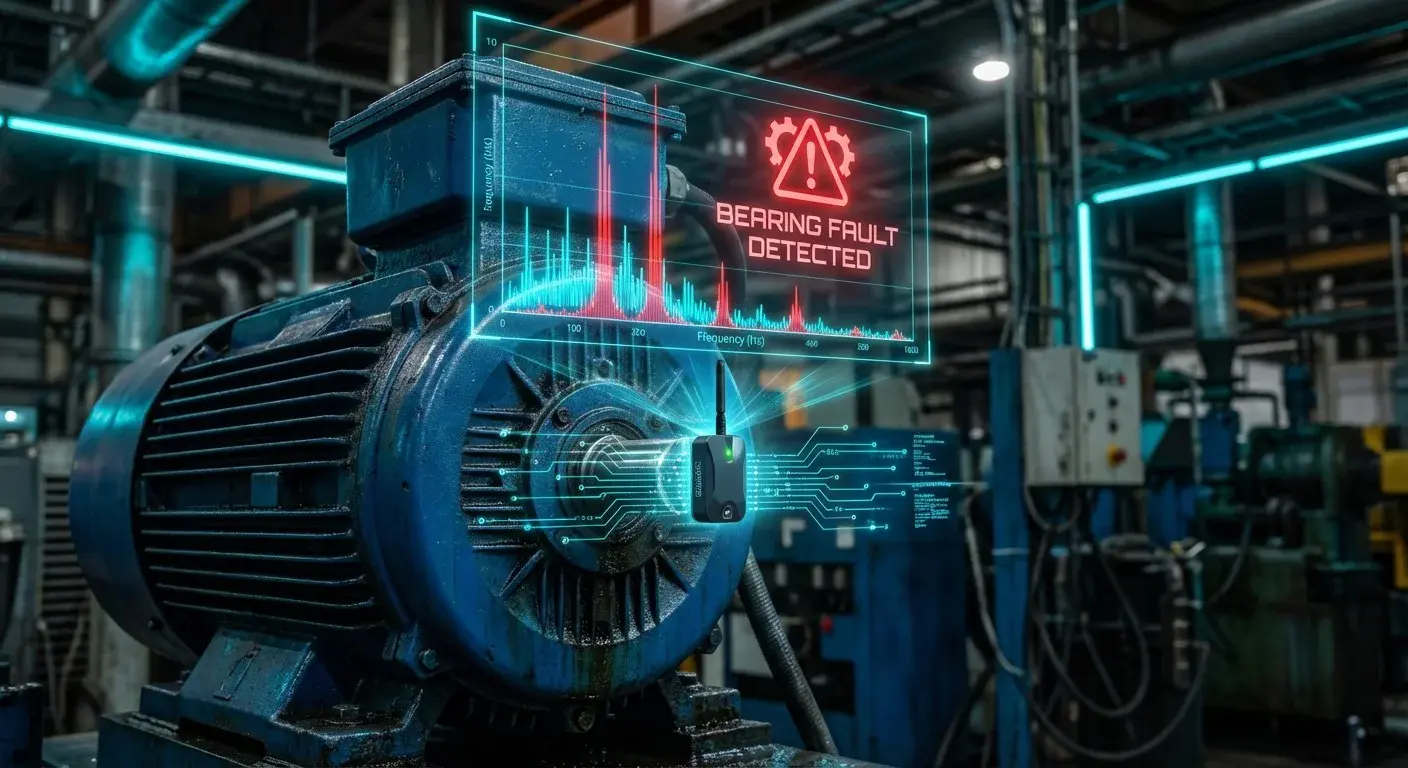
Automatic Product Counting with Computer Vision: 2026 Guide
Still counting boxes by hand? Industrial computer vision eliminates human error and guarantees 99.9% accuracy. Technical implementation guide.

Hassle-free automation?
Checklist: 10 Steps to Digitize Your Plant
Avoid costly implementation errors
The End of Tally Marks (and the Error Costing You $100k/Year) #
Counting products manually is the most absurd bottleneck in modern industry. It's slow, it's boring, and worst of all, it is systematically inaccurate.
A tired operator has an error rate of 2-5%. In a daily production of 10,000 units, that means 200-500 "phantom" products—you don't know if they are in the warehouse, in transit, or never existed.
⚠️ The Real Cost of Manual Error:
- • Customer claims for shortages (loss of contracts)
- • Invisible overstock (unnecessarily tied capital)
- • Man-hours wasted on recounts
- • Logistics decisions based on incorrect data
Average cost for a medium plant: $8,000-15,000 USD/month
🚀 Benefits of Computer Vision Counting
- 99.9% Accuracy: Cameras don't get tired, distracted, or have a "bad day".
- Extreme Speed: Up to 60,000 units/hour on high-speed belts (vs 1,200/hour manual).
- Digital Evidence: Timestamped photo of EVERY product counted (goodbye customer claims).
- Multi-function: Beyond counting, it detects defects, incorrect orientation, missing labels.
- ROI < 6 months: Pays for itself just with error savings + freed up labor.
Computer Vision vs. Traditional Sensors: The Battle #
Before AI, automated counting was done with photoelectric sensors or lasers. The problem: they are "blind".
| Aspect | Photoelectric/Laser Sensor | Computer Vision (AI) |
|---|---|---|
| Accuracy | 85-95% (fails if overlap) | 99.9% (detects individual objects) |
| Transparencies | ❌ NO (bottles, plastic film) | ✅ Detects by shape/reflection |
| Stuck Objects | ❌ Counts as 1 (critical error) | ✅ Differentiates 1 vs 2 vs 3 boxes |
| Flexibility | Fixed position, 1 product per sensor | 1 camera = multiple SKUs, retrainable |
| Extra Functions | Only ON/OFF counting | Count + defects + OCR + color + orientation |
| Initial Cost | $500-2,000 USD | $3,000-8,000 USD |
| Operating Cost | High (false negatives → losses) | Low (precision eliminates recounts) |
Verdict: Traditional sensors are good for simple applications (1 SKU, opaque objects, uniform spacing). For EVERYTHING else, computer vision is the only solution that works.
How Does AI Counting Work? (Technical Architecture) #
A computer vision counting system has 3 critical components:
1. Image Capture (The Eyes)
Critical Hardware: Industrial cameras with Global Shutter (not Rolling Shutter like cellphones).
- FPS (frames/second): Minimum 30 FPS. For fast belts (>1 m/s): 60-100 FPS
- Resolution: 2MP-5MP (more megapixels ≠ better; sensor and optics are critical)
- Interface: GigE (1Gb ethernet) or USB3 for uncompressed transmission
- Lighting: Stroboscopic LED synchronized with camera (freezes motion without blur)
💡 Installation Tip: Lighting is 80% of success. A $500 camera with perfect lighting beats a $5,000 camera with bad lighting.
Use homogeneous diffuse light (no spotlights creating shadows) and position lights at 45° to the object to minimize reflections.
2. AI Processing (The Brain)
Here is where the magic happens. The most used model is YOLO (You Only Look Once), a convolutional neural network that:
- Receives the raw image from the camera
- Divides it into a grid (e.g., 13×13 cells)
- Each cell predicts:
"Is there an object here? What is it? Where are its edges?" - Filters detections with confidence <70% (noise)
- Applies NMS (Non-Maximum Suppression) to eliminate duplicates
Training: You need 500-2,000 photos of YOUR product in different angles, lighting, and backgrounds. You manually annotate "bounding boxes" and train the model for 12-48 hours on a GPU.
🎯 Available Models (2026)
- YOLOv8 Nano: 6 MB, 80 FPS on Jetson Nano → Ideal for simple counting
- YOLOv8 Small: 22 MB, 45 FPS on Jetson Orin → Balance quality/speed
- YOLOv9: 51 MB, 30 FPS on edge → Max precision for complex QA
At iGromi we use YOLOv8-Small fine-tuned with custom client datasets. Average accuracy: 99.2%
3. Edge Computing vs Cloud: Where to Process?
You have 2 architectural options:
☁️ Cloud Processing
Images sent to remote server (AWS/Azure) for processing
Pro: Powerful GPUs, easy scaling
Con: Latency 200-500ms, bandwidth cost, internet dependent
Monthly cost: $0.05-0.15 per 1000 images
🖥️ Edge Computing (Recommended)
Local processing on industrial mini-PC next to camera
Pro: Latency <20ms, no internet needed, total privacy
Con: Higher initial CAPEX ($800-2,000 hardware)
Monthly cost: $0 (only electricity ~$5/mo)
Our recommendation: 100% Edge for manufacturing. Cloud latency (200-500ms) means a belt at 1 m/s moves product 20-50 cm while you wait for a response. Unacceptable for real-time counting.
5 Real Use Cases by Industry #
🥤 Food & Bev: Transparent Bottle Counting
Client: Bottling plant in Rancagua, Chile
Problem: Laser sensors counted clear glass bottles as "0" (invisible to laser). Error 4% = $8,000 USD/mo losses.
Solution: 5MP Camera with backlight (light behind bottle). YOLO detects by silhouette.
Result: 99.8% Accuracy, ROI in 2 months. Bonus: Detects missing caps (critical defect).
🌾 Agro-industry: Sack Counting on Pallets
Client: Seed exporter
Problem: Manual sack counting on pallet before dispatch (12 min/pallet × 80 pallets/day = 16 man-hours).
Solution: Overhead camera (top-down). Full pallet view. YOLO counts sacks in 2 seconds.
Result: From 16 hours → 3 hours/day. Savings: 2 full operators ($3,600 USD/mo).
📦 Logistics: Missing Package Detection
Client: Retail distribution center
Problem: Trucks leaving with incomplete orders (forgotten boxes). Client claims, contract loss.
Solution: Camera in dispatch tunnel. Compares AI count vs order manifest. Alerts on mismatch.
Result: Zero shortage claims in 6 months. Recovered $2M USD/year contract.
🏭 Manufacturing: Multi-SKU Production Control
Client: Snack plant (20 different SKUs)
Problem: Changing photoelectric sensors every time SKU changes (30 min downtime).
Solution: 1 camera with multi-class YOLO model. Automatically recognizes all SKUs.
Result: Changeover time: 30 min → 0 min. OEE +8% (just by eliminating adjustment stops).
💊 Pharma: 100% Validation with Photo Evidence
Client: Drug manufacturer (FDA regulation)
Problem: FDA requires photo evidence of EVERY lot. Manual photo taking = bottleneck.
Solution: System saves image + timestamp + count of every blister pack. Database searchable by lot.
Result: FDA audit passed with zero observations. 100% Traceability.
Digitize your Plant with iGromi
Book a 30-min demo and discover how to increase your productivity.
Implementation Guide: What Hardware & Software Do You Need? #
🛠️ Recommended Tech Stack (2026)
Hardware
| Camera | Hikrobot MV-CE050-10GM (5MP GigE) - $450 USD |
| Lens | 8mm f/1.4 (adjust per distance/FOV) - $80 USD |
| Lighting | 60W Diffuse LED Panel + Controller - $150 USD |
| Edge Computer | NVIDIA Jetson Orin Nano 8GB - $499 USD |
| Enclosure IP65 | Stainless steel with ventilation - $200 USD |
| TOTAL Hardware | ~$1,380 USD |
Software
- ✅ OS: Ubuntu 22.04 + JetPack 6.0 (free)
- ✅ Framework: Ultralytics YOLOv8 (open-source)
- ✅ Database: InfluxDB for timeseries + PostgreSQL for metadata (free)
- ✅ Dashboard: Grafana (free) or iGromi MES (native integration)
Software Cost: $0 with open-source stack. Or $200-400/mo for commercial MES license with support.
Quantified ROI: When Does It Pay Off? #
The million dollar question. Here is the real calculation for a medium plant:
💰 ROI Calculator: Computer Vision Counting
Initial Investment:
- • Hardware: $1,400 USD
- • Installation + model training: $2,000 USD
- • Integration with existing system: $800 USD
Total CAPEX: $4,200 USD
Monthly Savings:
- • Elimination of 1.5 counting operators: $2,700 USD/mo
- • Error reduction (2% → 0.1%): $800 USD/mo
- • Zero man-hours on recounts: $400 USD/mo
- • Reduced customer claims: $300 USD/mo
Total Savings: $4,200 USD/mo
ROI: 1 Month
System paid off in 30 days. Net savings Year 1: $46,200 USD
Troubleshooting: Common Problems & Solutions #
❓ "Accuracy is only 85%, not 99%"
Cause #1: Inconsistent lighting (shadows, reflections). Solution: Diffuse homogeneous light.
Cause #2: Small training dataset (<500 images). Solution: Capture 1,500+ varied photos and retrain.
Cause #3: Products very similar. Solution: Add unique features (e.g., QR code, color band).
❓ "System hangs / processing lag"
Cause: GPU saturated (model too heavy for hardware). Solution: Use YOLOv8-Nano instead of Large, or upgrade to Jetson Orin NX.
❓ "Works by day but not by night (or vice versa)"
Cause: Variable ambient light affects image. Solution: Closed enclosure with controlled artificial lighting (eliminate natural light).
❓ "How to integrate with my existing MES/ERP?"
Solution: System exposes REST API endpoint /count returning JSON with count + timestamp. Any MES can consume it via HTTP.
FAQ: Technical Frequently Asked Questions #
1. Does it work with irregular products (non-uniform like fruits/vegetables)?
YES. YOLO works excellently with organic shapes. In fact, it was originally trained with people (the most irregular shape possible). Critical: train with 800+ photos of YOUR specific fruit in different angles/ripeness.
2. What happens if product packaging changes?
You need to retrain the model. But it only takes 4-8 hours: capture 200 photos of new packaging, annotate, train overnight. By next day you have the updated model.
3. Can it count semi-transparent objects like plastic film?
Depends. If plastic has visible features (edges, reflection, printed text): YES. If 100% transparent without marks: use backlight or UV lighting to generate artificial contrast.
4. How many cameras do I need for a 10-meter line?
Depends on FOV (Field of View). An 8mm lens camera covers ~2 meters of belt from 1.5m height. For 10 meters you need 5 cameras OR 1 camera on a mobile cart traversing the line.
5. Is it more accurate than weight counting?
YES, especially for products with weight variance (e.g., semi-filled sacks, variable level bottles). Weight counting has ±2-5 unit error in large batches. Vision has ±0 error in 99.9% of cases.
6. Does it work in dirty/dusty environments (mining, construction)?
YES, but you need IP65+ enclosure with tempered glass window and compressed air system to clean lens every X minutes (automated). This adds $300-500 to initial cost.
7. Annual maintenance cost?
Almost $0. Industrial hardware has MTBF (Mean Time Between Failures) of 50,000+ hours (5+ years 24/7). Only maintenance: clean lens monthly (5 mins) and update software (free).
Conclusion: The Future is Autonomous #
Manual product counting is an anachronism. It's the industrial equivalent of using typewriters in the smartphone era.
Computer vision isn't just more accurate—it's qualitatively different. It doesn't just count: it validates, inspects, certifies, and documents. All in milliseconds.
And with open-architecture hardware and open-source models, cost has dropped 10x in 5 years. What used to cost $50,000 (Cognex), today costs $4,000 (complete edge solution).
Ready to Eliminate Human Error?
Send us a 30-second video of your production line. We'll provide a technical feasibility analysis + budget in 24 hours. Free, no commitment.
📹 See Live Demo 📅 Schedule Technical Analysis