IoT Predictive Maintenance: Complete Guide for Electric Motors
Stop fixing when it breaks. With IoT vibration sensors, you can predict failures months in advance. Reduce unplanned downtime by 40%.

Hassle-free automation?
Checklist: 10 Steps to Digitize Your Plant
Avoid costly implementation errors
The Difference Between "Oops" and "Aha" #
Corrective Maintenance is "Oops, it broke". Preventive is "Let's change it just in case". Predictive is "Aha, the bearing will fail in 3 weeks, let's schedule the swap".
The magic isn't divination. It's pure physics monitored by IIoT. In this 2026 guide, we demystify how to predict your machines' future without spending a fortune.
🔧 What does an IoT sensor actually detect?
- Unbalance: The motor "dances" more than normal (1x RPM frequency).
- Misalignment: The shaft isn't straight (2x RPM frequency).
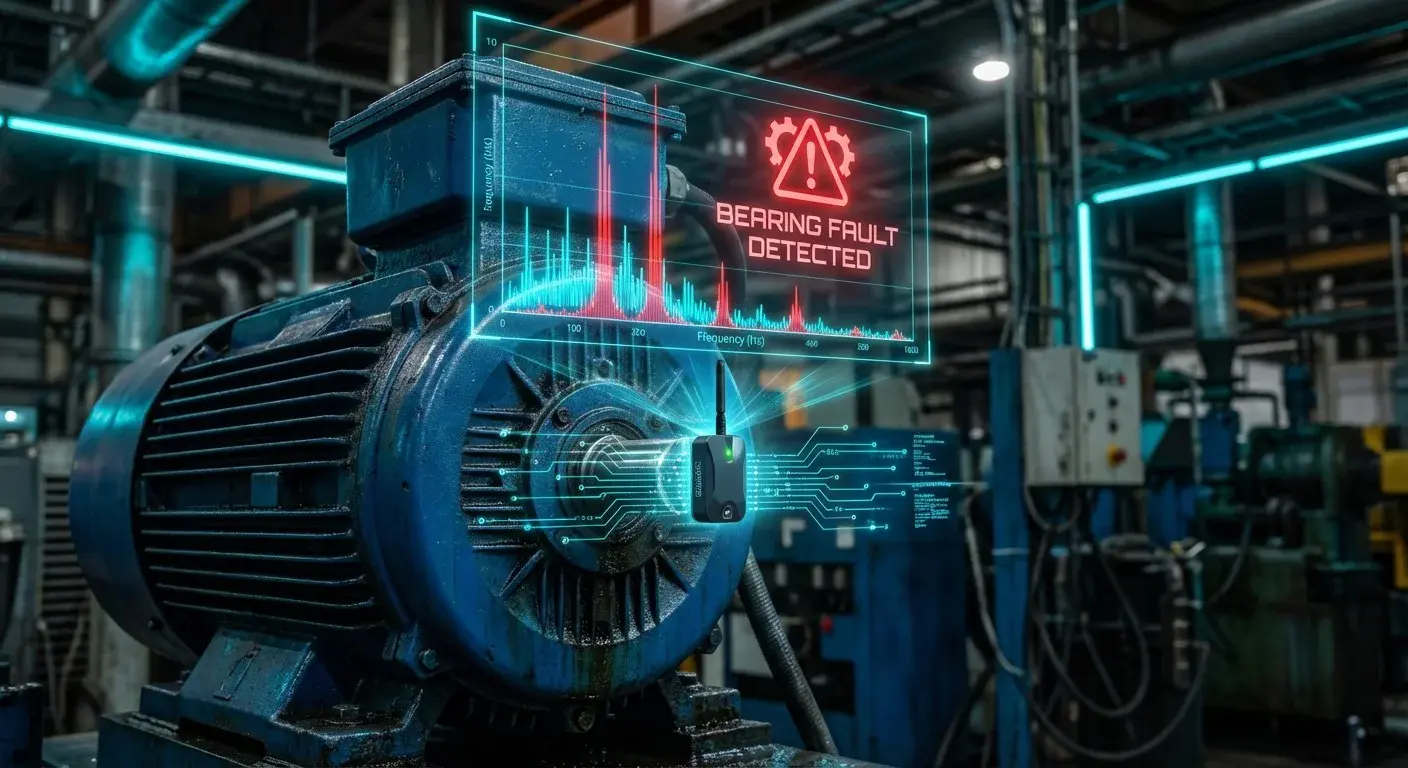
- Bearing Failure: High-frequency "noise" increases (ultrasound > 5kHz).
- Mechanical Looseness: Loose parts vibrating (multiple harmonics).
The P-F Curve: Your New Treasure Map #
If you understand the P-F curve, you understand why preventive maintenance is dead.
P (Potential Failure): The moment failure is DETECTABLE (physically, though not visible).
F (Functional Failure): The moment the machine STOPS WORKING.
The goal of Predictive Maintenance is to maximize the P-F interval. We want to detect failure months ahead (P), not seconds ahead (F).
| Detection Tech | Warning Time (P-F Interval) | Repair Cost |
|---|---|---|
| Ultrasound / HF Vibration | 3 to 9 Months | $ (Minimal) |
| Oil Analysis | 1 to 6 Months | $ |
| Standard Vibration (ISO 10816) | 3 to 8 Weeks | $$ (Planned) |
| Thermography (Heat) | 1 to 5 Days | $$$ (Urgent) |
| Audible Noise / Smoke | 0 to 1 Hour | $$$$$ (Catastrophic) |
Hardware: Piezoelectric or MEMS? #
10 years ago, a piezoelectric accelerometer cost $500 USD. Today, MEMS (Micro-Electro-Mechanical Systems) sensors have democratized monitoring.
MEMS (Smartphone Brain in your Motor)
Microscopic silicon chips. Cheap ($50-$150), low power (battery lasts years), but limited bandwidth (usually up to 2-5 kHz).
Ideal use: Mass monitoring of pumps, fans, and standard motors (Balance of Plant).
Piezoeléctrico (Old School)
Crystals that generate voltage when vibrating. Expensive ($300+), require cabling (IEPE), but read up to 20 kHz.
Ideal use: Critical turbines, complex gearboxes, very early lubrication failure detection.
Digitize your Plant with iGromi
Book a 30-min demo and discover how to increase your productivity.
The Connectivity Problem (Physics vs LoRaWAN) #
This is where 90% of pilot projects fail.
A 2-second vibration "Time Waveform" at 10 kHz generates 40-60 KB of data. That is HUGE for an IoT network like LoRaWAN or Sigfox (which send 50 bytes per message).
❌ Common Mistake: Trying to send all raw vibration data to the cloud.
You kill sensor battery in 2 weeks and saturate the network.
✅ The "Edge Computing" Solution:
The sensor processes data internally. Calculates RMS, Kurtosis, Crest Factor. Runs FFT. And sends ONLY the RESULT to cloud.
"Motor 3: RMS Vib = 4.2 mm/s. Alert on 2x RPM (Misalignment)." -> This is just 10 bytes. Perfect for LoRaWAN.
Case Study: Crushing Plant (Chilean Mining) #
Scenario: 12 Cone Crushers. Main bushing failure stops the full line (Downtime cost: $15,000 USD/hour).
Implementation: Installing wireless triaxial vibration sensors on each unit.
- Day 0: Magnetic installation (machine running). ISO 10816 threshold calibration.
- Day 14: System detects subtle increase in Peak-to-Peak acceleration (knocking). Global vibration (RMS) stays normal (green). Edge algorithm flags "Early Warning".
- Day 18: FFT spectrum shows clear peak at BPFO (Ball Pass Frequency Outer Race). Auto-diagnosis: "Outer Race Bearing Fault".
- Day 20: Maintenance schedules replacement during Friday's planned stop.
- Result: Bearing changed in 2 controlled hours. Avoided catastrophic failure that would have taken 12 emergency repair hours ($180,000 USD savings).
ROI Calculator: When does it pay off? #
A starter kit (Gateway + 5 sensors) costs approx. $2,500 USD.
💰 Your Savings Equation
Savings = (Downtime_Cost_Hour × Reduced_Hours) + (Emergency_Repair_Cost - Planned_Repair_Cost)
If your downtime hour is worth $500 USD and you avoid 10 hours a year (one shift):
$500 × 10 = $5,000 USD
System paid off in the first event!
2026 Buying Guide: What to Look For #
- Rango de Frecuencia: Mínimo hasta 5-10 kHz si quieres ver rodamientos. Si solo llega a 1 kHz, solo verás desbalanceo.
- Batería Reemplazable: No compres sensores desechables. Busca los que usan baterías estándar (ej: 1/2 AA) que tú mismo puedas cambiar.
- Protocolo Abierto: Evita nubes cerradas que "secuestran" tus datos. Busca dispositivos que hablen LoRaWAN estándar o MQTT, para que puedas llevar los datos a tu propio SCADA o ERP si quieres.
Conclusion: Stop Fighting Fires #
The Maintenance Manager's life doesn't have to be answering calls at 3 AM. IoT Predictive Maintenance gives you back control. It lets you sleep tight knowing your machines will "call you" weeks before getting sick.
Technology is now cheap and reliable. Staying in "firefighter mode" is optional.
"Machines speak. We just need the right ears to listen."