Lean ManufacturingDec 20, 2025
Jidoka 4.0: Lean Manufacturing Meets the IoT
Lean isn't the enemy of technology. How to digitize jidoka, andon, poka-yoke and kanban so the line stops automatically when a defect appears.
The "Lean Is Anti-Technology" Myth #
There's a persistent myth: "Lean Manufacturing means paper, kaizen boards and the Toyota Production System of the 1980s. Technology is muda (waste) because it complicates things." FALSE.
Lean isn't the enemy of technology. Lean is the enemy of WASTE. And writing data by hand on a sheet, walking 50 meters to check a whiteboard, or waiting an hour to find out a machine is failing are MASSIVE WASTES.
Industry 4.0 doesn't replace Lean; it amplifies it by removing the manual bureaucracy that always held back a full implementation.
The Lean Pillars, Digitized #
1. Jidoka (Automation with a Human Touch)
Jidoka means the machine must have the "intelligence" to stop AUTOMATICALLY when it detects an anomaly, so it doesn't produce scrap. The operator only steps in to fix the root cause.
Example: Hydraulic Press (Metal Stamping)
Before (manual method):
- The press is running poorly (low hydraulic pressure from a leak).
- The operator doesn't notice until parts start coming out deformed (an hour later).
- Result: 500 parts in the trash, counting material and lost time.
Now (digital Jidoka 4.0):
- A pressure sensor on the hydraulic line measures EVERY cycle (100 strokes/min).
- The PLC compares the pressure-vs-time curve with the "golden sample" pattern.
- If the deviation exceeds 2%, the PLC stops the machine immediately, turns on the red andon, buzzes the supervisor's smartwatch and logs the event in the MES.
- Result: detection in 0.6 seconds. Only 1 rejected part (vs. 500) per event.
Investment: one sensor and a PLC update, paid back by the first event avoided.
2. Digital Andon: Full Real-Time Visibility
Toyota's traditional andon board is a grid of lights (green/yellow/red) showing the status of each station. Problem: it's passive. You only see it if you're looking.
Digital andon:
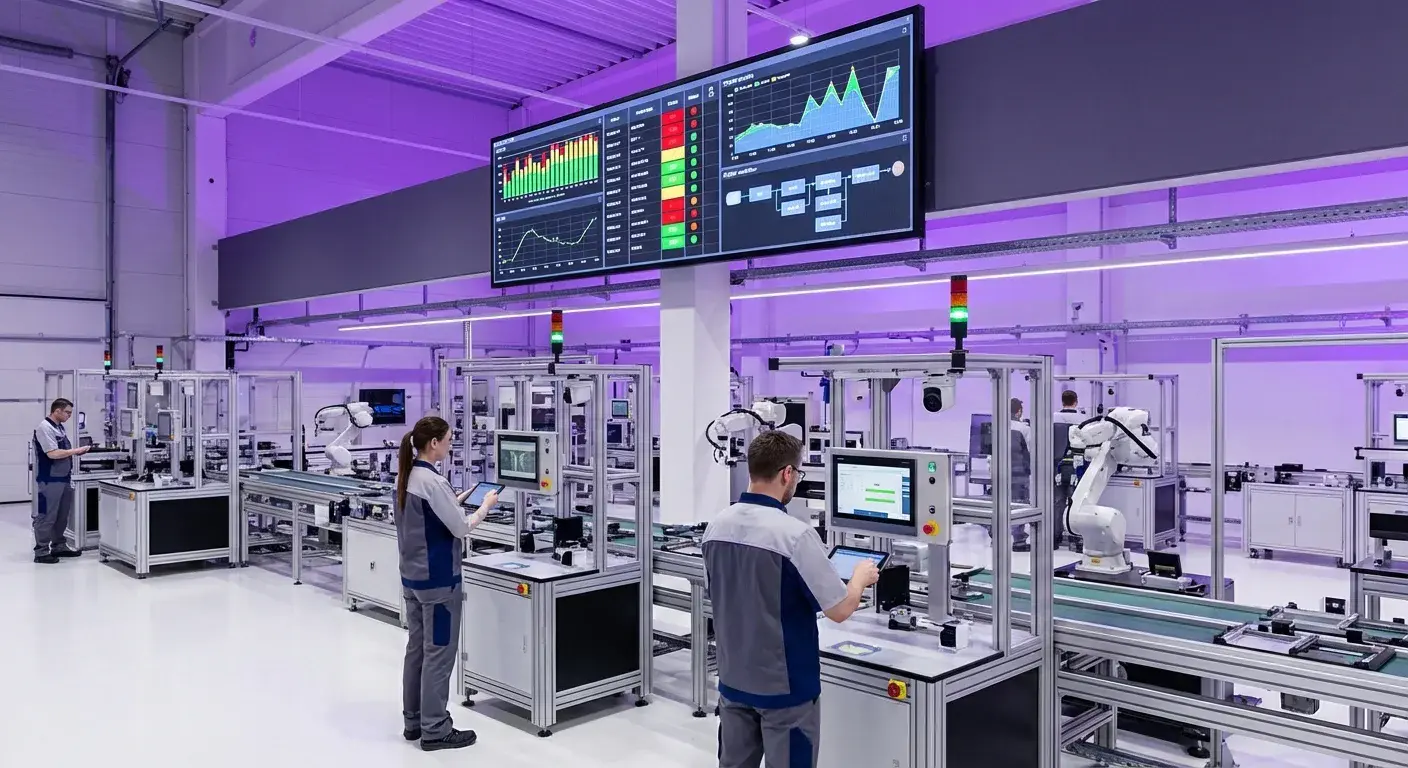
- Giant TV screens: Real-time dashboards showing OEE, active issues and the order queue per cell.
- Push alerts: If Line 3 triggers a yellow andon ("material shortage"), the warehouse gets a notification on a tablet and the system suggests which material is missing (MES/ERP integration).
- Built-in root cause capture: When an andon is closed, the system asks for the root cause (from a predefined catalog). It builds the Pareto automatically: "60% of stops are due to stockouts of SKU X123."
Illustrative result: andon response time drops from 12 minutes (manual average) to 45 seconds, and unplanned downtime falls by 40%.
3. Smart Poka-Yoke (Digital Error-Proofing)
Classic poka-yoke: a mold that only fits one way (impossible to mount backwards). It works, but it's passive.
Poka-Yoke 4.0: computer vision that validates EVERY part before it moves on:
- Wire harness assembly: a camera checks that all 8 connectors are in the right position. If one is missing, the conveyor stops automatically.
- Packaging: a camera checks that the label matches the product barcode (so Product A doesn't ship in Product B's box).
Illustrative example: a plastics plant with vision on 3 packaging lines can bring packaging defects down from several percentage points to tenths of a percent.
Digital Kanban: From Physical Card to Automatic Trigger #
Traditional kanban: physical cards that trigger material replenishment. The operator sees the empty bin, puts the card on the board, the warehouse sees the card and restocks.
Problem: 10-30 minutes of lag. Cards get lost.
Digital kanban:
- A weight or level sensor on the bin detects when stock drops below the trigger point.
- It sends an automatic signal to the WMS (Warehouse Management System).
- The WMS assigns the task to a material handler via tablet ("Restock Line 2: SKU #4432, Qty: 50 units").
- The handler scans the material's QR code on delivery. The MES confirms receipt.
Total time: 3-7 minutes. Full traceability.
IoT-Augmented Gemba Walks #
Gemba walk = go to the production floor, observe, ask. It's the heart of Lean. Problem: it's subjective. It depends on WHAT you look at and WHEN.
Gemba Walk 4.0: the manager carries a tablet with a live IoT dashboard and sees:
- The real temperature of every oven (vs. setpoint).
- Compressor pressure (to spot leaks).
- Micro-stops on every machine over the last 2 hours.
And asks the RIGHT questions: "I see Compressor 2 is cycling every 3 minutes. Is there a leak?" (instead of walking around without knowing what to look for).
Conclusion: Lean + IoT = Automated Continuous Kaizen #
Lean without data is intuition. IoT without Lean philosophy is noise. Together they create a system that detects waste automatically and FORCES continuous improvement.
Companies that combine Lean and Industry 4.0 will have competitive advantages that those doing only one of the two can't match.
Topics
- jidoka
- digital jidoka
- lean iot
- digital andon
- poka-yoke vision
- digital kanban

About the author
Víctor RuzCEO
Automation and Robotics Engineer (Universidad Andrés Bello, 2012). More than twelve years in robotics and industrial automation. Founder and CEO of iGromi, where he connects machines, systems and plant people with secure industrial AI.