Machine VisionMay 1, 2026
How Machine Vision Is Applied in Manufacturing (YOLOv8)
How modern factories use standard IP cameras and YOLOv8 models for quality control and part counting without expensive proprietary hardware.

The Outdated Proprietary Camera Paradigm #
Historically, if a plant manager wanted automatic quality control on a production line, the only option was to call closed vendors (such as Cognex or Keyence). These companies sell expensive "smart cameras" for every inspection point, and they require proprietary software that is a nightmare to integrate with the rest of the factory's ecosystem.
Today the question isn't whether you need machine vision but how to apply it without blowing your innovation budget (CAPEX). The answer is to separate the hardware from the intelligence using Edge Computing.
How Does Modern Machine Vision Work? #
In Industry 4.0, the architecture is far more agile and affordable:
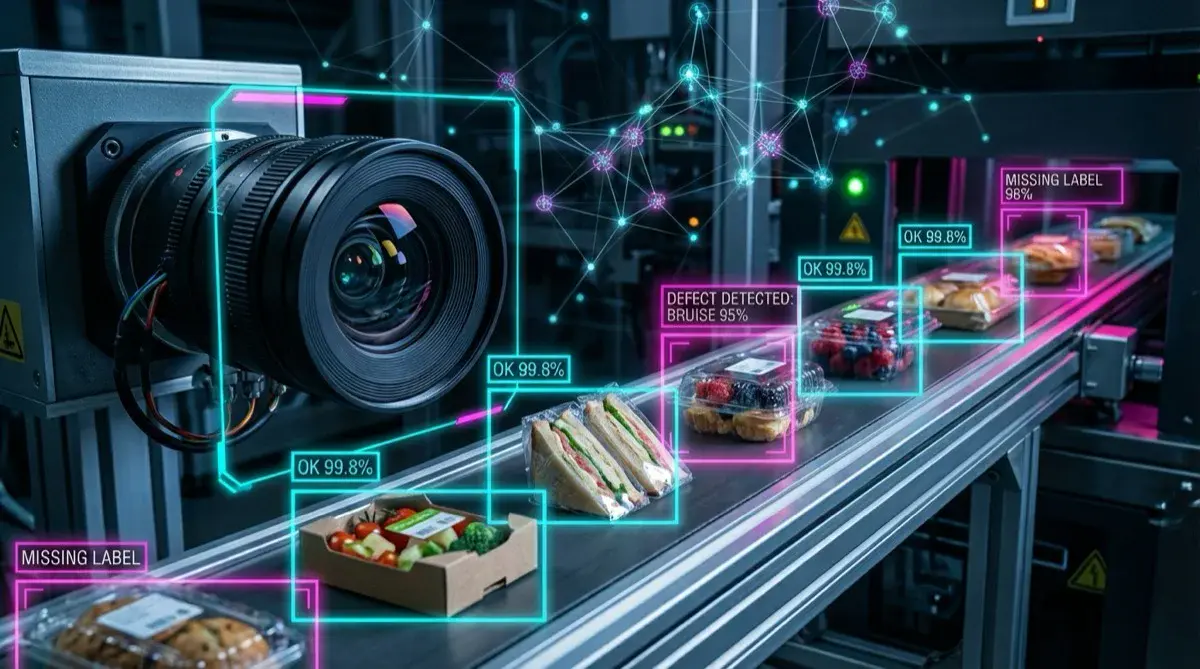
- The cameras: Instead of proprietary hardware, you install standard industrial IP cameras (at a fraction of the cost) or well-lit 1080p webcams over the production line.
- The brain (Edge AI): These cameras connect over Ethernet to a local server (such as iGromi Edge AI). The server has an NVIDIA neural processing unit that can analyze several video streams at once.
- The algorithm (YOLOv8): Inside the server runs a state-of-the-art convolutional neural network, trained on photos of your own products, able to detect anomalies at more than 60 frames per second (FPS).
💡 Local Intelligence (Zero-Trust)
It's critical that the video is never sent to the cloud for analysis. Internet latency would make it impossible to reject a defective bottle traveling at 3 meters per second. All processing has to happen inside the plant, fast enough to act on the line.
Three Real Applications in Manufacturing #
1. Quality and Defect Control (Visual Inspection)
AI models can be trained to detect micro-cracks in glass containers, poorly closed seals on food packaging or rusted parts in metalworking. When integrated with the machine's PLC over Modbus, a vision system can send a reject signal to the PLC, which decides whether to eject the product; at iGromi that integration is defined and validated with the customer.
2. High-Speed Counting and OEE Calculation
Many older machines have no output sensors. A camera pointed at the final packing box can count how many units come out per second; at Grupo Proa, vision counting reaches 99% measured against manual counts. That information goes straight into iGromi MES to calculate your OEE automatically.
3. Assembly Verification (Poka-Yoke)
On complex assembly lines, machine vision acts as a second pair of eyes that checks whether an operator installed all 4 screws on a part or plugged a cable into the wrong pin, preventing massive rework at the end of the line.
Topics
- machine vision in manufacturing
- computer vision manufacturing
- yolov8 quality control
- vision part counting
- visual inspection ai
- poka-yoke vision

About the author
Víctor RuzCEO
Automation and Robotics Engineer (Universidad Andrés Bello, 2012). More than twelve years in robotics and industrial automation. Founder and CEO of iGromi, where he connects machines, systems and plant people with secure industrial AI.