Machine VisionNov 28, 2025
Computer Vision in Industry: Real Uses and How to Start
What computer vision is, what it does in a plant (counting, inspection, safety), what it takes to implement, and why your existing camera may be enough.
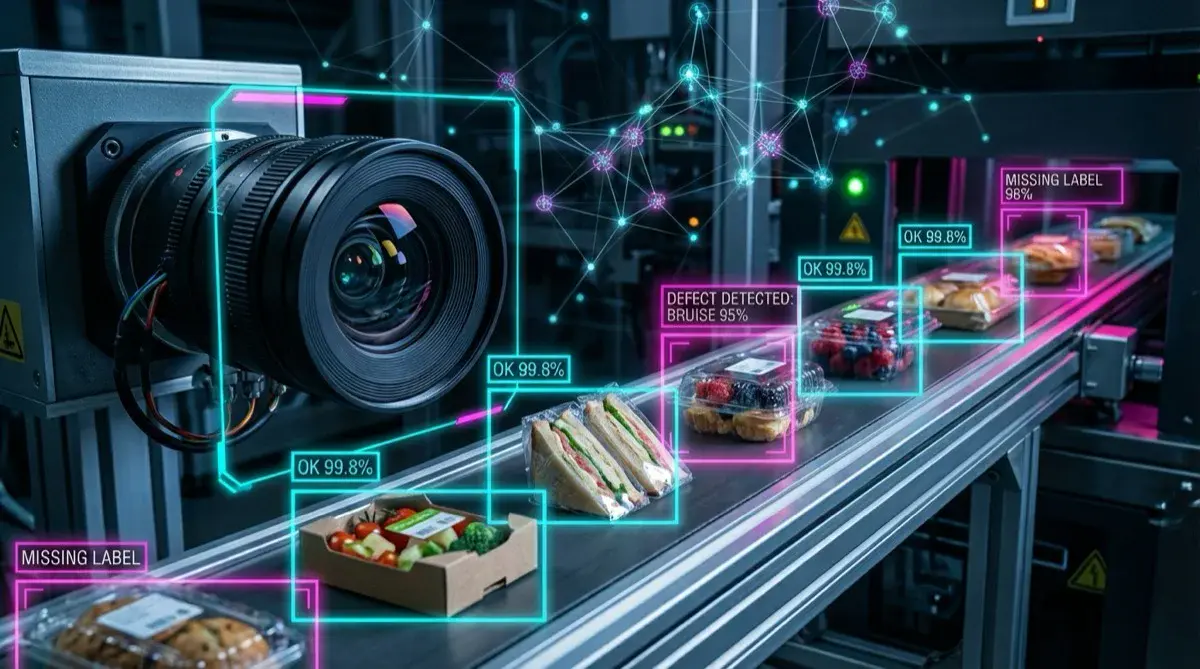
Computer vision is software that looks at an image and answers a specific question: how many units went by, whether a part has a defect, whether someone walked in without a hard hat. In a plant it's almost always built from three pieces: a camera, a device that processes the video close to the line, and a model trained for that question. Often the camera already exists: it's the CCTV camera.
This guide explains what it does well, what it doesn't, and how to implement it without starting by buying cameras.
What Is Computer Vision? #
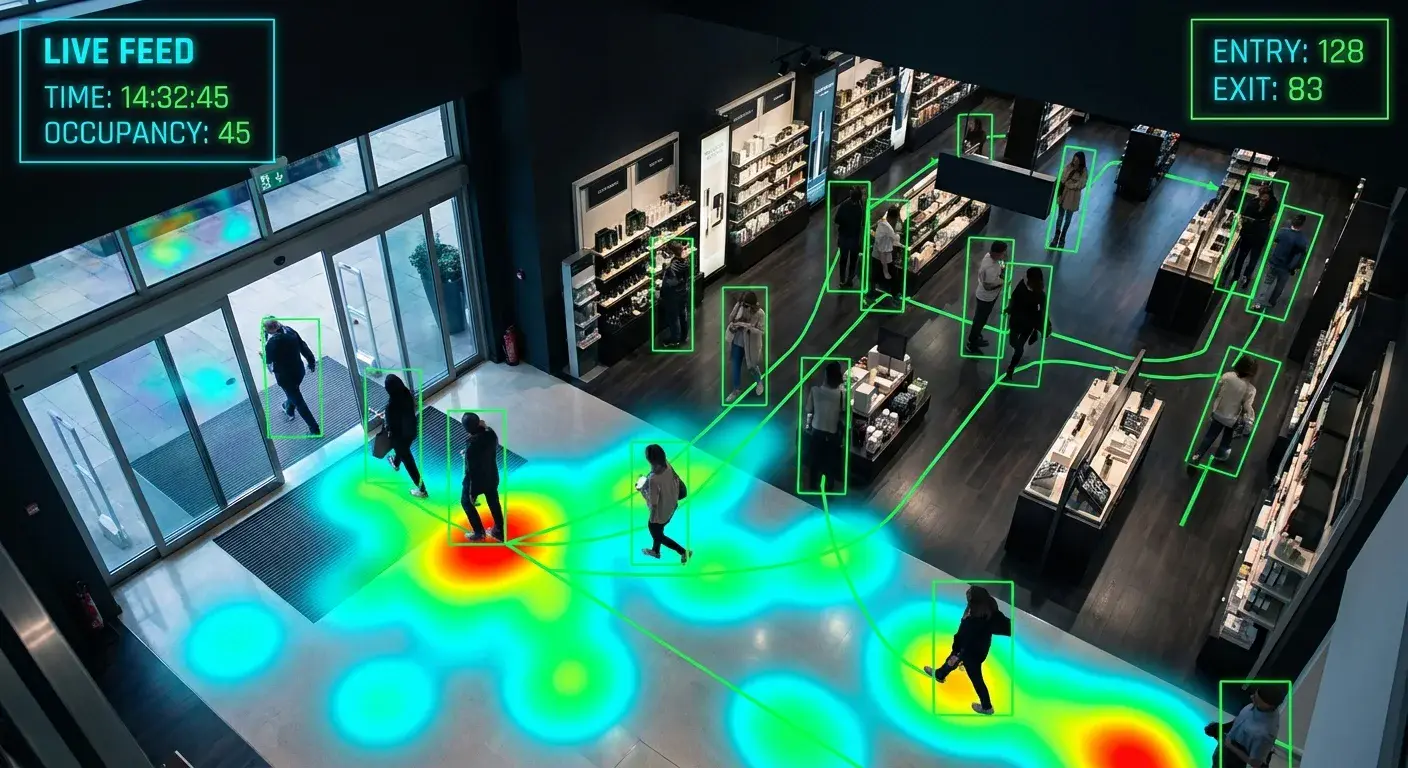
It's the field of artificial intelligence that interprets images and video. It's also called machine vision, especially for inspection systems; in everyday use the terms overlap. The difference from an ordinary security camera is that nobody has to watch the screen: the model detects objects in every frame and outputs a piece of data, such as a number, an alert or a timestamped record.
The most widely used models in industry are open source. The YOLO family detects and counts objects in real time; other models segment shapes or classify whole images. The hard part isn't the model; it's training it on images from the plant and keeping it running every day.
What Is It Used For in a Plant? #
| Use | What it delivers | What it requires |
|---|---|---|
| Counting production | Units per hour, per shift and per line, with no hand tallies | A camera that sees the product go by; the CCTV camera often works |
| Detecting stops and micro-stops | When product stopped flowing and for how long | The same as counting; better if cross-checked with the PLC |
| Quality inspection | Defective parts, misplaced labels, missing components | A dedicated camera, controlled lighting and labeled images of each defect |
| Safety (PPE and zones) | Alerts for hard hats, vests or people in a hazard zone | Cameras covering the zone and clear rules for what to do with each alert |
Counting is the fastest use to get running because the question is simple and the existing camera is often enough. Quality inspection is the most demanding: the model won't detect a defect it has never seen, so you have to collect and label real examples before promising anything. Each case is covered in detail in automatic counting with computer vision and in the guide to quality control with computer vision.
What Does It Take to Implement? #
- Camera. For counting, a CCTV IP camera with a clear view of the line usually works. For inspecting small defects you need an industrial camera with a fixed lens and fixed lighting.
- Processing device. An industrial computer with a GPU inside the plant processes the video right there. That way the video never goes out to the internet and measurement continues even if the connection drops. How to choose one is covered in the guide to industrial PCs for computer vision.
- Trained model. You start from an open model and fine-tune it with images from the plant: the product, the lighting, the camera angle.
- Where the data goes. A count nobody looks at changes nothing. Decide up front whether it goes to a screen on the line, a per-shift report or the ERP.
Will the Cameras I Already Have Work? #
For counting and detecting stops, often yes. What matters is that the camera sees the product go by without anything blocking it, with reasonably stable light and at a resolution where each unit can be told apart. A CCTV camera mounted to watch a hallway probably won't work; one looking at the conveyor will.
For quality inspection, almost never: small defects require a camera close to the product and controlled lighting.
Process in the Plant or in the Cloud? #
In the plant. Sending video from several cameras to the cloud eats bandwidth around the clock, adds latency and takes images of your operation outside the company. Processing on a local device solves all three and only lets results leave: numbers and alerts, not video. The cost comparison is in edge vs. cloud.
What Does iGromi Do with Computer Vision? #
iGromi uses computer vision to measure production with the cameras the plant already has. A device in the plant reads the CCTV cameras to count units and, where one exists, the machine's PLC to know when it was stopped. At Grupo PROA, a poultry producer, 19 security cameras that were already installed across six farms have been counting production for two years, with 99% accuracy measured against manual counts.
What we don't do without a prior project: detect quality defects without a set of labeled images from the customer, or detect foreign material, which requires X-ray or hyperspectral cameras. PPE detection is under development.
Frequently Asked Questions #
What's the difference between computer vision and machine vision?
In practice they overlap. Computer vision is the broad field; in industry, machine vision usually refers to inspection systems with a dedicated camera.
What is an AI camera?
It's a camera whose video runs through a model that detects objects or events. The intelligence can sit inside the camera or, more commonly in a plant, in a device that processes several ordinary cameras at once. The second option lets you use the cameras already installed.
Can you do computer vision with Arduino?
For learning, yes; for a production line, it isn't enough. The differences are covered in Arduino vs. industrial computer vision.
How long does it take to implement?
It depends on the use. Counting on existing cameras is measured in weeks; quality inspection takes longer, because you first have to collect and label images of each defect.
Context: this article is part of the guide to industrial artificial intelligence: what it is, where it applies and four cases in production in Chile.
Topics
- computer vision in industry
- machine vision
- industrial computer vision
- ai cameras
- smart camera
- computer vision manufacturing
- vision production counting

About the author
Víctor RuzCEO
Automation and Robotics Engineer (Universidad Andrés Bello, 2012). More than twelve years in robotics and industrial automation. Founder and CEO of iGromi, where he connects machines, systems and plant people with secure industrial AI.