B2B Hyperautomation: Definitive Guide to Integrating AI Agents and LLMs into Your Enterprise Architecture
Discover how to transform your enterprise architecture by integrating autonomous AI Agents and LLMs. Dive deep into advanced architectures, corporate RAG, Manufacturing 4.0, CMMS integrations, and B2B IoT telemetry strategies.
Hassle-free automation?
Checklist: 10 Steps to Digitize Your Plant
Avoid costly implementation errors
Introduction to the B2B Cognitive Hyperautomation Era #
Traditional automation has reached its operational ceiling. Robotic Process Automation (RPA) systems, strictly based on predefined rules and scripts, are utterly blind to the variability and ambiguity that characterize complex enterprise environments. Today, we stand at the epicenter of a massive paradigm shift: B2B Cognitive Hyperautomation. This revolution is not simply about executing tasks faster, but about equipping the enterprise architecture with reasoning capabilities, dynamic decision-making, and autonomous orchestration through the deep integration of Large Language Models (LLMs) and Artificial Intelligence (AI) Agents.
For Chief Technology Officers (CTOs), Enterprise Software Architects, and Operations Leaders, the challenge is no longer whether to adopt AI, but how to securely, scalably, and governably integrate these autonomous agents into legacy ecosystems, monolithic ERPs, CMMS platforms, and real-time IoT telemetry flows. An AI Agent, unlike a simple predictive model, possesses agency: it can plan (using techniques like Chain-of-Thought), utilize corporate tools via APIs, query databases in real-time, and collaborate with other agents to solve multidisciplinary problems without human intervention.
In this definitive technical and strategic guide, we will dissect the anatomy of an agent-driven enterprise architecture, dive deep into integration protocols, and explore hyper-specific industrial use cases, such as Manufacturing 4.0, smart asset management (CMMS), and edge IoT orchestration, all under a framework of maximum security and robust Return on Investment (ROI).
Breaking Down the Architecture: LLMs and Autonomous Agents in the B2B Ecosystem #
Implementing LLMs in the B2B environment requires far more than a simple chat interface. It demands a robust, modular, and decoupled architecture that allows models to interact with corporate data deterministically and securely. This architecture is built upon several foundational pillars that transform a probabilistic language model into a reliable operations engine.
1. The Agent Orchestrator and Reasoning Engine
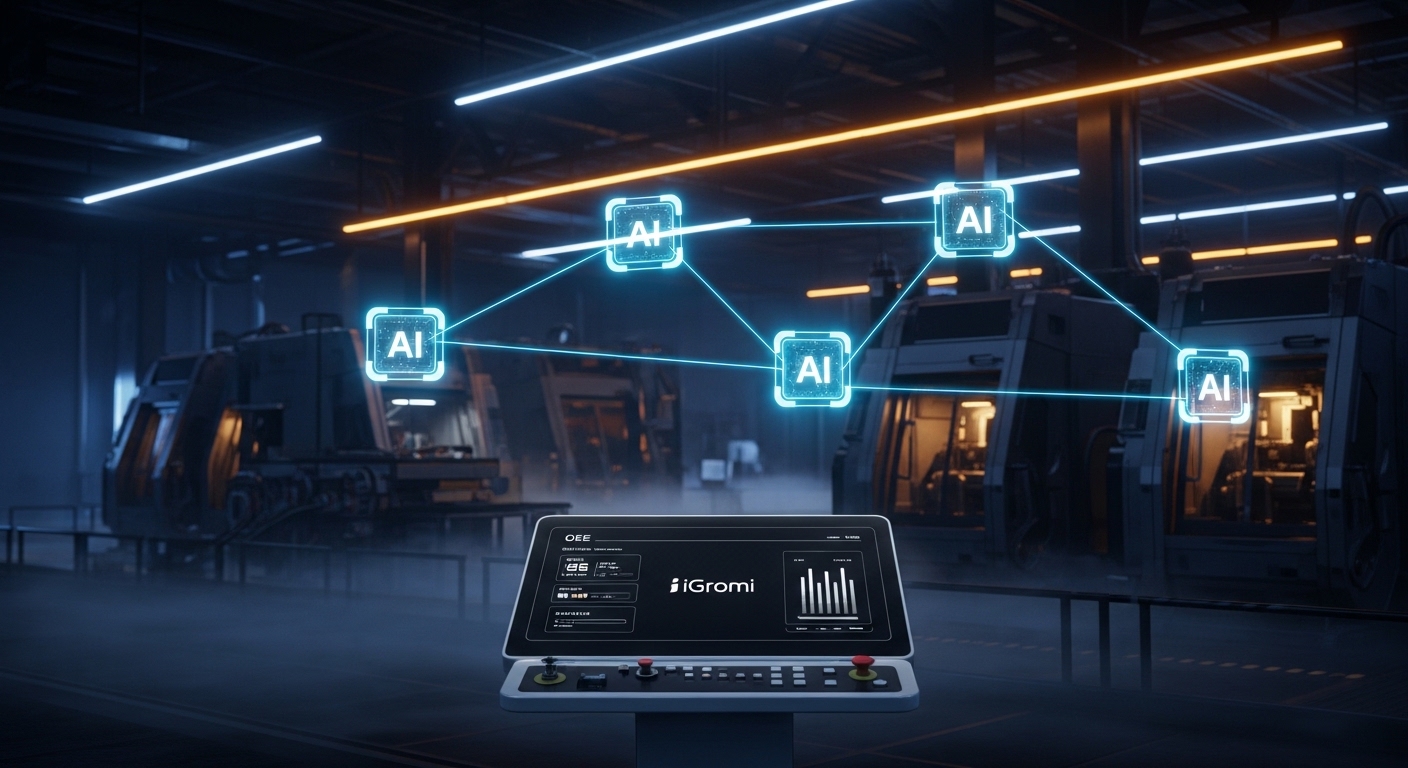
The core of hyperautomation is the Agent Orchestrator (frequently built on frameworks like LangChain, LlamaIndex, or Microsoft AutoGen). The orchestrator acts as the executive brain, implementing the ReAct (Reason + Act) reasoning loop. When a system detects an anomaly in the supply chain, the Agent doesn't spit out a generic response; instead, the Orchestrator breaks down the problem, formulates an action plan, invokes specific tools (e.g., a REST call to an ERP like SAP), and evaluates the result before proceeding.
- Dynamic Planning: Agents' ability to generate Directed Acyclic Graphs (DAGs) of tasks on the fly, adapting to API errors and finding alternative execution routes.
- Short and Long-Term Memory: Utilizing ephemeral caches for the immediate task context and transactional databases to store interaction history, enabling rigorous auditing and state persistence.
- Semantic Routing: Leveraging smaller, faster models to classify input intents and route requests to the correct specialized Agent or LLM, effectively minimizing latency and computational costs.
2. Advanced Corporate RAG and Vector Databases
Retrieval-Augmented Generation (RAG) is mandatory in any enterprise architecture. RAG prevents hallucinations by forcing the LLM to ground its responses exclusively on a corpus of corporate knowledge retrieved in real-time. In advanced B2B deployments, RAG evolves into highly complex, multi-layered systems.
- Semantic Chunking and Metadata: Intelligent segmentation of documents (technical manuals, compliance policies, maintenance histories) preserving context and tagging vectors with critical Role-Based Access Control (RBAC) metadata.
- Hybrid Search: Combining dense vector search (using engines like Pinecone, Milvus, or Qdrant) with traditional lexical search (BM25 in Elasticsearch) to capture both deep semantic meaning and exact matches of industrial serial numbers or fault codes.
- Re-Ranking: Applying Cross-Encoder models in the final retrieval phase to surgically reorder results before injecting them into the LLM's context window, ensuring the model receives the most pertinent information with the lowest possible noise contamination.
Deep Integration: Orchestrating Legacy Systems, Modern Stacks, and IoT #
An AI agent without access to operational tools is merely a static encyclopedia. True hyperautomation occurs at the integration layer, where silicon connects with enterprise software and, ultimately, with the steel of industrial shop floors.
Event-Driven Architecture (EDA)
To achieve real-time operations, agents must be embedded within an Event-Driven Architecture (EDA). Using message brokers like Apache Kafka, RabbitMQ, or AWS EventBridge, agents act as event consumers and producers. For instance, a pressure drop in a valve reported via MQTT is ingested into a Kafka topic; a Diagnostic Agent subscribed to this topic receives the event, analyzes the historical data via RAG, and emits a new event to the Work Orders topic, effectively closing the loop without manual intervention.
API Gateways and Swagger/OpenAPI Contracts
The secure exposure of corporate tools to AI Agents is handled through advanced API Gateways (such as Kong, Apigee, or AWS API Gateway). Agents consume OpenAPI contracts that describe precisely how to interact with enterprise endpoints. It is crucial to implement strict Tool Calling mechanisms, where the API Gateway applies rate limiting, JSON schema validation, and prompt injection protection on API payloads, ensuring that an agent cannot, under any circumstances, execute a destructive query (like a DROP TABLE in a production database).
Security, Privacy, and Governance (Zero Trust)
B2B adoption demands military-grade regulatory compliance (SOC 2, ISO 27001, GDPR). The architecture must be deployed within an isolated Virtual Private Cloud (VPC).
- PII/PHI Redaction: Implementing AI firewalls (like NeMo Guardrails) to anonymize sensitive data before it reaches the LLMs, especially if external model APIs are used instead of locally deployed open-source models.
- Role-Based Access Control for Agents (RBAC-A): Agents must inherit the permissions of the invoking user or the executing service process. An agent querying financial metrics must absolutely not have access to HR modification tools.
- Absolute Traceability: Exhaustive logging of every chain of thought, invoked tool, and generated token into centralized logging systems (like Splunk or Datadog) for rigorous post-incident audits.
Try iGromi CMMS
Manage work orders and predictive alerts without relying on paper.
Industrial Use Cases: Where Silicon Connects with Steel #
Architectural theory gains incalculable value when applied to the most thorny problems of heavy industry and complex operations. Below, we explore how hyperautomation with AI agents redefines the landscape.
1. Manufacturing 4.0 and Dynamic Supply Chain Optimization
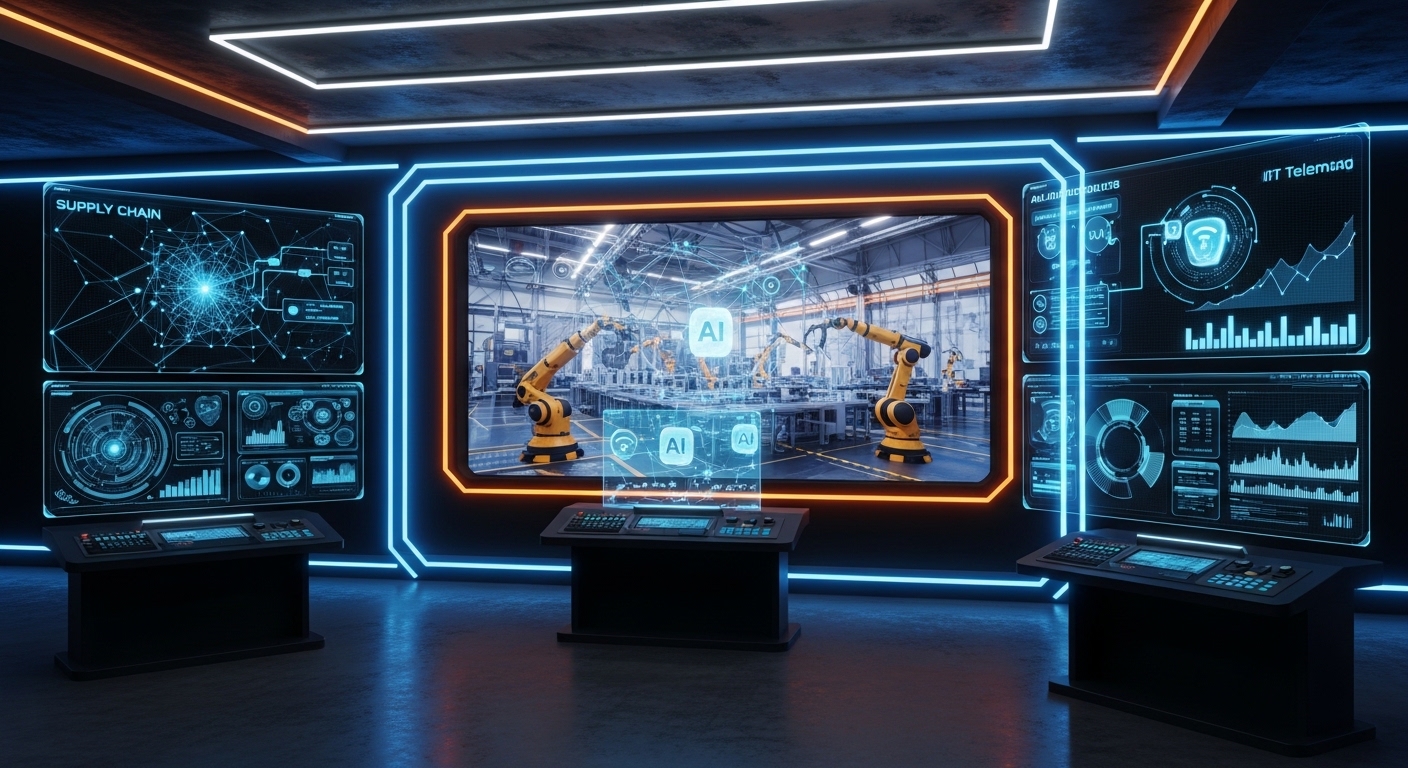
At the heart of Industry 4.0, factories generate terabytes of Digital Twin data. AI agents act as real-time supply chain orchestrators. If a Logistics Agent detects, via supplier APIs and global weather data, that a ship carrying raw materials will be delayed, it triggers immediately. It communicates with the Production Agent to re-evaluate the master schedule in the ERP. Simultaneously, the Purchasing Agent launches requests for quotes (RFQs) to alternative local suppliers and presents an optimized decision matrix to the Operations Director. What previously took entire teams days of analysis with spreadsheets, the agent swarm resolves in seconds.
2. Next-Generation CMMS and Smart Predictive Maintenance
Computerized Maintenance Management Systems (CMMS) are the nervous system of asset maintenance, but historically they have relied on manual data entry and static planning. By integrating LLMs, we transform the CMMS into a predictive and proactive platform.
- Assisted Root Cause Analysis: When a technician faces an atypical breakdown in a turbine, they can consult the CMMS Agent from their mobile device. The agent instantly cross-references current error codes with decades of previous technicians' notes, P&ID schematics, and manufacturer manuals using RAG, providing a holographic or text-based step-by-step guide.
- Automated Work Order Generation: Upon receiving an excessive vibration alert from a SCADA sensor, the Diagnostic Agent not only notifies the alert but automatically drafts a prioritized work order, checks inventory in SAP to ensure spare parts are available, reserves them, and schedules the appropriate technician based on skills and location, inserting everything into the CMMS via API.
3. Telemetry and IoT: Agents Interrogating Sensors at the Edge (Edge AI)
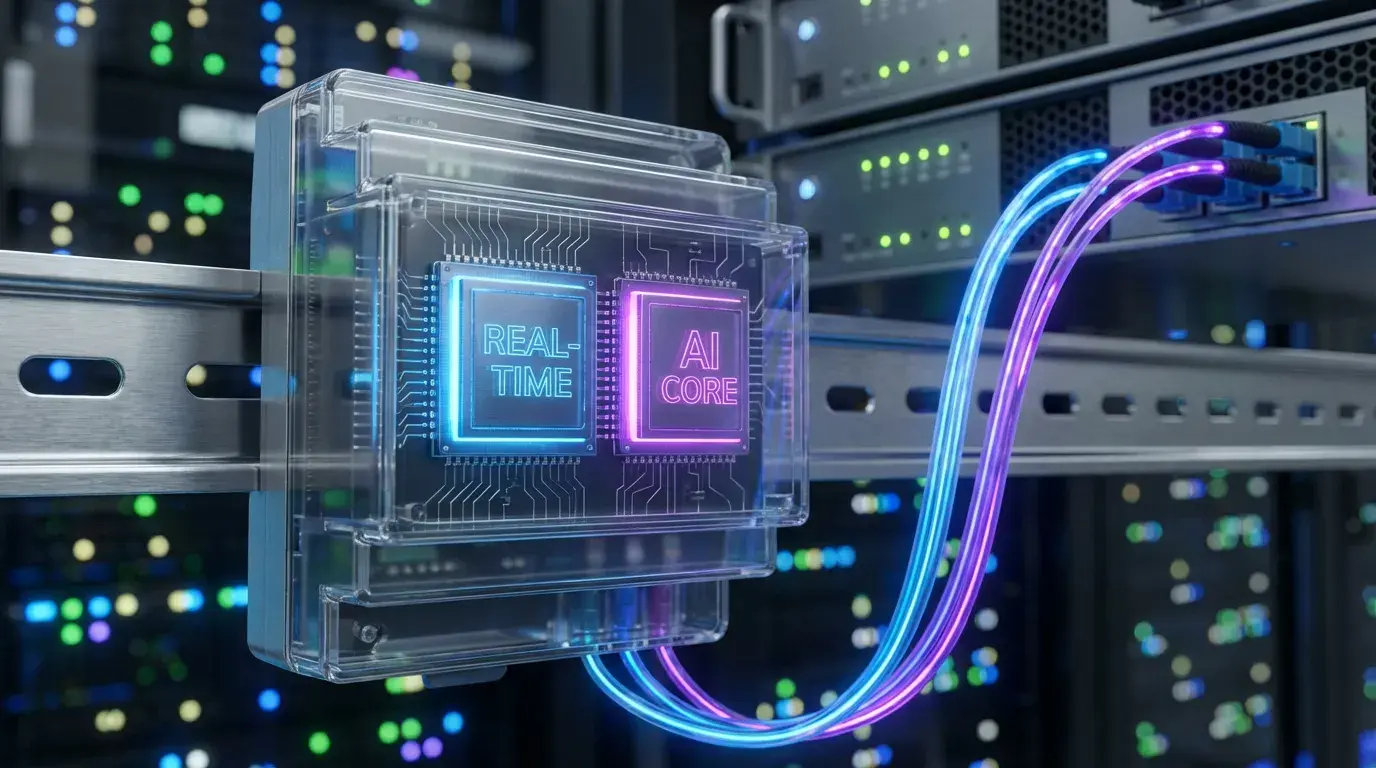
In environments where connectivity is limited or latency is critical (oil rigs, underground mining), hyperautomation is deployed at the edge of the network (Edge Computing). Small, Highly Specialized Language Models (SLMs) like Llama 3 (8B quantized versions) or Mistral operate directly on industrial IoT gateways. These local agents analyze real-time protocols such as OPC UA or Modbus, instantly detecting acoustic or thermal anomalies. If they detect a critical pattern, they act locally by shutting down safety valves and then package an ultra-compressed semantic diagnostic report to send to the Central Cloud Orchestrator when connectivity is restored.
The Tactical Roadmap: Implementation Without Breaking Operations #
Deploying an architecture driven by AI agents must be surgical, avoiding disruption to mission-critical operations. A successful roadmap follows a strict methodology.
Phase 1: Data Audit and Analytical Readiness
Before implementing any LLM, the data infrastructure must be sanitized. This involves de-siloing data, structuring unstructured repositories, and defining clear data dictionaries. An agent is only as good as the quality of the data it consumes (Garbage in, Garbage out). A modern data lake or lakehouse with strict data governance must be established.
Phase 2: Proof of Concept (PoC) in Isolated Environments (Shadow Operations)
Adoption begins in read-only mode. An AI Agent is deployed to observe past operations and propose solutions to historical events (e.g., analyzing maintenance tickets closed last month) to compare the AI's proposal with the actual human decision. This allows for fine-tuning and adjusting retrieval metrics in the RAG system without operational risk.
Phase 3: Human-in-the-Loop and Gradual Automation
Agents begin to execute actions in real systems, but every write action (approving an order, dispatching a ticket in CMMS) requires explicit human validation. Over time, as the agent's confidence level and accuracy surpass predefined thresholds, validations are reduced for low-risk tasks, maintaining the Human-in-the-Loop only for decisions with high financial or physical safety impact.
ROI and Success Metrics in B2B LLM Integration #
Justifying the investment (CapEx and OpEx) in complex AI infrastructures relies on hard business metrics, moving away from mere technological hype. Key KPIs that organizations must monitor include:
- Mean Time To Repair (MTTR) Reduction: The immediate availability of RAG-diagnosed manuals and intelligent spare parts dispatching can reduce MTTR by 30-40% in heavy manufacturing plants.
- Overall Equipment Effectiveness (OEE) Improvement: By predicting failures and orchestrating preventive maintenance during optimal windows, hyperautomation directly attacks unplanned downtime.
- Operational Scalability without Linear Human CapEx: The ability to process 10x the level 1 technical support tickets or analyze hundreds of daily supplier bids without increasing the headcount of the purchasing or technical support departments.
- Waste Reduction and Energy Optimization: Agents monitoring IoT metrics to dynamically micro-adjust furnaces, boilers, or HVAC systems in real-time based on weather and production patterns.
Conclusion: The Future Belongs to the Orchestrated Enterprise #
B2B Hyperautomation powered by AI Agents and LLMs is not a simple software update; it is a fundamental redesign of the enterprise value architecture. Companies that succeed in deeply integrating their physical assets (machines, sensors, inventory) with the cognitive capabilities of multi-agent systems will gain an asymmetrical competitive advantage. They will operate with almost biological agility, responding to market fluctuations, supply chain failures, and industrial anomalies in real-time.
For technology leaders, the time for siloed experimentation is over. It is time to build the foundational infrastructure, ensure data governance, and deploy the first generation of cognitive enterprise agents. In the digital economy of the next decade, intelligent autonomous orchestration will be the difference between leading the market or becoming irrelevant.