Agentic AI in Manufacturing: What It Is and 5 Real Use Cases
What sets an AI agent apart from a chatbot or classic automation, five plant-floor use cases (OEE, maintenance, quality, energy, inventory), the architecture that keeps them safe, and how to start without giving up control of the machine.

Hassle-free automation?
Checklist: 10 Steps to Digitize Your Plant
Avoid costly implementation errors
What agentic AI is #
A chatbot answers a question. An agent pursues a goal: it breaks the task into steps, queries sources, uses tools (a database, a CMMS, a vision model), evaluates what it gets and decides the next step until it reaches a result. Agentic AI is that capacity to plan and act over several steps with bounded autonomy.
In an office, bounded autonomy means the agent may send an email. In a plant it means something very different, because at the end of the chain there is a machine. That is why the design of industrial agents starts by defining what they cannot do.
Agent, automation and chatbot: the practical difference #
| Classic automation | Chatbot / copilot | Agent | |
|---|---|---|---|
| How it decides | Fixed rules | Answers each question | Plans steps from context |
| New situations | Fails or stops | Answers, does not act | Investigates and proposes |
| Uses tools | Only those programmed | Rarely | Yes, those it is authorized to use |
| Risk | Predictable | Low | Needs explicit governance |
Digitize your Plant with iGromi
Book a 30-min demo and discover how to increase your productivity.
Five plant-floor use cases #
1. Explaining every OEE drop
The agent takes the availability drop of the shift, cross-checks PLC state, logged stops, format changes and open maintenance orders, and delivers a probable cause with evidence. What is a one-hour meeting the next morning becomes a report ready at shift end.
2. Preparing the work order
When condition monitoring detects an abnormal vibration pattern, the agent identifies the asset, retrieves its history and the applicable procedure, checks spare parts in stock and drafts the order with a suggested priority. The planner approves or corrects it. The agent does not execute it.
3. Quality with vision
A vision model detects a defect; the agent links the event to the batch, machine and shift, checks whether the same defect appeared before and proposes an action: hold the batch, alert the supervisor, open a non-conformance.
4. Energy per machine
With per-machine power analyzers, the agent compares consumption per cycle against the baseline, points to the machine that drifted and suggests whether it is mechanical degradation or a recipe change. The decision to intervene remains human.
5. Plant inventory and logistics
A silo-inventory Lobe combines level, consumption and purchase orders to propose when to order and how much. When a verified figure is missing, it says so instead of estimating.
The architecture that keeps them safe #
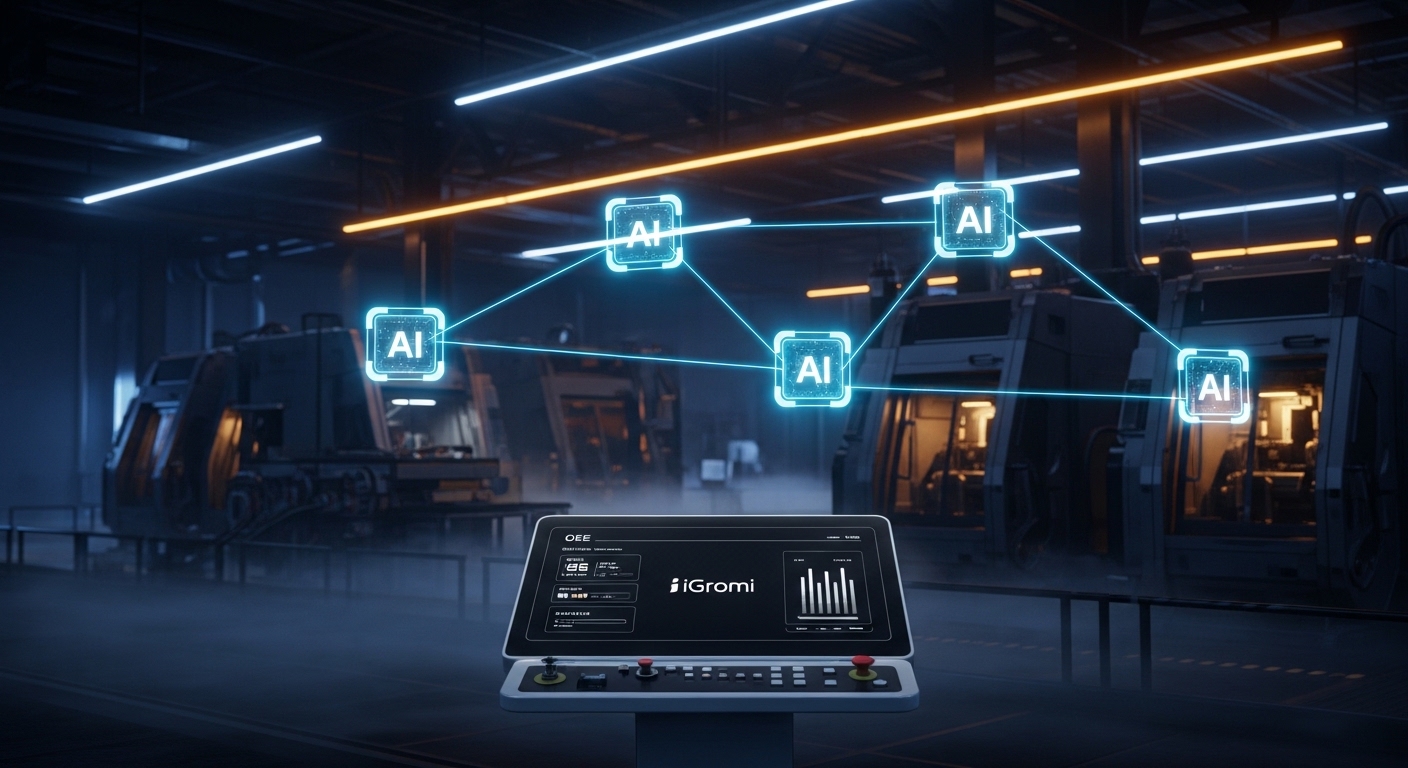
- Perception: PLC, camera and sensor signals enter through a passive gateway, without touching control.
- Memory: an Industrial Second Brain relates every signal to its machine, history and rules, and marks what is verified and current.
- Agent: reads the memory through standard tools (MCP, APIs), reasons and produces a proposal with citations.
- Person: approves, corrects or rejects.
- Control system: executes what was approved, with the same logic and safety as always.
There is one rule: AI never controls the machine directly. It is not a temporary limitation waiting for better models; it is the condition for using probabilistic systems in processes with physical consequences.
How to start #
- Pick a read-only, measurable task: explaining OEE drops or preparing work orders.
- Give the agent access only to verified sources; if the plant memory does not exist, build it first.
- Measure one thing: the share of proposals approved without changes. When it stays above 80 percent for a month, widen the scope.
- Log every proposal, approval and execution. The audit trail is what lets you expand autonomy with arguments instead of faith.
Frequently asked questions #
What is agentic AI?
Agentic AI does not just answer; it pursues a goal over several steps: it queries sources, uses tools, evaluates results and proposes actions. In manufacturing an agent can investigate the cause of an OEE drop and draft the work order, but not execute it without approval.
How is an AI agent different from traditional automation?
Automation follows fixed rules written by a person. An agent decides which steps to take based on context and can handle situations nobody anticipated. In exchange it demands governance: which tools it may use, what it may propose and who approves.
Can an AI agent control a PLC?
It should not, and in iGromi OS it cannot. The agent reads the plant memory and proposes; a person approves; the control system executes. That is the only way to use probabilistic models in processes with physical consequences.
Where should a plant start with agentic AI?
With a read-only agent on a narrow, measurable task: explaining every OEE drop of the shift with evidence, or preparing the work order when condition monitoring detects an anomaly. Measure how many proposals are approved without changes.