Machine Condition Monitoring
with edge AI inference.
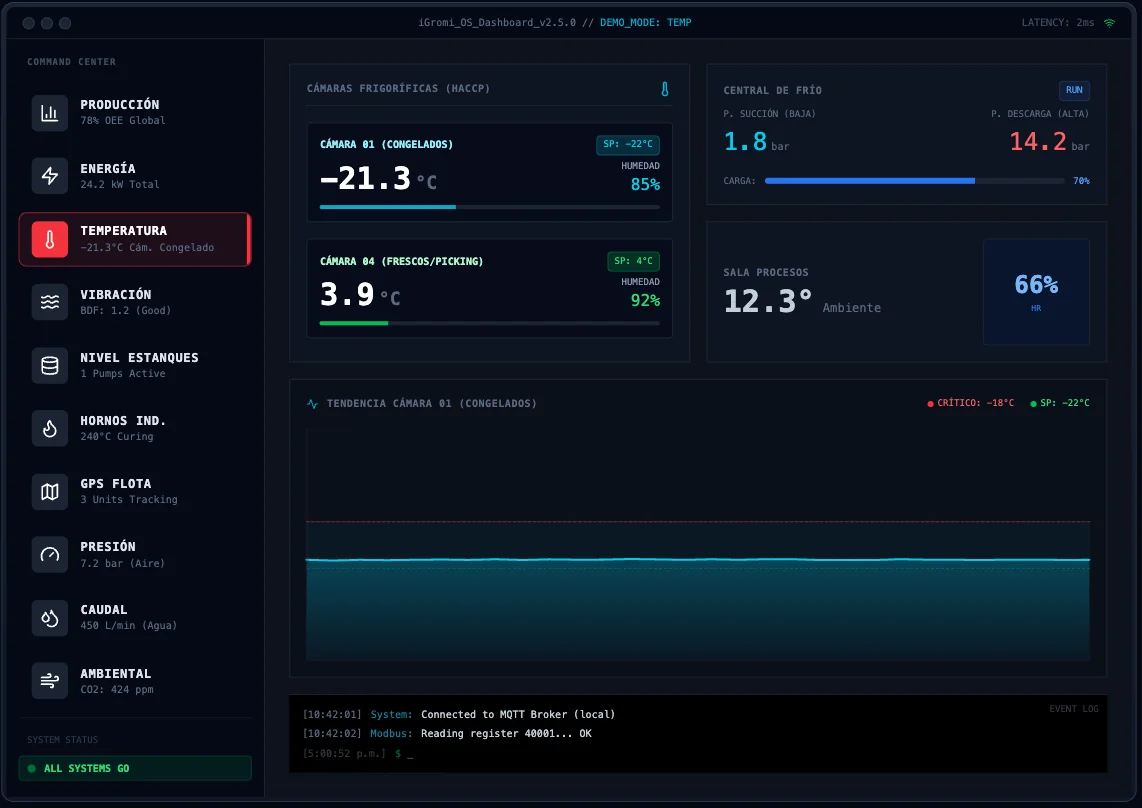
Pumps, motors, gearboxes and compressors warn before they fail: vibration shifts, temperature climbs, current drifts. iGromi OS listens to those signals at the edge of your plant and alerts you when something leaves its normal pattern, with no data sent to the cloud and no extra subscriptions.
The problem
Traditional condition monitoring
costs a fortune.
Expensive proprietary hardware
Legacy condition monitoring systems require dedicated sensors, proprietary gateways and annual calibration contracts. You are locked into a single vendor ecosystem.
Mandatory cloud subscriptions
Most vibration monitoring platforms force you to stream raw data to their cloud. Monthly fees scale with sensor count. Your plant data lives on someone else's servers.
False alarms and noise
Without edge AI, generic threshold-based alerts trigger false positives constantly. Maintenance teams ignore alerts. The system becomes background noise instead of a decision tool.
The solution
Edge AI condition monitoring
that runs on your hardware.
Vibration spectrum analysis
iGromi OS takes vibration signatures from your existing sensors, computes their spectrum at the edge and alerts you when a machine’s signature departs from its normal behaviour.
Multi-parameter fusion
Combine vibration, temperature, current, and pressure data into a unified health index. Cross-correlate signals to eliminate false positives and detect compound failure modes.
PLC-native integration
Connect directly to Modbus, OPC-UA, and MQTT. No middleware, no protocol converters. Your existing PLCs become condition monitoring data sources without replacing them.
What you get with iGromi condition monitoring
1 · What your plant already has
- Vibration sensors
- Bearing and motor temperature
- Motor current from the PLC or meter
2 · The iGromi node on site
- Reads sensors and PLC on the same node
- Compares with each asset’s normal behaviour
- Works without internet
3 · What your team gets
- An alert when a signal leaves its normal range
- Trend per asset
- History to plan maintenance
Know your machines' health
before they fail.
Book a 30-minute demo and see how iGromi OS monitors vibration, temperature, and current — at the edge, without cloud subscriptions.
Book a diagnosticHow is this rolled out in a plant that is already running?
The same five questions come up in every meeting, whichever solution is on the table. The answers depend on how the system works, not on the module.
Do I have to replace my PLC or my SCADA?
No. The system connects to what is already installed and reads from it; it does not replace the control layer and does not write to it unless that is explicitly defined. If the PLC does not expose its parameters, the iGromi Bridge discovers them by trying combinations until it gets a response, and if the machine speaks no protocol at all it is read by a sensor on the electrical signal.
Does it work if the internet goes down?
Yes. Processing happens at the Edge, inside the plant, so capture, rules and inference keep running with the link down. What stops is remote access and outbound synchronisation, which resumes on its own when the connection returns.
Does my data leave the plant?
Not by default. Video and telemetry are processed on the customer's Edge device. What leaves, and where it goes, is defined when the system is configured. That is the same property that underpins compliance with Chile's Ley 21.719 and what makes this viable in mining and in food.
How long until the first data point?
It depends on how many machines there are and what they expose. A line with equipment that speaks Modbus is read in days; a line of silent machines needs sensors installed and panel shutdowns coordinated, and that is set by the plant's maintenance calendar, not by us. The usual sequence is assessment, pilot, expansion.
What happens to what we already measure by hand?
It runs alongside during commissioning. For the first weeks the manual record keeps going in parallel as a validation counterpart: it is how you find out whether the automatic figure beats the handwritten one, and the habit is dropped on its own once that is demonstrated.
Related solutions
Vibration monitoring
Edge FFT analysis detects imbalance, misalignment and mechanical looseness.
Predictive maintenance
Local AI detects bearing, motor and pump faults before production stops.
Energy management
Monitor consumption, power factor and electrical quality in real time.