CMMS Software: Why Traditional Systems Fail and How to Evolve to Edge AI Maintenance (2026 Guide)
Discover why your traditional CMMS software is merely digital paper. Learn how IIoT integration and Edge AI processing with <5ms latency are redefining the future of industrial maintenance towards 2026 with iGromi OS.
Hassle-free automation?
Checklist: 10 Steps to Digitize Your Plant
Avoid costly implementation errors
The Illusion of Traditional CMMS Software: Why You Are Investing in Digital Paper #
In today's industrial ecosystem, the search for CMMS software (Computerized Maintenance Management System) is often the first step taken by operations directors and plant managers in an attempt to digitize their processes. However, there is an inconvenient truth in Industry 4.0 that very few vendors are willing to admit: if your CMMS software requires a human to manually input data to function, you have not digitized your maintenance; you have merely transformed physical paper into digital paper.
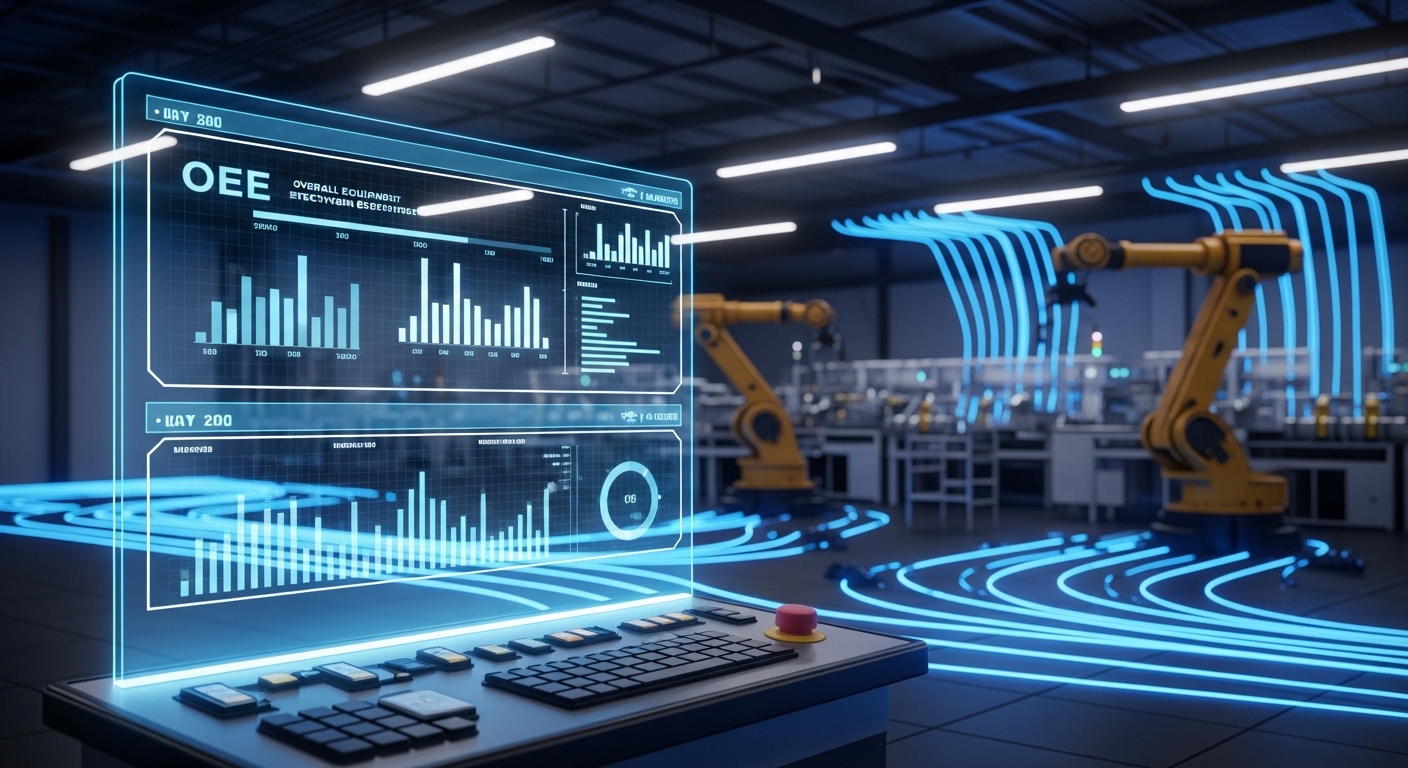
Looking towards 2026, the operational complexity of production lines, hyper-connected supply chains, and the imperative to maximize OEE (Overall Equipment Effectiveness) will render any passive system obsolete. Conventional CMMS software acts as a historical ledger, a forensic database that tells you what broke, who fixed it, and how much it cost, but always after the financial impact and machine downtime have already occurred.
The Problem of Static Data and the Human Factor
Traditional systems rely on human latency. An operator hears an unusual noise in a centrifugal pump, finishes their shift, and hours later logs an anomaly in the system. By the time the maintenance team opens the platform, the microscopic degradation has already escalated into a catastrophic bearing failure. This reliance on human observation and manual data entry is the Achilles' heel of any legacy CMMS software. True evolution demands systems that listen, analyze, and act at the machine level, in milliseconds.
Work Order Management: From Reactive Bureaucracy to Predictive Autonomy #
The operational heartbeat of any maintenance platform is Work Order Management. In a classical environment, the lifecycle of a work order is bureaucratic, sluggish, and error-prone. It involves a request, managerial approval, technician assignment, the hunting down of physical manuals or disconnected PDFs, and finally, the execution and manual closure of the order.
With the integration of Edge AI, the paradigm of Work Order Management transforms radically, evolving from an administrative management tool into an autonomous orchestration engine. Let's examine the fundamental difference:
- Condition-Based Autonomous Generation: Instead of waiting for a person to create a ticket, IIoT sensors detect anomalous vibrations or thermal spikes. The Edge AI system analyzes the spectral signature of the vibration, identifies an impending failure in a helical gear, and instantly generates a work order.
- Dynamic and Intelligent Assignment: The system evaluates in real-time which technician has the necessary certification and is physically closest to the affected asset, pushing a priority alert directly to their mobile device.
- Predictive Spare Parts Kitting: The evolved CMMS software cross-references the anomaly data with the ERP (Enterprise Resource Planning) inventory, automatically reserving the necessary components (bearings, mechanical seals) before the technician even reaches the warehouse area.
By redefining Work Order Management with artificial intelligence, companies eliminate administrative latency time, drastically reducing MTTR (Mean Time To Repair) and increasing MTBF (Mean Time Between Failures).
Move beyond restrictive licensing
See why iGromi OS is a modern alternative to legacy SCADA and MES systems.
The New Standard: Edge AI
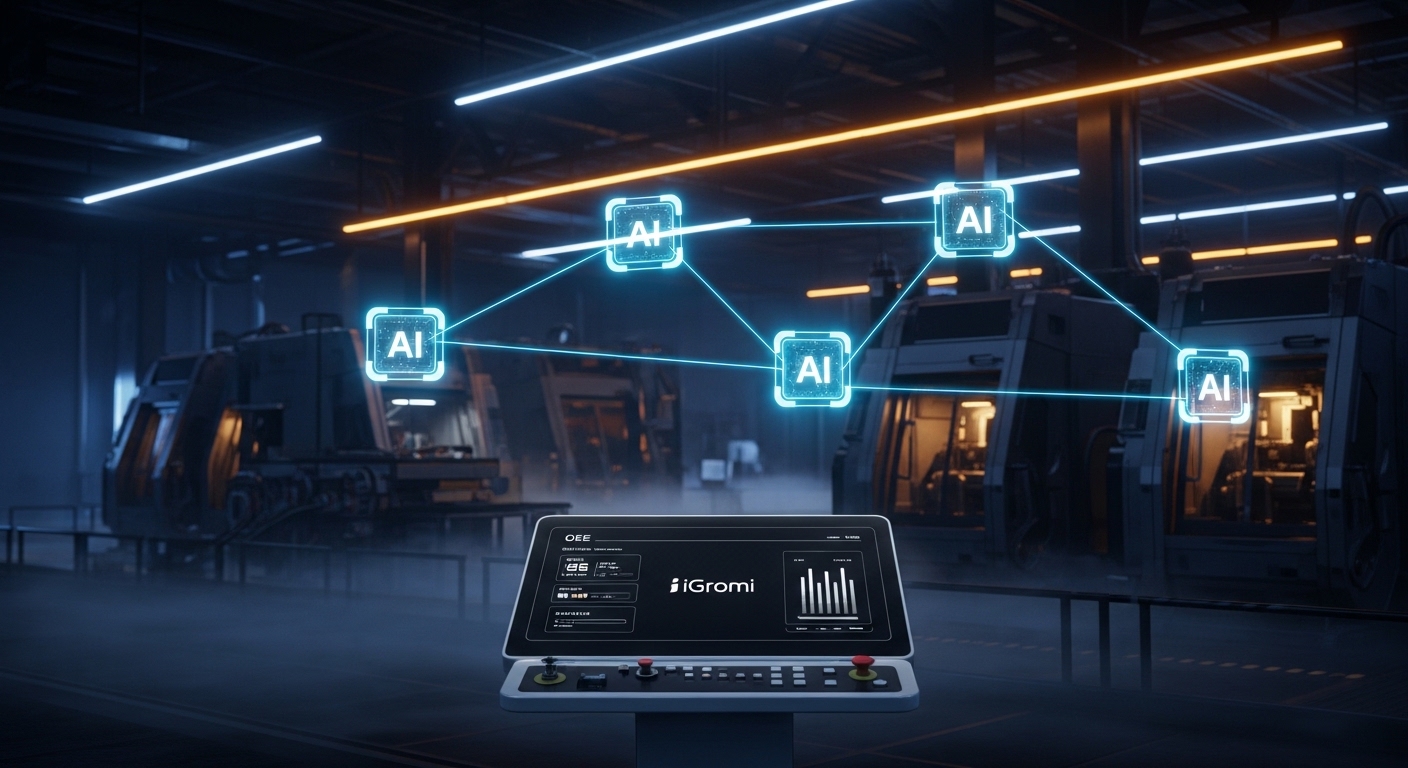
The industry no longer buys expensive per-tag licences or depends on slow clouds. Modern plants process data locally at < 5ms with full autonomy, even with no internet.
View Architecture MatrixPreventive Maintenance: The Calendar Fallacy and the Awakening of Edge AI #
For decades, Preventive Maintenance has been considered the gold standard in the industry. The logic seemed irrefutable: replace components and perform lubrication routines based on fixed time intervals or run-hours dictated by the Original Equipment Manufacturer (OEM). However, this approach hides profound technical and financial inefficiency.
The Hidden Cost of Traditional Preventive Maintenance
Calendar-based Preventive Maintenance assumes that all machines operate under identical conditions of environmental load, thermal stress, and operational intensity. This is a mathematical fallacy. In practice, this results in two devastating scenarios: over-maintenance (replacing parts that still have 40% of their useful life, wasting budget) or unplanned failures that occur between scheduled maintenance cycles due to micro-operational variations.
This is where traditional CMMS software demonstrates its severe limitations. It cannot understand context. The evolution towards 2026 demands abandoning blind preventive maintenance to adopt a Prescriptive and Predictive approach driven by Edge AI. Through Machine Learning models deployed directly at the edge of the network, systems can calculate the Remaining Useful Life (RUL) of a component based on its actual, real-time degradation, not a textbook estimation.
The Latency Imperative: Why Cloud-Only CMMS Fails (< 5ms) #
Many SaaS software providers boast of having 100% cloud-based architectures. While Cloud Computing is excellent for massive historical data storage and long-term AI model training, it is inherently deficient for mission-critical process control on the factory floor due to an irrefutable factor: network latency and intermittency.
When a high-speed servo-valve begins to cavitate, irreversible damage can occur in fractions of a second. If your CMMS software relies on sending that data to a cloud server located thousands of miles away, processing it, and sending an alert back, the inherent latency (which often exceeds 100-500 milliseconds, coupled with potential Wi-Fi or 5G network drops in dense industrial environments) means the decision will arrive far too late.
- The Edge Advantage: True revolution requires AI model inference executed locally on machine controllers or adjacent IIoT gateways.
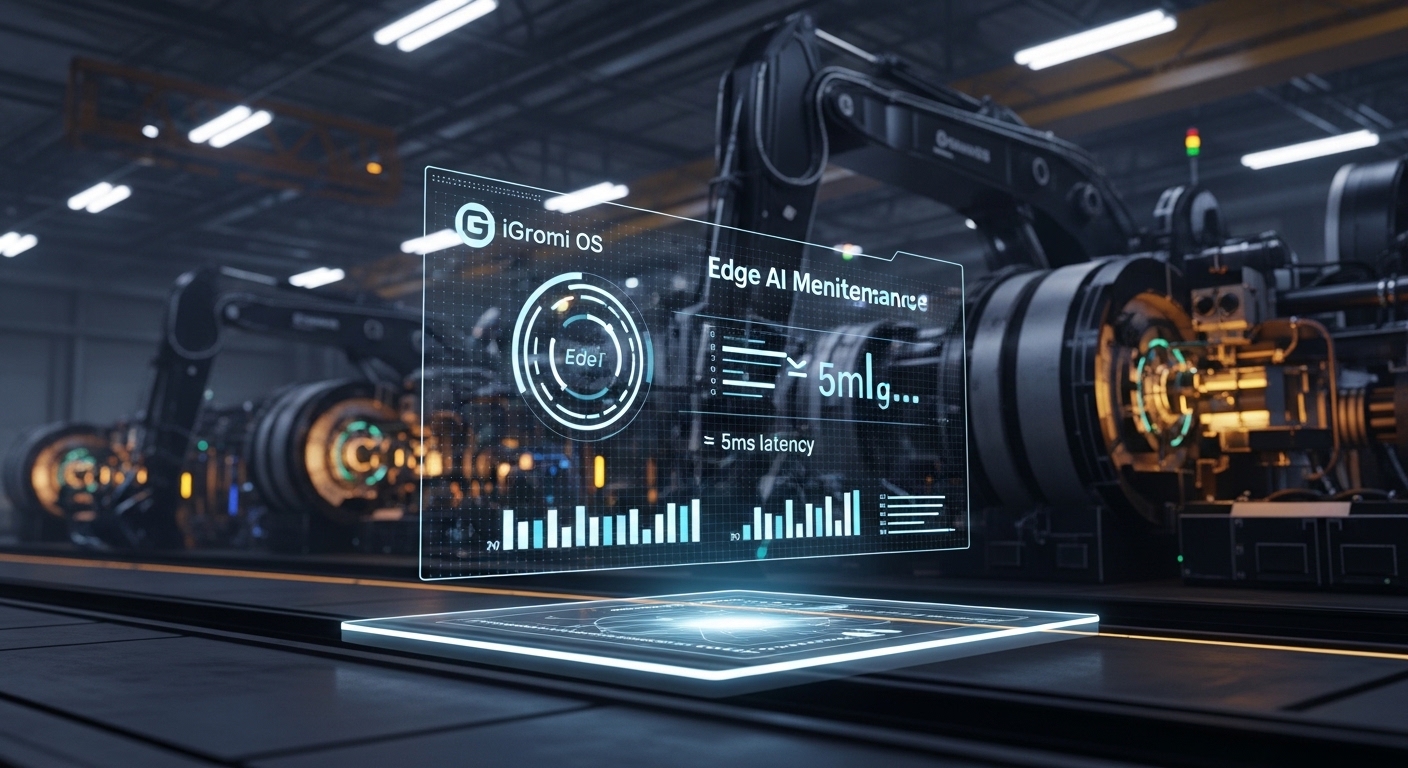
- Microsecond Decisions: We are talking about guaranteed latency of < 5ms. Edge AI does not need to ask the cloud for permission to order an emergency machine shutdown or to reroute a critical work order. Processing happens in situ, guaranteeing absolute resilience even if the factory completely loses its internet connection.
IIoT Integration: The Central Nervous System of Industry 4.0 #
A modern CMMS software is deaf, blind, and mute without a high-fidelity IIoT (Industrial Internet of Things) infrastructure. Advanced sensors are the nerve endings that feed artificial intelligence. We analyze continuous, high-frequency variables:
- High-Frequency Vibration Analysis: Utilizing Fast Fourier Transforms (FFT) to break down vibration spectra and identify misalignments, imbalances, or wear on bearing raceways.
- Continuous Infrared Thermography: Monitoring electrical panels and motors to detect overheating before they cause fires or massive power outages.
- Acoustic Emission and Ultrasound Analysis: Detecting compressed air leaks or cavitation in fluid systems, which often go unnoticed during visual inspections.
Without the ability to ingest terabytes of this telemetry per hour, standard CMMS software simply collapses. The architecture must be designed from the ground up to handle massive, asynchronous data streams, correlating them with the enterprise's asset topology in milliseconds.
iGromi OS: The Ultimate Evolution of CMMS Software Towards 2026 #
By understanding the fundamental flaws of the traditional approach, it becomes clear that high-performance B2B companies do not simply need another CMMS software; they need a holistic Industrial Operating System. This is where iGromi OS stands as the definitive standard for the year 2026 and beyond.
iGromi OS is not a passive database. It is a living ecosystem acutely aware of its environment. By fusing real-time IIoT data capture, Edge AI inference with near-zero latency (< 5ms), and a completely autonomous Work Order Management engine, iGromi OS eliminates the obsolete concept of manual Preventive Maintenance.
With iGromi OS, you move from managing repairs to orchestrating maximum reliability. Our platform redefines asset management, allowing artificial intelligence to analyze patterns invisible to the human eye, prescribe exact actions, and democratize technical knowledge through augmented interfaces for operators. Evolve your plant floor, abandon digital paper, and transform your maintenance into a relentless competitive advantage with iGromi OS.