MES Software: How to Automate OEE Without Operators Typing It In
Discover the technical architecture of a modern MES Software, why managing OEE in Excel destroys your factory's profitability, and how IoT and Edge Computing are leading the industrial digital transformation in 2026.
Hassle-free automation?
Checklist: 10 Steps to Digitize Your Plant
Avoid costly implementation errors
The Path to Operational Excellence: Why Paper and Excel Are No Longer Enough #
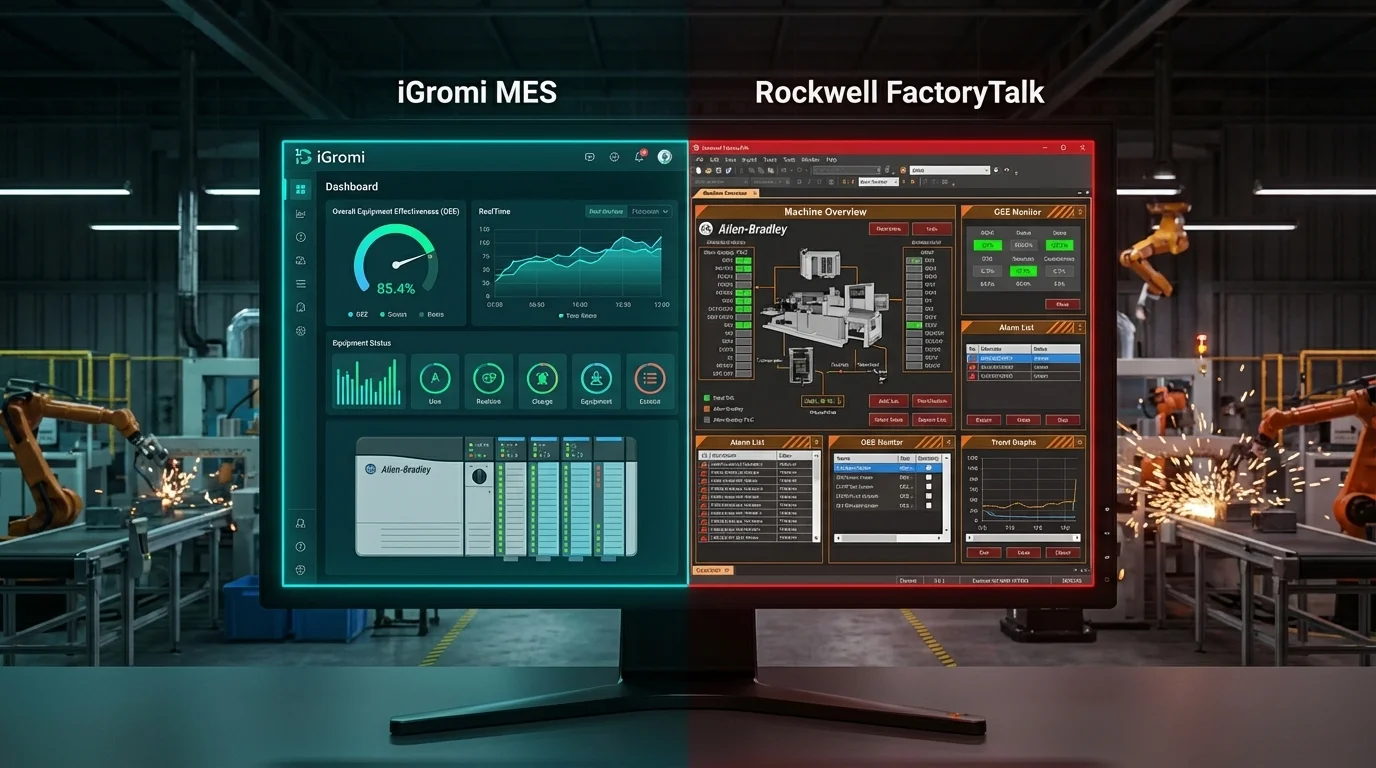
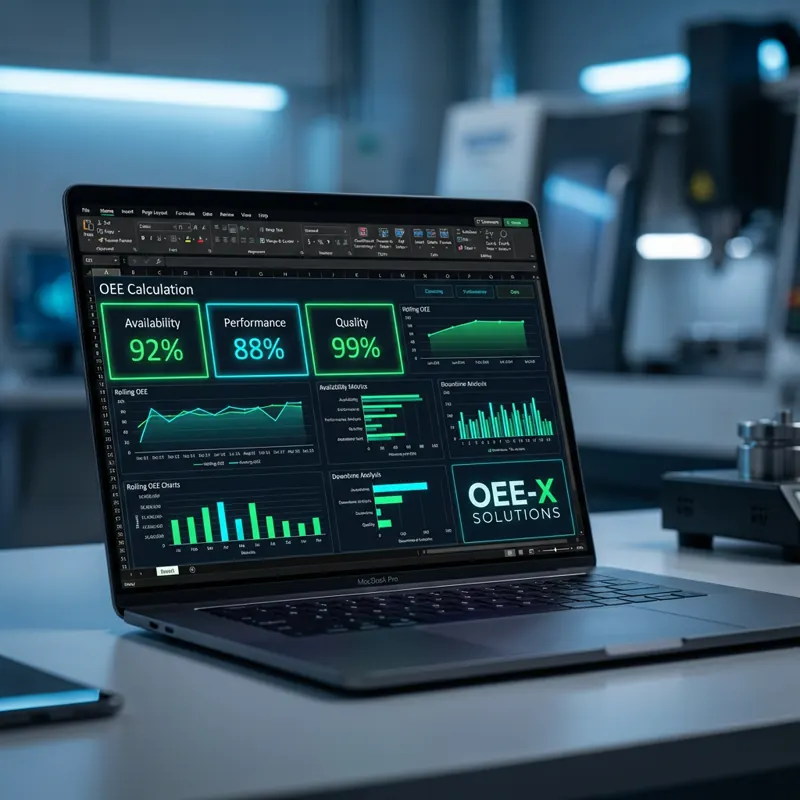
In today's hyper-competitive B2B industrial manufacturing environment, the speed and accuracy of data are the absolute frontier separating leading factories from laggards. Many plant managers and operations directors begin their continuous improvement journey using familiar, highly accessible tools. Before diving deep into advanced MES architecture, if your plant is still in the early stages of efficiency measurement, we have a transitional resource for you. You can download our free OEE calculation spreadsheet, a good starting point to understand your core metrics before making the leap to full automation with iGromi.
1. In-Depth Definition and Architecture of a Manufacturing Execution System (MES) #
A MES (Manufacturing Execution System) Software is the tactical brain of the production floor. While an ERP (Enterprise Resource Planning) plans from a financial and logistical perspective (Level 4 of the ISA-95 standard), the MES operates precisely at Level 3. Its primary objective is to execute production orders, track work-in-progress (WIP) inventory, manage quality standards, and critically, capture machine performance in real time.
The architecture of a modern MES in 2026 has evolved drastically. Monolithic systems that took years to deploy are no longer the only option. Two models now coexist: MES in the cloud and MES on a server inside the plant, which keeps working when the internet goes down. The choice depends on the plant's connectivity and on where the data must stay. Either way, data travels from the machine (Level 0/1) to the management dashboard without anyone retyping it.
The Importance of the ISA-95 Standard in MES Architecture
To standardize systems integration at both the enterprise and industrial control levels, the ISA-95 standard divides technology into clear hierarchies:
- Level 0 and 1: Physical processes and sensing (Sensors, Actuators, Motors).
- Level 2: Supervisory control (SCADA, PLC, DCS). This is where industrial network protocols operate.
- Level 3: Manufacturing operations (MES). This is the critical bridge. It is where dynamic OEE is calculated and resources are allocated.
- Level 4: Business planning and logistics (ERP). Finances, purchasing, and sales.
The MES Software extracts raw data from Level 2 and contextualizes it with the work orders flowing down from Level 4. The result is unparalleled, 360-degree operational visibility.
2. Hidden Costs and Bottlenecks of Managing OEE with Excel #
While our introductory template can help you kick-start your initiatives, sustaining your entire manufacturing strategy purely on spreadsheets is a massive systemic and financial risk. Managing OEE (Overall Equipment Effectiveness) in Excel presents severe vulnerabilities that often go entirely unnoticed until they critically impact the company's EBITDA.
The Fallacy of Zero Cost
Excel appears to be free simply because the Office license is already paid for. However, the hidden costs are staggering. Consider the raw engineering time invested: a supervisor spending 2 hours every single day gathering sheets of paper, transcribing machine downtime data, and attempting to balance production figures. By the end of the week, you've lost an entire production shift just to manual data entry. For a comprehensive deep dive into why this method is obsolete, we strongly recommend reading our Excel OEE Guide 2026.
Data Bottlenecks and Severe Latency
- Invisible Micro-Stops: An operator will never write down a 30-second stop on paper. However, 50 micro-stops per shift will completely destroy your OEE Performance metric.
- Decision-Making Latency: Excel reports are typically reviewed the next day (usually in the morning shift meeting). If a machine experienced quality issues at 10:00 AM, the plant manager finds out 24 hours later. By then, that entire batch is scrap.
- Data Corruption and Silos: Macros break, formulas are dragged incorrectly, and there are multiple "versions of the truth" constantly circulating via email.
Download the 2026 OEE Excel template
Stop calculating by hand. Download the automated template and start measuring efficiency.
3. How Edge Computing and IoT Eliminate Manual Capture #
The fourth industrial revolution (Industry 4.0) has brought technological enablers that completely democratize access to MES solutions. Chief among them are the Industrial Internet of Things (IIoT) and Edge Computing. This powerful technological duo automates the capture of critical variables, feeding advanced algorithms so you know exactly what OEE is and how it is calculated without any human intervention.
Instead of relying on an operator to push buttons on an interface screen, IoT data acquisition hardware connects directly to PLCs or is installed non-intrusively via current and vibration sensors. Edge Computing comes into play by locally processing massive volumes of raw data, right next to the machine. Rather than saturating bandwidth by sending voltage signals to the cloud every millisecond, the Edge device analyzes the signal, accurately identifies the machine's state (Producing, Stopped, Idle), and sends only a lightweight, MQTT-encrypted data packet directly to the cloud servers.
The operator stops writing down counts and downtime. Only what the machine cannot know, such as the cause of a stop, stays in their hands.
4. Technical Comparison Table: Excel vs MES Software #
For B2B technical and leadership teams, the structural difference between both tools becomes glaringly evident when directly contrasting their operational capabilities:
- Data Capture: In Excel, it is 100% manual and deeply retrospective. In an MES Software, it is fully automated (IoT/PLCs) and strictly real-time.
- OEE Accuracy: Excel depends on what someone remembers at the end of the shift and rarely records micro-stops. An MES connected to the machine logs every stop with its start and end time, including those lasting a few seconds.
- Visibility and Scalability: Excel requires isolated files per production line or plant, generating vast data silos. An MES offers a unified, multi-plant cloud dashboard with a highly scalable architecture.
- Traceability and Compliance: In Excel, change auditing is virtually non-existent, and tracking a specific batch is incredibly complex. In an MES, each batch is linked to the line, the shift and the stops it had, which makes quality audits easier.
5. Structural Differences Between MES, ERP, and CMMS #
One of the most common mistakes in manufacturing IT strategic planning is attempting to force software to serve a purpose for which it was never designed. Heavily customizing an ERP to try and act as an MES usually results in multi-million dollar projects that fail due to extreme rigidity and a total lack of direct connectivity with factory machines.
- ERP (Enterprise Resource Planning): Handles accounting, the global supply chain, human resources, and billing. It simply lacks the transactional speed necessary to deal with the rapid cycle time of a packaging machine.
- CMMS (Computerized Maintenance Management System): Its entire universe revolves around asset health, preventive/predictive work orders, and spare parts management. If you are evaluating one, see how to choose a CMMS for manufacturing.
- MES (Manufacturing Execution System): It is the true conductor on the plant floor. It takes production orders down from the ERP, rigorously verifies machine availability (relying on CMMS data), and meticulously records every single second of the operation to vastly optimize efficiency and OEE.
6. iGromi's Role in Industrial Digitalization and Automation #
iGromi does not replace the ERP or require changes to the PLC. A node in the plant reads the PLC read-only —S7, Modbus or EtherNet/IP— and, when counting is needed, uses the cameras already installed. From that it calculates OEE per machine and per shift without anyone writing it down. Data is processed on site; the cloud is optional.
An example in production: at Intercos, a cosmetics plant, iGromi runs as the MES on packaging lines with counting sensors: units per shift, stops per machine and export to Excel for the reports the plant already used.
7. The Next Step: Abandon Excel and Transform Your Factory #
The operational theory is crystal clear: keeping your plant's core management locked in spreadsheets is placing a massive artificial limit on your business's profitability. MES Software in 2026 is no longer a luxury reserved for multinational corporations; it is a strict survival and competitiveness mandate for any serious manufacturing facility.
Are you ready to permanently leave behind data latency, manual errors, and a total lack of visibility? The time to lead the digital transformation within your enterprise is right now. Book a customized Demo with iGromi's technical experts today. Discover firsthand how we can connect your machines, seamlessly automate your OEE, and elevate your operational excellence to the next level in record time.