ConnectivityDec 2, 2025
Industrial LoRaWAN: Long-Range Wireless Sensors for the Plant
Monitor slow-changing variables (temperature, level, humidity) kilometers away without pulling a single cable. The LPWAN shift, explained for plant engineers.
Breaking the Cable Barrier #
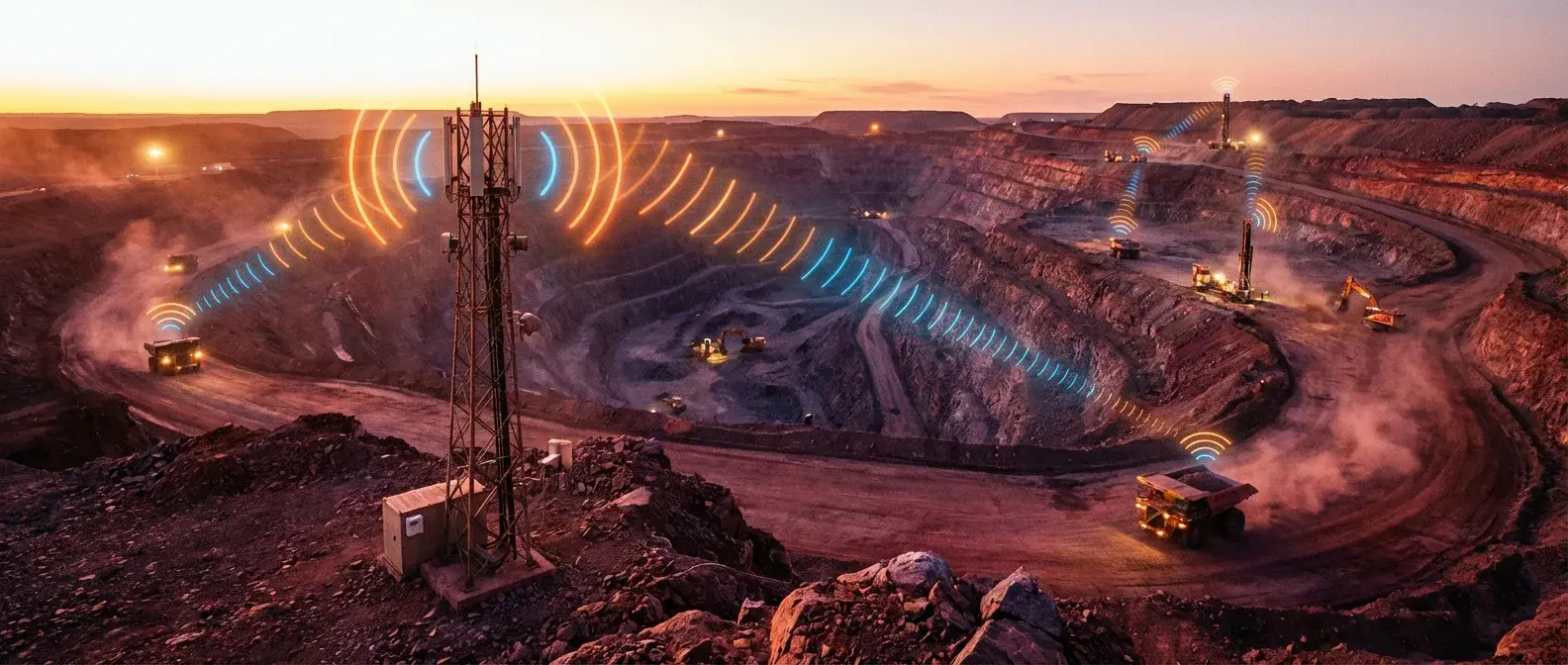
Picture monitoring the temperature of 50 storage tanks spread over 10 hectares (about 25 acres). With traditional wiring you are talking about kilometers of cable, conduit, labor and upkeep. LoRaWAN changes the rules of the game.
LoRaWAN (Long Range Wide Area Network) is a wireless protocol designed specifically for low-power, long-range industrial IoT. It connects sensors that send small payloads (temperature, level, status) over distances of up to 15 km in open terrain, on batteries that last for years.
When Should You Use LoRaWAN? #
LoRaWAN is NOT for real-time control. It is a great fit for:
- Remote tank monitoring: fuel, water and chemical levels.
- Environmental sensors: temperature, humidity and air quality across large areas.
- Utility metering: water, gas and electricity in distributed plants.
- Leak detection: moisture sensors on buried pipelines.
- Asset tracking: location of containers, pallets and mobile equipment.
LoRaWAN Architecture: Gateway + Network Server #
Unlike WiFi or Bluetooth, LoRaWAN uses a star topology:
- Sensors (End Devices): transmit data every X minutes or hours.
- LoRaWAN Gateway: receives transmissions from every sensor in range (up to hundreds).
- Network Server: processes the data, removes duplicates and forwards it to your application (MQTT, HTTP, etc.).
A single gateway can cover an entire plant. Sensors do not talk to each other; they only transmit to the nearest gateway.
Example: Silo Monitoring at an Agro-Industrial Plant #
An agro-industrial plant with 12 grain silos spread across 5 hectares needed to measure level and temperature to prevent losses from fermentation.
Solution:
- 12 LoRaWAN sensors (ultrasonic level + temperature).
- 1 LoRaWAN gateway installed on the roof of the main office.
- Data sent to iGromi over MQTT every 30 minutes.
Result: installed in 2 days (vs. 2 weeks with cabling). 60% lower cost. Batteries rated for 5 years.
LoRaWAN vs. Other Wireless Technologies #
| Technology | Range | Power draw | Industrial use |
|---|---|---|---|
| LoRaWAN | 2-15 km | Ultra low | Slow monitoring |
| WiFi | 50-100 m | High | Fast data |
| Zigbee | 10-100 m | Low | Local mesh |
| Cellular (4G/5G) | Unlimited | Very high | Critical data |
LoRaWAN Limitations #
It is not perfect. LoRaWAN has important constraints:
- Low data rate: 50 kbps maximum (not suitable for video or audio).
- Duty cycle: in Europe (EU868) a 1% duty cycle applies; in Chile (AU915) it does not, although there are transmit power and airtime limits.
- Not real time: latency is measured in seconds. Do not use it for closed-loop control.
Conclusion: The Right Tool for the Right Job #
LoRaWAN is the right answer when you need to monitor many remote points whose data changes slowly. If you need real-time control, use EtherNet/IP or PROFINET. If you need mobility with fast data, use 4G/5G.
"LoRaWAN doesn't replace cabling. It makes it unnecessary in 80% of monitoring use cases."
Topics
- industrial lorawan
- lorawan sensors
- lorawan industrial iot
- lpwan
- wireless industrial sensors
- lorawan gateway

About the author
Francisco CisternasSenior Full-Stack Lead
Works on both the Edge and the cloud. Builds iGromi's infrastructure, from firmware on the controller to the dashboards the plant uses.