ConnectivityDec 22, 2025
Private 5G vs Industrial WiFi: Is It Worth the Investment?
WiFi struggles with steel structures and mobile robots. When a private cellular network for your plant is worth it, and when WiFi 6 is enough.
The WiFi Problem in Harsh Industrial Environments #
Everyone loves WiFi at the office. It works perfectly. But walk into an industrial plant and the picture changes drastically:
- Steel beams: They block 2.4/5 GHz signals like a bunker. You need 10x more access points than in an office of the same size.
- Severe electromagnetic interference: VFD motors, welders and induction furnaces generate EM noise that saturates the unlicensed WiFi spectrum (shared with microwaves, Bluetooth and employees' phones).
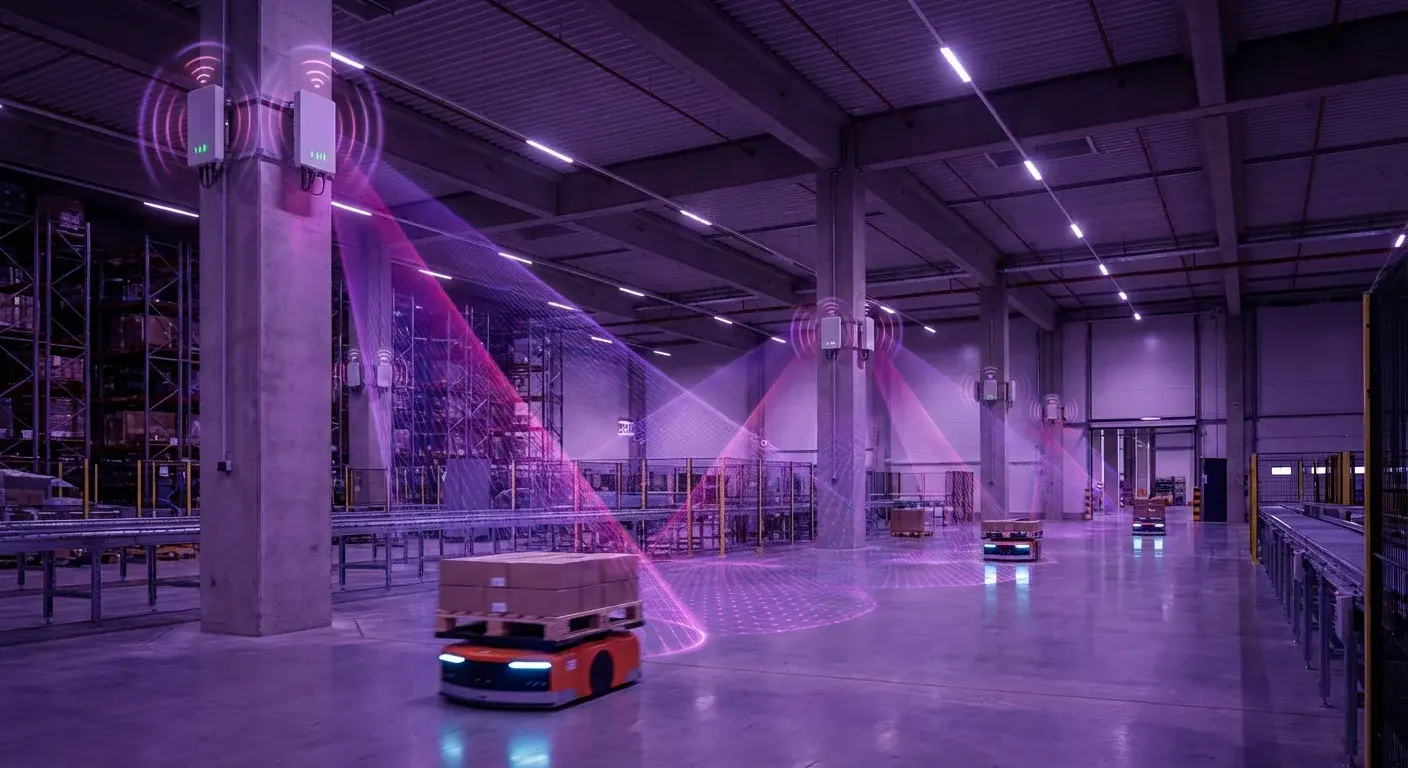
- High mobility: AGVs/AMRs (mobile robots) move at 2 m/s. When they cross from one AP to another, WiFi suffers slow handover (100-500 ms of disconnection). That's enough for the robot to trigger its emergency brake.
- Device density: A modern plant can have 10,000+ IoT sensors. WiFi starts to saturate at ~150 devices per AP (depending on traffic).
WiFi 6: Better, but It Doesn't Solve Everything #
WiFi 6 improves on WiFi 5: OFDMA (multiple devices at once), TWT (battery savings), improved MU-MIMO. But it's STILL WiFi: unlicensed spectrum (interference), slow handover and no latency commitments (best effort).
Private 5G: Your Own Cellular Network #
We're not talking about the signal on your iPhone. We're talking about installing YOUR OWN 4G/5G cellular network in the factory, operating on clean spectrum.
Comparison: WiFi 6 vs Private 5G
| Metric | WiFi 6 | Private 5G |
|---|---|---|
| Latency | 15-30 ms | <10 ms with reserved QoS |
| Handover | 100-500 ms | <50 ms, seamless |
| Indoor range | 30-50 m | 100-300 m |
| Penetration | Poor (steel blocks it) | Excellent |
| Density | ~150/AP | 1M/km² |
| Upfront cost | Low (per access point) | High (full network) |
Use Cases Where 5G Is a Must #
1. Autonomous Mobile Robots (AMRs)
AMRs moving hazardous materials can't afford 200 ms disconnections. With 5G, handover is imperceptible.
Illustrative example: a 40,000 m² warehouse running 80 AMRs that, on WiFi, logs a dozen emergency stops a day from signal loss. That is the kind of operation where private 5G earns its keep.
2. Augmented Reality for Maintenance
A technician with a HoloLens needs two-way 4K streaming with latency under 20 ms. WiFi: fails in a noisy plant. 5G: works well (reserved QoS).
Costs: Is It Worth It? #
Typical private 5G investment: core network + 5 to 10 radio units + integration. It's an infrastructure project, not an equipment purchase.
When It Does NOT Pay Off
If you only poll sensors every 15 minutes, with no mobile robots or ultra-low-latency applications: use WiFi 6. It's 10x cheaper.
When It DOES Pay Off
If your mobile robots stop several times a month because of WiFi dropouts and each stop costs hours of production, multiply those hours by what that production is worth: that's your business case.
Conclusion: A Hybrid Strategy #
WiFi 6: Perfect for offices and non-critical monitoring. Your reliable, inexpensive "Toyota Corolla."
Private 5G: For mission-critical applications where downtime = massive losses. Your "Volvo with every airbag." It costs more, but it saves you.
Most plants will have BOTH: WiFi for general use, 5G for what's critical. It isn't a fight; it's strategic thinking.
Topics
- private 5g vs wifi
- private 5g manufacturing
- industrial wifi
- wifi 6 industrial
- private lte factory
- amr connectivity

About the author
Francisco CisternasSenior Full-Stack Lead
Works on both the Edge and the cloud. Builds iGromi's infrastructure, from firmware on the controller to the dashboards the plant uses.