ProductivityDec 21, 2025
Micro-Stops: The Silent Killer of Your Productivity
Those 30-second stops nobody logs add up to 2-3 hours a day. How to detect micro-stops on your line and the 6 strategies to eliminate them.
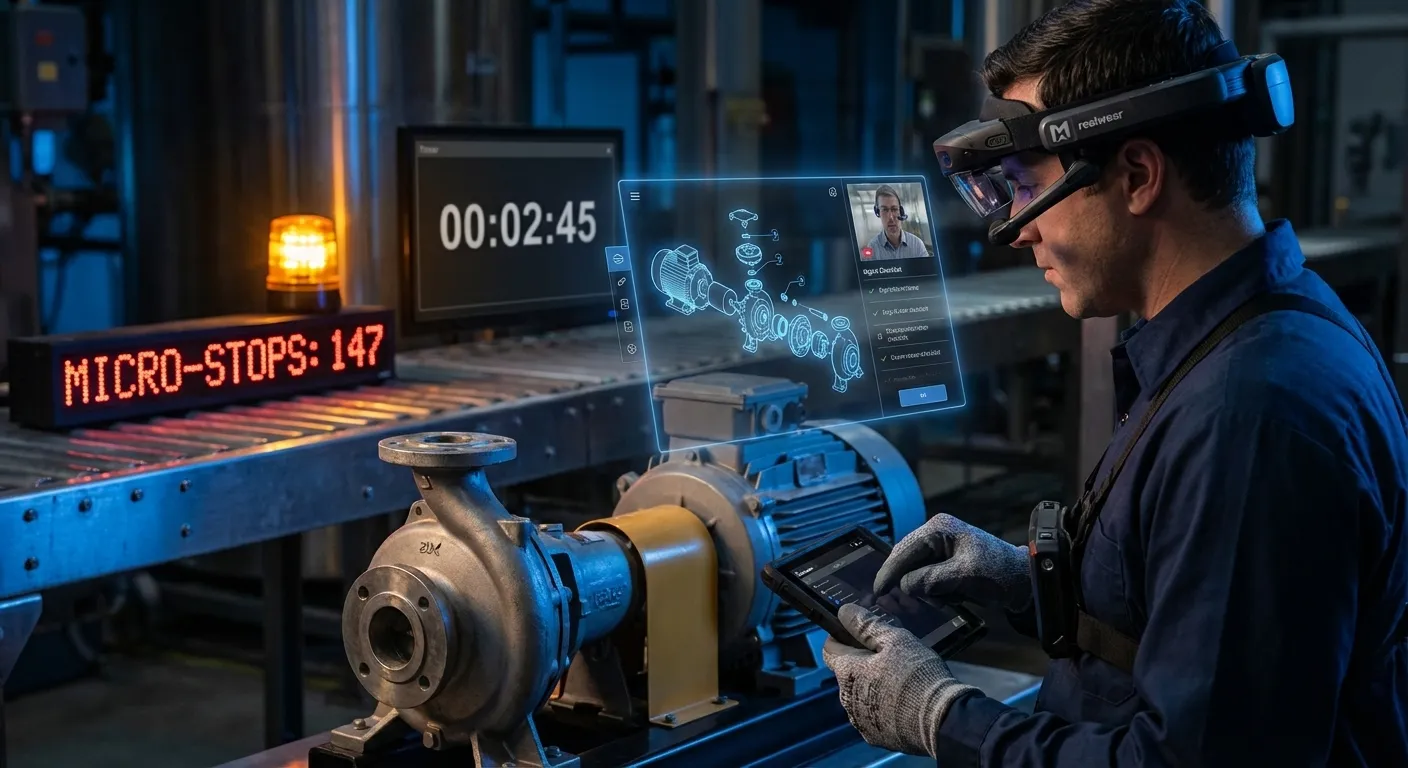
The Invisible Enemy of Productivity #
A 2-hour stop is impossible to ignore. Everyone notices it; it gets documented, investigated and presented at the production meeting.
But 240 stops of 30 seconds each... nobody sees them. And they add up to exactly the same thing: 2 hours lost.
That's the difference between availability (which everyone measures) and performance (which almost nobody measures well).
What Counts as a Micro-Stop? #
Any interruption of less than 5 minutes that typically is NOT logged in the system:
- Material jam at the infeed (30 sec)
- Clearing product at the discharge (45 sec)
- Sensor or parameter adjustment (1 min)
- Waiting for an empty pallet (1-2 min)
- Cleaning up a minor spill (2 min)
- Label roll change (2-3 min)
- Operator briefly away (1 min)
- Restart after a sensor jam (20 sec)
The problem: Each one seems insignificant. But when they happen 50, 80, 100 times per shift... the loss is brutal.
Locked file
oee-calculation-template.xlsx
Leave your work email to download this spreadsheet and hear about the next one.
The Real Impact in Numbers #
Reference values for manufacturing lines (indicative):
| Metric | Without monitoring | With real monitoring |
|---|---|---|
| Reported performance | 92% | 74% |
| Micro-stops detected | 5-10/shift | 60-120/shift |
| Time lost | "Not significant" | 45-90 min/shift |
If your shift is 8 hours long and you lose 90 minutes to micro-stops, that's 19% of your productive time evaporating without anyone seeing it.
How to Detect Micro-Stops #
Method 1: Automatic Monitoring (Recommended)
Sensors connected to the machine that detect every time it stops, even for 5 seconds.
- Sensor on the main motor shaft
- Timestamped part counter
- Digital signal from the PLC
A well-configured MES captures all of it automatically and generates Pareto reports of micro-stops.
Method 2: Manual Time Study
If you don't have sensors, you can run a manual study:
- Assign 1 person to watch the line for 2-4 hours
- With a stopwatch, log EVERY time the machine stops
- Record: time, duration, apparent cause
- At the end, add up the times and categorize the causes
Tip: Run the study without telling the operator. People who know they're being watched behave differently.
6 Strategies to Eliminate Micro-Stops #
1. TPM (Total Productive Maintenance)
Operators perform basic cleaning, lubrication and inspection at the start of every shift. Many micro-stops come from built-up dirt or lack of lubrication.
2. 5S at the Workstation
Everything in its place: adjustment tools, cleaning supplies, common spare parts. Less time searching = fewer micro-stops from waiting.
3. Poka-Yoke (Error-Proofing)
If a product always jams at the same point, why not redesign that guide? Eliminate the root cause, not just the symptom.
4. Focused Preventive Maintenance
Identify which components cause the most jams and schedule their replacement BEFORE they fail.
5. Operator Training
Many micro-stops happen because the operator doesn't know the optimal setting. Train on best practices.
6. Sensor and Parameter Tuning
Oversensitive sensors trigger false alarms. Set the thresholds correctly.
Illustrative Example: A Filling Line #
Situation: A filling line reported 88% performance
Diagnosis: Measuring with sensors revealed 95 micro-stops per shift. Real performance: 71%
Actions: Daily TPM, guide adjustments, training
Result: Micro-stops reduced to 22/shift. Real performance: 89%. +18 points recovered.
The "reported" performance had been a fantasy. Only by measuring reality could it be improved.
Topics
- micro stops
- minor stoppages
- micro stoppages manufacturing
- oee performance loss
- machine downtime tracking
- reduce micro stops

About the author
Víctor RuzCEO
Automation and Robotics Engineer (Universidad Andrés Bello, 2012). More than twelve years in robotics and industrial automation. Founder and CEO of iGromi, where he connects machines, systems and plant people with secure industrial AI.