Predictive MaintenanceFeb 1, 2026
Vibration Analysis for Predictive Maintenance: An Industrial Guide
A practical guide to catching bearing faults, misalignment and imbalance before they cause downtime. Overall monitoring per ISO 10816 compared with FFT spectral analysis.
Why Do Machines Vibrate? #
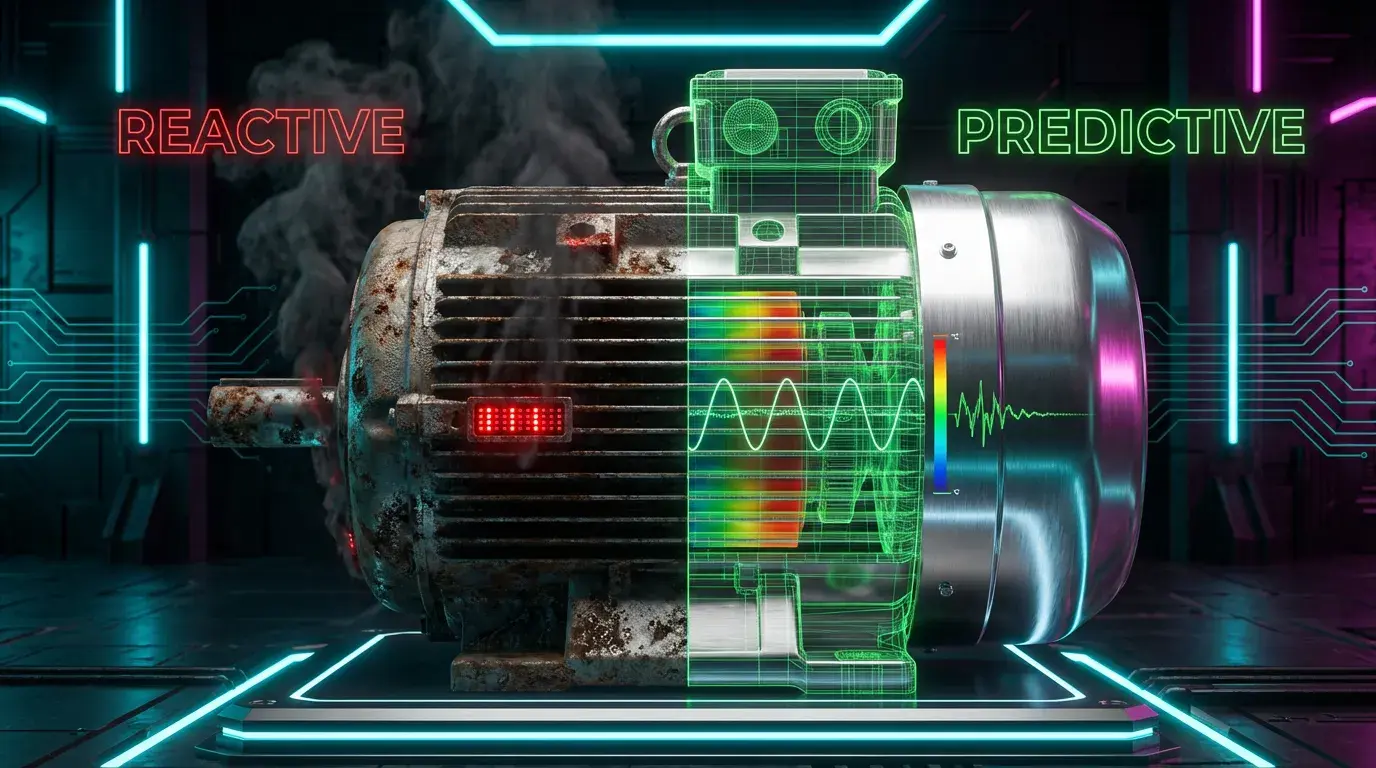
Every machine vibrates. But when that vibration changes, the machine is "talking" to you. The problem is that most plants run in run-to-failure mode or do blind preventive maintenance (swapping parts "just in case").
Vibration analysis is the cornerstone of predictive maintenance (PdM). It lets you detect:
- Shaft and pulley misalignment.
- Mass imbalance.
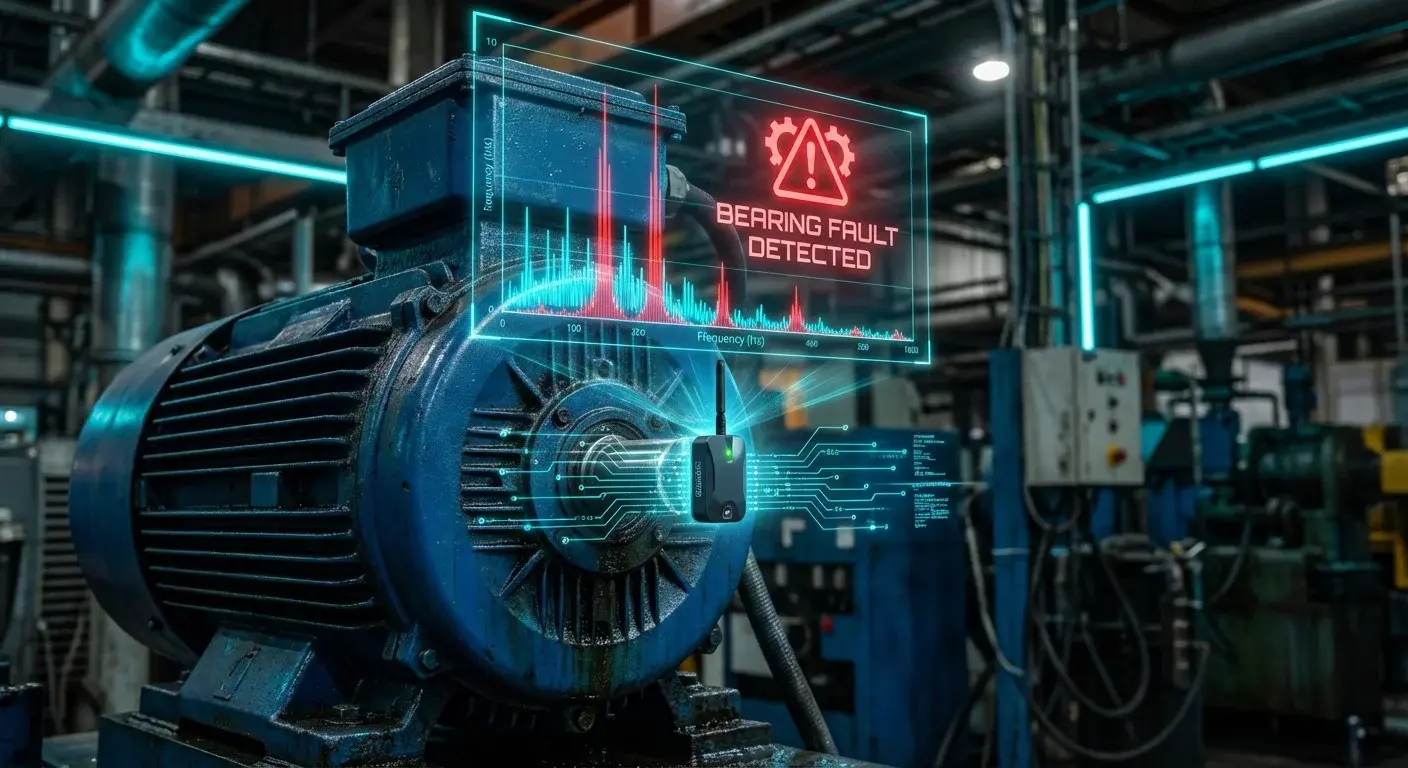
- Bearing faults (inner race, outer race, cage).
- Mechanical looseness (soft foot).
Level 1: Overall Monitoring (ISO 10816) #
This is the machine's "blood pressure check." You measure total vibration (RMS) in mm/s (velocity).
The ISO 10816 standard defines clear limits:
| Severity | Small motors | Large motors | Action |
|---|---|---|---|
| Good | < 1.1 mm/s | < 1.8 mm/s | Normal operation |
| Alert | 1.1 - 4.5 mm/s | 1.8 - 7.1 mm/s | Schedule maintenance |
| Danger | > 4.5 mm/s | > 7.1 mm/s | STOP IMMEDIATELY |
Level 2: Spectral Diagnosis (FFT) #
Knowing THAT something vibrates is not enough. You need to know WHY. This is where the Fast Fourier Transform (FFT) comes in: it breaks the complex waveform down into its component frequencies.
The Fault Signature:
- 1x RPM: the fundamental frequency. Usually points to imbalance.
- 2x RPM: usually points to misalignment.
- High frequencies (non-synchronous): point to a bearing fault (a ball rolling over a crack).
Sensors: MEMS or Piezoelectric? #
Ten years ago a vibration sensor was expensive (an industrial piezoelectric unit). Today, thanks to smartphones, there are MEMS (Micro-Electro-Mechanical Systems) sensors that cost a fraction of that.
Are they the same? No. MEMS sensors have a higher noise floor and lower bandwidth (up to 2-4 kHz). But for 90% of industrial pumps and fans, a MEMS sensor tracking ISO 10816 is infinitely better than "putting your hand on it" or "listening with a screwdriver."
Recommended strategy: install low-cost MEMS sensors (wireless, LoRaWAN) on all your auxiliary motors as a "traffic light" (green/yellow/red). Bring in a consultant with high-end piezoelectric equipment only when a MEMS sensor turns yellow.
Topics
- vibration analysis
- vibration analysis predictive maintenance
- iso 10816
- fft vibration analysis
- bearing fault detection
- mems vibration sensor

About the author
Sebastián CarrilloLead Hardware Engineer
Translates code into tightened screws. Leads on-site installations and designs iGromi's industrial gateways, solving problems where dust and vibration come into play.