StrategyDec 21, 2025
IT vs OT: How to Bring Two Worlds Together
IT wants security and patches. The plant wants the machine to never stop. How to align two opposing cultures with a hybrid team and a Purdue DMZ.
Two Tribes in a Permanent Cold War #
I've been in meetings where the CIO (Chief Information Officer) and the plant manager nearly came to blows. The tension is palpable. It's a deep culture clash that kills digital transformation projects before they start:
- IT (Information Technology): Prioritizes confidentiality (data). Its equipment lasts 3-5 years. It's used to "rebooting to update." Security updates every Tuesday. Daily backups. Standard remote access. Mandatory antivirus. ITIL, DevOps, Agile.
- OT (Operational Technology): Prioritizes availability (uptime) and physical safety. Its equipment lasts 20-30 years. "Reboot" is a dirty word that costs production every hour. Maintenance windows: once a year. Certified systems that CANNOT be modified. Determinism is non-negotiable. ISA-95, IEC 62443, real-time operating systems.
The Broken Bridge: When IT Tries to "Help" #
The typical conflict starts when corporate IT, with good intentions, tries to apply office policies on the operating floor:
Illustrative Disaster Scenario (Pharmaceutical Plant)
IT decides: "Let's apply the critical Windows security patch to the SCADA that controls the autoclave (sterilization). And we'll reboot the server at 3 AM Tuesday, like we always do with the office PCs."
Result:
- The SCADA runs on Windows Server 2012 (yes, obsolete, but the OEM only certifies it on that version).
- The patch changes network drivers. The PLC loses communication with the SCADA.
- The autoclave goes into fail-safe mode and shuts down in the middle of a sterilization cycle.
- The entire batch of medication is lost because sterility can't be confirmed.
- The plant is down for 18 hours while the OEM technician (based in Germany) connects remotely and rolls back the change.
Total loss: an entire batch and 18 hours of downtime. The CIO and the plant manager don't speak for 6 months.
The 3 Root Causes of the Conflict #
1. Incompatible Life Cycles
IT replaces servers every 3-5 years (the warranty expires, the hardware becomes "legacy"). OT has PLCs from 1995 running 24/7 without issues. Why? Because they work. Replacing them means re-certification, re-validation and days of downtime. IT's idea of "upgrade just because" is anathema to OT.
2. Opposite Risk Tolerance
IT: "This system has a critical CVE vulnerability. We need to patch NOW."
OT: "This system runs production all day. If you patch it and it fails, I get fired. DON'T touch it without 6 months of testing in a QA environment first."
3. Different Technical Language
IT talks about IP, VLANs, firewalls, OAuth, TLS.
OT talks about OPC-UA, Modbus RTU, ladder logic, cycle time (ms), jitter.
When IT says "let's segment the network with VLANs," OT thinks "I have no idea what you're talking about, but if my PLC stops talking to the SCADA, you're dead."
The Peace Strategy: IT/OT Convergence #
1. Build a Hybrid Team (a "Purple Team")
You can't put only IT people in charge of OT, or vice versa. You need a bicultural team:
- OT engineers upskilled in IP networking: the electrician who understands PLCs now learns subnetting, firewalls and VPNs.
- IT engineers trained in control systems: the sysadmin learns what a PLC is, what "determinism" means, and why you can't "reboot a robot in the middle of a weld."
Key certifications: GICSP (Global Industrial Cyber Security Professional), ISA/IEC 62443.
2. DMZ Architecture (Demilitarized Zone)
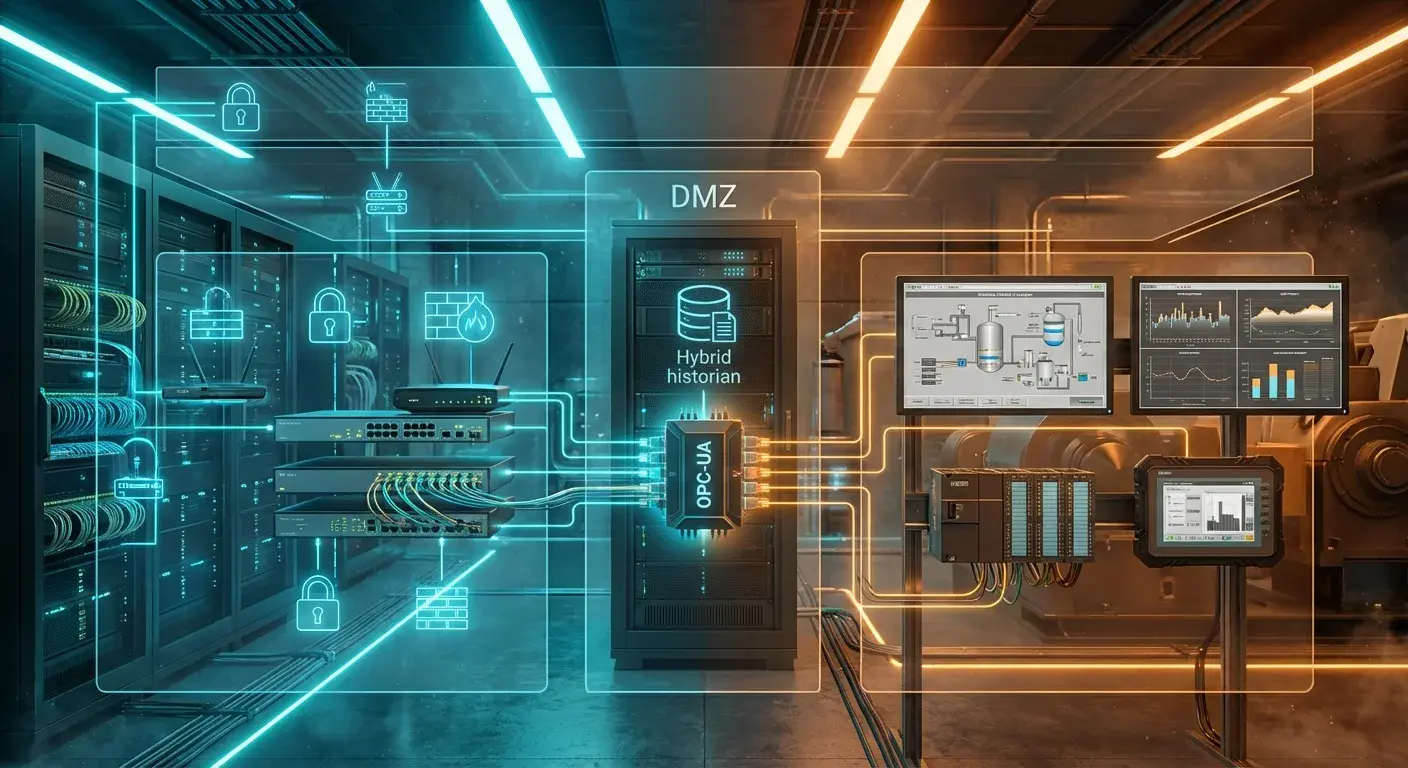
IT should not touch the PLCs directly. The right architecture is the Purdue model (ISA-95):
Simplified Purdue Levels
- Levels 0-2 (OT zone): PLCs, SCADA, HMIs. Isolated network. No internet. OT protocols only (Modbus, Profinet, EtherNet/IP).
- Levels 3-3.5 (DMZ): This is where the MES, the historian (e.g., OSIsoft PI) and the OPC-UA gateway live. This is the "safe bridge." IT can read data FROM here but CANNOT write downward (to the PLCs).
- Levels 4-5 (IT zone): ERP, BI, cloud. Here IT can do whatever it wants: patches, updates, reboots whenever it likes. It doesn't affect production.
The historian (DMZ) replicates SCADA data in real time. IT queries the historian, NOT the SCADA directly. If IT breaks something in the historian, production keeps running.
Conclusion: Convergence Is Inevitable #
Industry 4.0 FORCES IT and OT to work together. Production data has to reach ERP/BI (IT's domain). OT systems need modern cybersecurity (IT expertise). Nobody can do it alone.
Companies that build a hybrid IT/OT culture will have massive competitive advantages. Those that keep their internal Berlin Wall will stay stuck in the pre-digital era.
The future isn't IT vs. OT. It's IT + OT = digital operational excellence.
Topics
- it ot convergence
- it vs ot
- purdue model dmz
- ot cybersecurity
- iec 62443
- industrial dmz

About the author
Víctor RuzCEO
Automation and Robotics Engineer (Universidad Andrés Bello, 2012). More than twelve years in robotics and industrial automation. Founder and CEO of iGromi, where he connects machines, systems and plant people with secure industrial AI.