Industry 4.0 ArchitectureJan 28, 2026
Local-First Architecture: Why the Cloud Fails on the Plant Floor
Your plant should not stop when the internet goes down. Learn how to design resilient systems where the cloud is an optional benefit, not a critical dependency.
The Mistake in Classic "Digital Transformation" #
Most IIoT projects fail because of one naive assumption: "The internet will always be available."
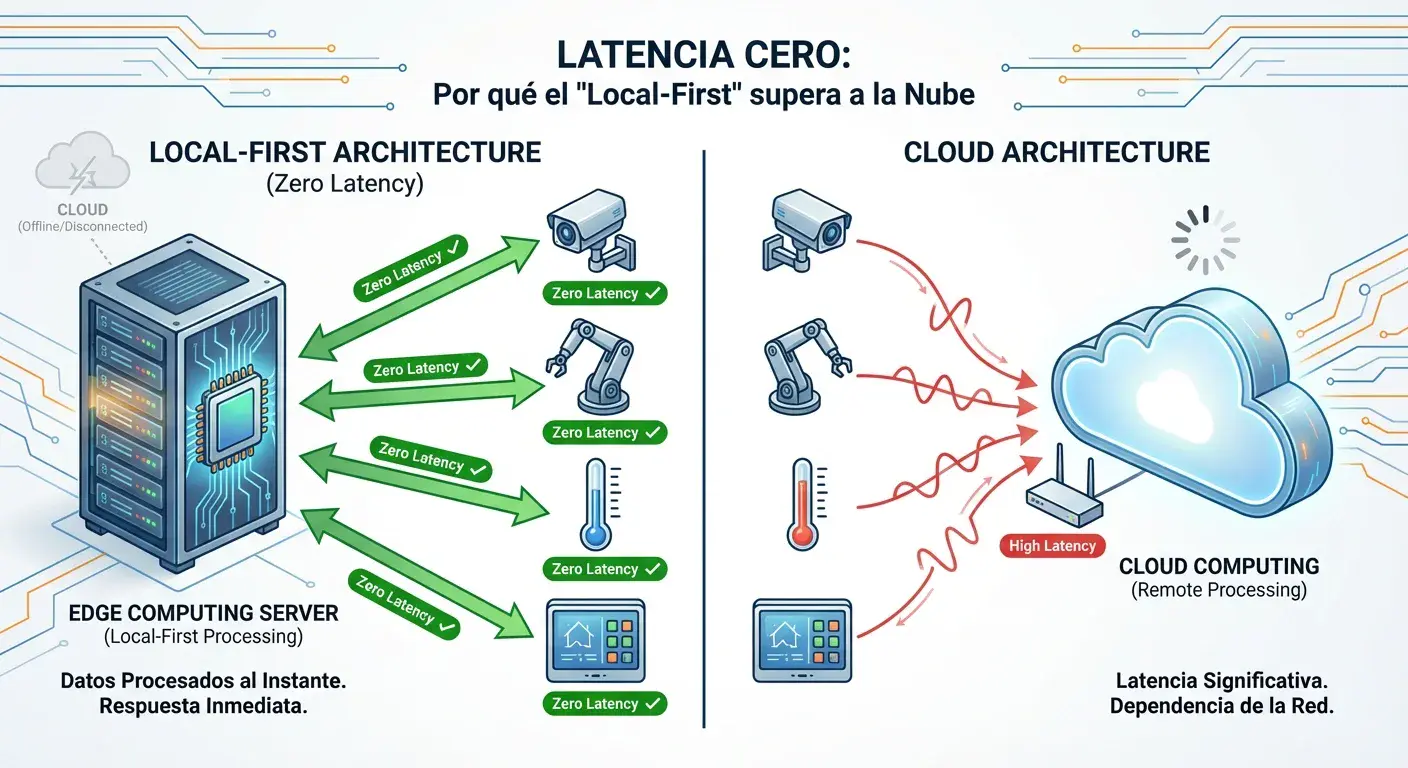
They design systems where the sensor sends data to AWS or Azure, the logic runs in a Lambda function, and the response travels back to the actuator. The result? 500 ms of latency (unacceptable for control) and a stopped plant whenever the internet service provider (ISP) has an outage.
🚨 iGromi's Golden Rule:
"If you cut the plant's fiber-optic cable, production MUST NOT STOP. Not the local dashboards, not the control, not the data historian."
What Is Industrial Local-First? #
It is an architecture where data processing, business logic and primary storage happen at the edge, inside the factory LAN.
- Real-time control: in the PLC (<10ms).
- Supervision and OEE: on the local edge server (<100ms).
- Heavy analytics / backup: in the cloud (asynchronous).
The 3 Pillars of Local-First #
1. Data Sovereignty
Your production data is an industrial trade secret. In a local-first architecture you physically own the database (InfluxDB/SQL on your own server). You are not "renting" your own data back from a SaaS vendor that charges you to access it.
2. Zero Latency
When the operator presses "Emergency Stop" on the HMI screen, the signal cannot travel to Virginia (USA) and back. Edge computing delivers an immediate response.
3. Egress Costs
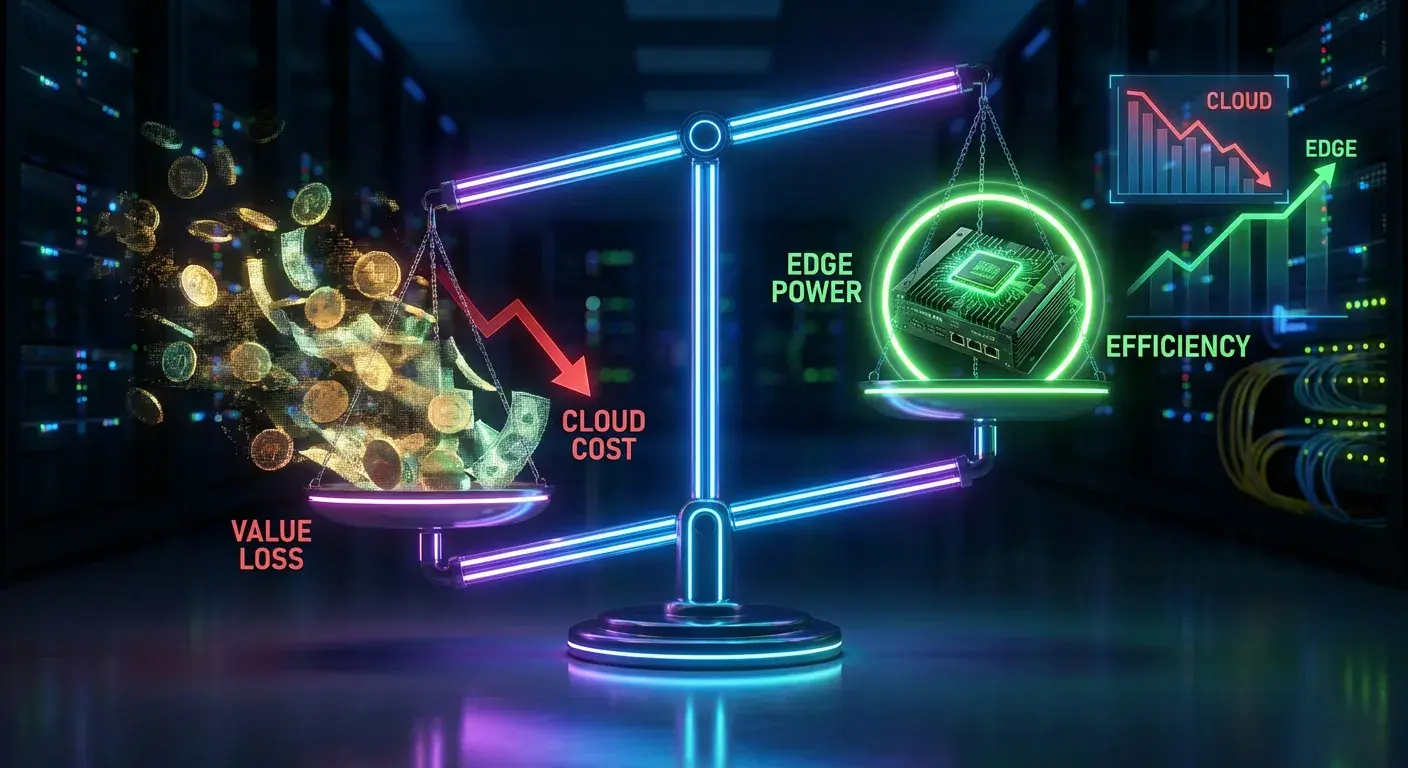
Uploading 1 TB of data to the cloud is free. Downloading that TB to analyze it costs a fortune. By processing at the edge you only upload the "insights" (e.g., "Machine stopped due to motor fault"), cutting your cloud bill by 90%.
Comparison: Cloud-Native vs Local-First #
| Scenario | Cloud-Native (pure SaaS) | Local-First (Edge) |
|---|---|---|
| Internet outage | Black screens. Data lost. | Normal operation. Syncs when back online. |
| Latency | Variable (200ms - 2s) | Deterministic (<10ms LAN) |
| Monthly cost | High (subscription + traffic) | Low (hardware you own) |
Implementing Local-First with iGromi OS #
We use Docker containers to deploy the entire stack on an industrial mini PC:
- MQTT broker (Mosquitto): the central nervous system.
- Node-RED: the logic layer.
- InfluxDB: short-term storage.
- Grafana: the visual interface.
All of this runs on-premise. If you want the cloud, we simply add an MQTT "bridge" that replicates the data to AWS IoT Core, but the plant never depends on it.
Topics
- local-first architecture
- industrial edge computing
- local first manufacturing
- resilient industrial architecture
- on-premise iiot
- data sovereignty

About the author
Francisco CisternasSenior Full-Stack Lead
Works on both the Edge and the cloud. Builds iGromi's infrastructure, from firmware on the controller to the dashboards the plant uses.