TechnologyNov 30, 2025
SCADA vs IIoT: Complementary or Rivals?
We break down the key differences between traditional SCADA systems and a modern industrial IoT platform. Is it time to replace your SCADA?
The Debate That Confuses Everyone: Replacement or Evolution? #
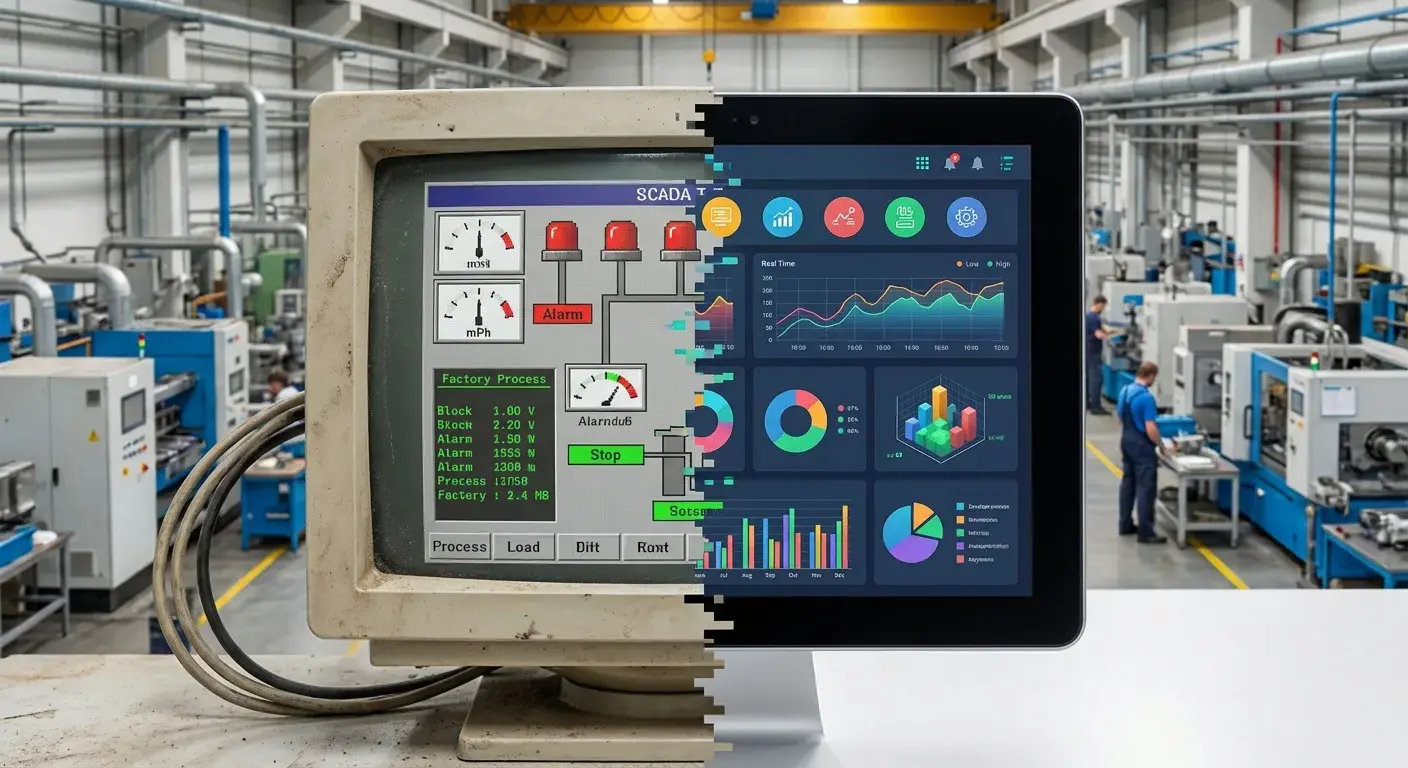
If you're starting from scratch, first read what SCADA is and what it's made of. Every month, an IIoT platform vendor knocks on your plant's door with the same pitch: "SCADA is dead. You need to migrate to IIoT now." Then, over coffee, your automation team tells you: "That SCADA has been running flawlessly for 15 years. Why change it?"
They're both right. And they're both wrong.
The uncomfortable truth is that SCADA and IIoT aren't direct rivals. They're tools for different problems that, in most cases, should coexist, not compete. This article ends the confusion.
What Is SCADA? (A Refresher) #
SCADA = Supervisory Control And Data Acquisition. It's the software that controls and monitors industrial processes in real time from a control room. Picture the screens in a chemical plant's control room, where the operator sees temperatures, pressures and valves and can open or close equipment with a click.
Core Characteristics:
- Closed architecture: A central server (usually Windows Server) with HMI clients (operator screens).
- Industrial connectivity: Speaks Modbus, OPC-UA, Profinet and EtherNet/IP natively.
- TIME-SERIES database: A historian (PI System, Wonderware, iFIX) that stores millions of signals per second.
- Deterministic by design: Predictable scan cycles (10ms, 100ms). No unexpected "lag."
- Mission-critical redundancy: Redundant servers (hot standby). If the primary fails, the secondary takes over in <1 second.
SCADA Examples:
Wonderware (now AVEVA), Siemens WinCC, Rockwell FactoryTalk, GE iFIX, Ignition by Inductive Automation, Schneider Electric Citect.
Example: Chemical Plant (Brazilian Petrochemical)
SCADA: Wonderware InTouch controlling 2,400 I/O tags from 18 PLCs (Rockwell ControLogix).
Role: The operator monitors 4 reactors in real time. If reactor A's temperature rises above 185°C, SCADA automatically commands the PLC to open the cooling valve. Required response time: <250ms.
Why NOT use IIoT for this? Because 250ms is too fast for the cloud. Network lag + cloud processing = 800ms-2 seconds. UNACCEPTABLE for chemical process control.
What Is IIoT? (Industrial Internet of Things) #
IIoT is the network of internet-connected industrial sensors that collect operational data to improve efficiency, predict failures and optimize processes outside the control loop.
Core Characteristics:
- Distributed architecture: Edge gateways + a cloud backend (AWS, Azure, Google Cloud).
- Flexible connectivity: WiFi, 4G/5G, LoRaWAN, NB-IoT, Ethernet.
- IT protocols: MQTT, HTTP/REST, WebSockets. OT protocols (Modbus, Profibus) are converted at the edge.
- Big Data + ML: Stores BILLIONS of events in data lakes. Runs ML models to predict failures.
- Massive scalability: Add 1,000 new sensors in 1 day (without reconfiguring a central server).
IIoT Platform Examples:
AWS IoT Core, Azure IoT Hub, Google Cloud IoT, ThingWorx (PTC), MindSphere (Siemens), Predix (GE, now discontinued), iGromi OS (edge-first, no cloud vendor lock-in).
Illustrative example: a copper mine
IIoT: 850 wireless vibration sensors (LoRaWAN) on crushers and SAG mills.
Role: Continuous bearing health monitoring. An ML algorithm predicts failure 2-4 weeks ahead. Maintenance swaps the bearing during a planned shutdown (not an emergency).
Why NOT use SCADA for this? Because SCADA doesn't do ML. And adding 850 wireless signals to the historian would be extremely expensive (per-tag licensing). IIoT is cheaper and more flexible for this use case.
Result: MTBF +34%. Unplanned downtime: -68%.
The Market Confusion: When to Use Which #
The problem is that vendors on both sides sell their tool as "THE solution." It isn't. Here's the real decision matrix:
| Use Case | SCADA | IIoT |
|---|---|---|
| Real-time control (<1s) | ✓ Yes | ✗ No |
| Condition monitoring (5min+) | △ Yes (expensive) | ✓ Ideal |
| Predictive maintenance | ✗ No ML | ✓ Perfect |
| Operator HMI | ✓ Specialized | △ Web dashboards |
| Remote wireless sensors | ✗ Complex | ✓ Built for it |
| ERP/MES integration | △ OPC-UA | ✓ REST APIs |
| Mission-critical redundancy | ✓ Hot Standby | △ Depends |
| Cost per tag (1000+ tags) | High ($$$) | Low ($) |
The Smart Hybrid Architecture (Purdue Model) #
The right answer is NOT to pick one or the other. It's to use both at the right layers of the Purdue model (ISA-95):
Levels 0-2: SCADA's Domain
- Level 0: Sensors and actuators (field).
- Level 1: PLCs, RTUs (local control).
- Level 2: SCADA/HMI (plant supervision).
Role: Real-time control. A human operator supervises the process. Response <1 second.
Level 3: The SCADA-IIoT Bridge
- MES (Manufacturing Execution System): Connects SCADA to the ERP.
- IIoT Edge Gateway: Pulls data from the SCADA historian via OPC-UA and sends it to the cloud.
Role: Historical data aggregation. Big Data analytics.
Levels 4-5: IIoT's Domain
- Level 4: ERP (SAP, Oracle), advanced analytics (ML, BI).
- Level 5: Corporate systems, C-level dashboards.
Role: Strategic planning. Multi-site optimization. Predictive ML.
When SHOULD You Replace SCADA with IIoT? #
There are exceptions where pure IIoT can work:
1. New Plants with Non-Critical Processes
If you're building a plant from scratch and your process tolerates latencies above 1 second (for example: packaging, internal logistics), you can run IIoT alone with edge computing.
Example: Amazon Fulfillment Centers run pure IIoT (no SCADA). AGV robots coordinate over WiFi + a cloud backend.
2. Migrating a 100% Obsolete Legacy SCADA
If your SCADA dates from the '90s (Win NT 4.0, no vendor support, lost licenses) and the upgrade cost is very high, then yes, consider replacing it with a modern IIoT platform + embedded edge SCADA.
Hybrid alternative: Ignition by Inductive Automation (a modern SCADA with an IIoT philosophy: unlimited tag licensing, web architecture, low cost).
3. "Soft Real-Time" Industries
Precision agriculture, smart buildings, retail analytics, fleet management. There's no chemical process control here. Pure IIoT works.
The Trend: SCADA Becomes "IIoT-Aware" #
Traditional SCADA vendors have already gotten the message. New versions include IIoT features:
- Ignition: Web architecture (HTML5), native MQTT connectors, flat licensing (not per tag).
- Siemens WinCC Unified: Native web client, integration with MindSphere IIoT.
- AVEVA Edge: Embedded SCADA that runs on a Raspberry Pi, synced with AVEVA Connect (cloud).
The future is convergence: SCADA for critical control + IIoT for everything else.
Costs: The Financial Reality #
Traditional SCADA (Wonderware, WinCC):
- Licenses: per-tag fees, which become the largest line item once you have thousands of tags.
- Server hardware: redundant servers.
- Historian: an additional license.
- Integration: specialist consultants.
- TOTAL for a typical project: a high up-front investment, dominated by licenses.
IIoT Platform (Azure IoT + Edge):
- Edge Gateway: one unit for every 100-500 sensors.
- Cloud ingestion: billed per million messages.
- Storage: billed per GB per month, cheaper in cold storage.
- Compute (ML): Variable (pay-as-you-go).
- TOTAL for a typical project (5000 sensors): a smaller setup cost and a monthly operating cost that grows with your data.
Financial bottom line: IIoT is ~10X cheaper for condition monitoring. SCADA is necessary (and justifies its cost) only where real-time control is critical.
Conclusion: It's Not a War, It's an Orchestra #
SCADA and IIoT are different instruments in the same industrial symphony:
- SCADA: The conductor. Precise control, real time, mission-critical.
- IIoT: The string section. Many musicians (sensors) creating the background melody (analytics, ML, trends).
The right question is NOT "SCADA or IIoT?"
The right question is: "What problem am I solving?"
- Real-time control → SCADA
- Monitoring and optimization → IIoT
- A complete modern plant → Both, properly integrated.
Anyone who sells you only one of the two is either lying to you or doesn't understand the problem.
Topics
- scada vs iiot
- scada vs iot
- industrial iot platform
- iiot solutions
- scada system
- purdue model
- industrial automation

About the author
Víctor RuzCEO
Automation and Robotics Engineer (Universidad Andrés Bello, 2012). More than twelve years in robotics and industrial automation. Founder and CEO of iGromi, where he connects machines, systems and plant people with secure industrial AI.