Industrial ConnectivitySep 7, 2026
What Is a SCADA System? Components, Architecture and AI
What a SCADA system is, what it is made of (PLC, RTU, HMI, historian), how it differs from a DCS, an MES and an IIoT platform, and when to modernize it without replacing the control layer.
What SCADA is #
SCADA stands for Supervisory Control and Data Acquisition. It is the system that lets an operator see what is happening in a distributed industrial process and act on it from a control room, without standing in front of each machine. It was born in the 1960s for power grids, pipelines and water plants, where equipment is kilometers apart, and today it is in almost every plant with more than a handful of PLCs.
It is worth establishing from the start what SCADA is not: it is not the system that controls the machine. Real-time control is executed by the PLC or the DCS. SCADA supervises, displays, raises alarms, records and lets the operator send setpoints. That distinction explains almost every architecture decision that follows.
What it is for #
- Supervise: show on overview screens the status of valves, motors, levels, temperatures and pressures across the whole process.
- Control at the supervisory level: the operator changes a setpoint, starts a pump or opens a valve, and SCADA sends the command to the PLC that executes it.
- Alarm: detect that a variable has gone out of range and notify with priority, logging and acknowledgment.
- Historize: store time series of the variables for analysis, reports, audits and regulatory reporting.
Components of a SCADA system #
| Component | Function | Examples |
|---|---|---|
| Field instrumentation | Measures and acts on the process | 4-20 mA transmitters, encoders, valves, drives |
| PLC / RTU | Runs the control logic and concentrates signals | Siemens S7, Allen-Bradley CompactLogix, RTUs at remote stations |
| Communications network | Carries data between the field and supervision | Industrial Ethernet, Profinet, EtherNet/IP, radio, fiber, cellular |
| SCADA server | Acquires data, processes alarms, serves the clients | Ignition, WinCC, FactoryTalk View, Citect, Wonderware |
| HMI / clients | Interface with the operator | Control room screens, local panels, web clients |
| Historian | Time-series database | PI System, Canary, InfluxDB, TimescaleDB |
Where it lives in the architecture: ISA-95 and Purdue #
The ISA-95 pyramid arranges a plant's systems into levels. Level 0 is the physical process and the sensors; level 1, control with PLCs; level 2 is SCADA and HMIs; level 3, the MES that coordinates production; level 4, the ERP. The Purdue model takes that same hierarchy and uses it to segment the network: nothing at level 4 or on the internet should be able to touch levels 0 to 2 directly. In the wiki we document the firewall rules per Purdue level that we apply when deploying.
That position at level 2 explains why SCADA is a system you protect more than you connect: every integration upward is a door that has to be watched.
SCADA, DCS, PLC and HMI: what each one is #
- PLC: the controller. It runs the logic in milliseconds. One SCADA supervises many PLCs.
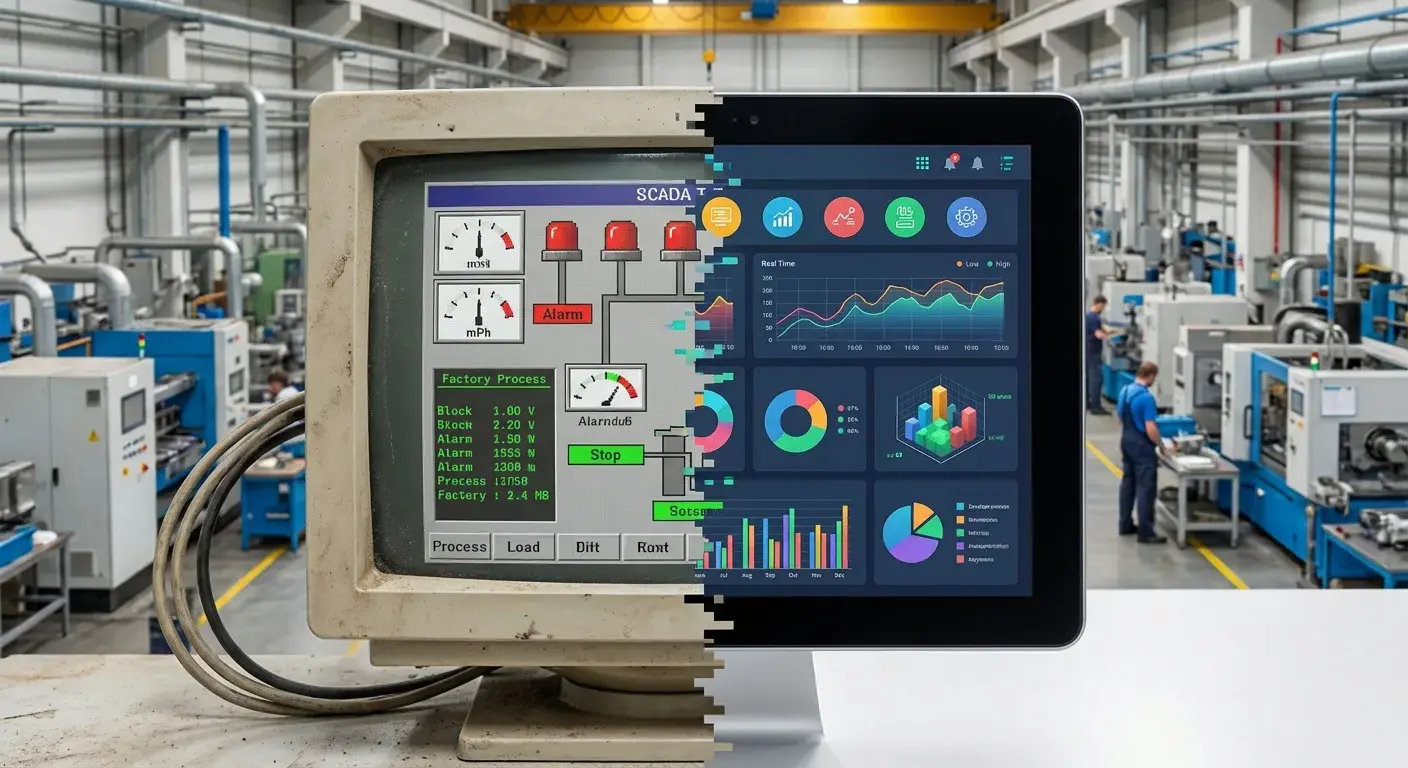
- HMI: the local screen in front of a machine. A SCADA is, in a sense, many HMIs centralized with history and alarms.
- DCS: distributed control system. It integrates control and supervision in a single closed platform, typical of continuous processes such as refineries, pulp mills or power generation. A SCADA is built from components by different manufacturers; a DCS comes integrated.
SCADA vs. MES and IIoT platforms #
This is where the most expensive confusion lies. SCADA answers the question what is happening in the process right now. MES answers what are we producing, with which lot, at what efficiency and against which order. One looks at variables in seconds; the other looks at shifts, orders and OEE. We develop the full comparison in MES vs SCADA.
IIoT platforms add a third layer: acquisition from any source, history in the cloud or at the edge, analytics and models. They do not replace SCADA for control, but they can take over the data and history side when SCADA falls short. In SCADA vs IIoT we explain when they complement each other and when they compete.
Protocols a SCADA speaks #
Acquisition is done with industrial protocols. The ones that show up most in Chile: Modbus TCP and RTU, the simplest and most widespread; OPC UA, the modern standard with security and an information model; S7 for Siemens and EtherNet/IP for Rockwell; DNP3 and IEC 61850 in water and energy; and MQTT as a bridge to data platforms. We compare the two most relevant in OPC UA vs Modbus and in MQTT Sparkplug B vs OPC UA. The full list of protocols supported by iGromi OS is in the wiki.
Security: the real risk of a connected SCADA #
Most SCADA systems in operation were designed when the plant network was isolated. When connected to the ERP, the cloud or remote access, they inherit an attack surface nobody planned for: protocols without authentication, unpatched operating systems, default passwords. The minimum rules are to segment by Purdue levels, allow only outbound traffic from the OT zone and never expose an inbound port from the internet to the control layer. The guide to defending against industrial ransomware turns this into a concrete plan.
Modernizing a SCADA without replacing the control layer #
A fifteen-year-old SCADA usually has three problems: per-tag licenses that make every expansion more expensive, history that cannot be queried from outside, and zero integration with quality, energy or maintenance data. Replacing it entirely is a multi-year project. What works is modernizing in layers:
- Keep the PLCs and control logic intact. Nothing that follows touches control.
- Read the same variables in parallel via OPC UA or Modbus with an edge gateway, without modifying the PLC program.
- Publish those variables in a Unified Namespace (UNS) over MQTT so that MES, maintenance and analytics consume a single source. We explain it in the Unified Namespace guide.
- Deploy modern supervision in containers, as we show in modern SCADA with Docker, or integrate with an open platform such as Ignition; in iGromi vs Ignition we explain why we prefer to integrate with it rather than compete.
In every case the same principle we apply in iGromi OS holds: models and agents read, add context and propose; the command to the machine is issued by the control system and decided by a person.
How to add AI to a SCADA without changing it #
SCADA already has what an AI needs: timestamped process variables, alarms and history. What it lacks is someone to cross-reference that data with production, maintenance and energy data and answer questions such as why did this line stop three times on Tuesday or which motor is consuming more than last month.
- Read, don't write. The AI reads the variables via OPC UA or Modbus in parallel with SCADA. It does not write setpoints or touch the PLC program.
- Process in the plant. The model runs on a unit inside the plant, so process data does not go out to an external service. The details are in the guide to local AI with PLC and SCADA data.
- Answer with a source. Every answer states which tag and which period the data comes from, so the supervisor can verify it.
Those three points are the basis of what we call safe industrial AI. For the full picture, see the guide to industrial artificial intelligence.
Frequently asked questions #
What is a SCADA system?
SCADA (Supervisory Control and Data Acquisition) is a system that supervises and controls industrial processes remotely: it collects data from PLCs, RTUs and sensors, displays it on HMI screens, generates alarms and stores history. It operates at level 2 of the ISA-95 pyramid.
What is the difference between SCADA and a PLC?
The PLC runs the control logic directly on the machine in milliseconds. SCADA does not control the machine: it supervises the PLCs, presents the information to the operator and lets the operator send setpoints. Without a PLC there is no control; without SCADA there is no centralized visibility.
What is the difference between SCADA and MES?
SCADA supervises process variables in seconds (temperature, pressure, motor status). MES coordinates production execution by shifts and orders: what is being made, with which lot, with what result and what OEE. They are different layers that should share data, not replace each other.
Can SCADA be replaced by an IIoT platform?
Not for control. An IIoT platform can take over data acquisition, history and analytics, but command of the process stays with the PLC and SCADA. The usual approach is to integrate them via OPC UA or MQTT so the platform reads without interfering.
Topics
- what is scada
- scada system
- scada components
- scada architecture
- scada vs plc
- scada vs mes
- scada vs dcs
- scada modernization
- scada ai

About the author
Bárbara RuzCTO
iGromi's CTO. Leads the architecture of iGromi OS and the platform's technical direction, turning messy industrial processes into elegant data flows.