Artificial IntelligenceNov 24, 2026
What Is an AI Agent? Explained With a Plant
An AI agent is a program that receives a goal, decides the steps, uses tools and checks the result. What sets it apart from a chatbot, four plant examples, what it can do alone and what a person must approve, and what a plant needs before installing one.

Locked file
preparacion-agentes-ia-planta-en.xlsx (9 KB)
Leave your email to download this free spreadsheet and hear about the next one.
An AI agent is a program that receives a goal, decides on its own which steps to take to reach it, uses tools and checks the result before moving on. In a plant, that means it can read the shift records, cross-check them against maintenance orders and leave a report ready. It does not mean it runs the machine: it reads and proposes, and a person decides.
What is an AI agent? #
It is a language model with four things added so that it can work and not just talk. The five parts are:
- Model. The part that understands the instruction and reasons out the next step.
- Tools. What it can use: query a database, read a file, create an order, send an alert.
- Memory. What it knows about the operation and what it has already done: procedures, history, earlier results.
- Permissions. What it can read, what it can propose and what it can execute.
- Control loop. The loop that moves it forward: it acts, looks at what it got, and decides whether to continue, correct or stop.
Without tools it is a chat. Without permissions or a control loop it is a risk.
How is it different from a chatbot and from classic automation? #
A chatbot answers a question, automation repeats a rule and an agent pursues a goal over several steps. The difference shows when something nobody programmed comes up:
| Classic automation | Chatbot | Agent | |
|---|---|---|---|
| What it receives | A signal or a schedule | A question | A goal |
| How it decides | Fixed rules | Answers and waits for the next question | Chooses steps based on what it finds |
| Faced with the unexpected | Stops or fails | Answers, but does not act | Investigates and proposes |
| Where it fits | Repetitive, critical work: the PLC | One-off queries | Multi-step tasks with scattered information |
An agent does not replace the PLC or the SCADA. Machine control needs fixed, predictable rules; the agent is for what a person does today by pulling data from four systems. The full comparison is in autonomous AI agents in industry.
What are some examples of AI agents in a plant? #
The ones that work are bounded, multi-step tasks with a result that someone reviews. Four illustrative examples:
Writing the shift report
The agent gathers output per line, stops with their duration and the notes logged, and leaves the report drafted at the end of the shift. The supervisor corrects and signs it instead of writing it from scratch.
Reviewing temperature records and flagging deviations
It goes through the cold room readings, finds the ones that left the defined range, checks whether a door opening or a defrost explains them and alerts the person responsible with the evidence. It does not decide what to do with the product: quality does.
Preparing the maintenance order
When an alarm repeats, it identifies the equipment, retrieves its history and the applicable procedure, checks whether the spare part is in stock and leaves the order written with a suggested priority. The maintenance manager approves, changes or discards it.
Reconciling a camera-based production count
Counting with a camera is not an agent's job but a vision model's. The agent comes in afterwards: it compares what was counted with what was recorded in the system, and when the gap exceeds a threshold, it finds the part of the shift where it opened up and reports it.
More cases, by area, in agentic AI in manufacturing.
What can it do alone and what must a person approve? #
It can read, summarize and propose without asking; anything that changes something in the operation is approved by a person. Autonomy is a scale, and it is best climbed one step at a time:
| Level | What the agent does | Who decides |
|---|---|---|
| 0 | Nothing yet: reliable data or documents are missing | — |
| 1 | Answers citing the source. Does not act | The person asking |
| 2 | Prepares the action: the order, the report, the alert | A person approves before it goes out |
| 3 | Executes low-risk tasks outside process control | A person defined which ones beforehand, and reviews them |
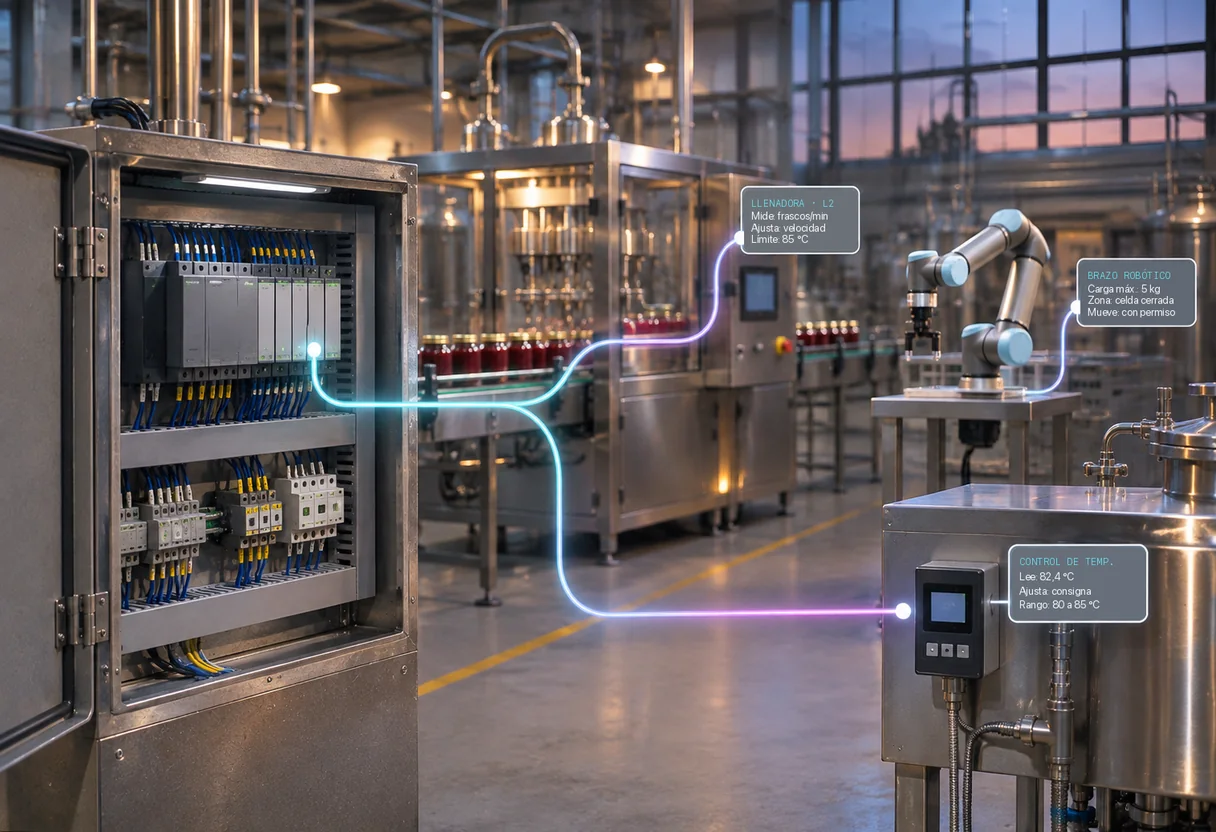
| Never | Writing to the PLC or changing setpoints on its own | Control stays with the PLC and authorized people |
Most plants are between level 0 and level 1, and level 1 already saves hours every week.
What does a plant need before installing an agent? #
Five things, and almost none of them is new technology:
- Data. Line signals arrive somewhere they can be queried, with their timestamp and their equipment. An agent built on hand-filled spreadsheets inherits their errors.
- Written knowledge. Procedures, manuals and failure history in current documents. What only one person knows, the agent does not know.
- Access. An account of its own for the agent, read-only at first, and the list of systems it may query.
- Limits. In writing: what it can propose, what it can execute and what it never touches.
- People. Someone who approves, someone who reviews what the agent did and someone who answers when it gets it wrong.
The spreadsheet in this article walks through those five areas with fifteen questions and gives you the level of autonomy that is prudent today and the area that limits you most. The other spreadsheets are in downloads.
What are the most common mistakes? #
Almost all of them come from starting with autonomy instead of data:
- Starting from the agent, not the task. "We want an agent" is not a goal; "the shift report ready at 7:00" is.
- Giving it write access on day one. First measure how many of its proposals are approved unchanged.
- Not measuring it. Without comparing against what the person used to do, nobody knows whether it helps.
- Believing it does not make mistakes. A language model can give a false answer with complete confidence. That is why it is required to cite its source.
- Leaving it without an owner. An agent nobody reviews degrades when procedures change.
How do you create an AI agent? #
You pick a task, connect a model to the tools that task needs, write its instructions and limits, and test it against real cases before letting it work. Today there are platforms and libraries that solve the programming part in days.
What takes months is the rest: getting the data connected and reliable, getting the knowledge written and current, and having someone define which answer is correct. An agent that works in a demo with three files is not an agent that works in a plant with ten years of history. If the tool you plan to use runs on a plant computer, first read what an agent sees inside a machine.
How does iGromi do it? #
At iGromi, Agents work on the engine, which holds the plant's context and memory. The engine proposes and a person approves; the model receives the question with what is needed to answer it, and one customer's data does not train another's. How it is built is in the iGromi engine.
If you want to review which task in your plant suits a first agent, let's talk.
Frequently asked questions #
Is an AI agent the same as ChatGPT?
No. ChatGPT, used as a chat, answers what it is asked with what is pasted into it. An agent uses a model like that one, but it also has tools, memory, permissions and a loop that lets it carry out a multi-step task.
Can an AI agent control a machine?
It should not. In a plant, the agent reads and proposes; the decision belongs to a person and execution on the machine stays in the control system. Language models make mistakes, and a mistake on a machine has physical consequences.
Do I need programmers to have an agent?
To build it, less and less. To connect it to plant data, define its permissions and maintain it, you do need someone technical, in-house or from a vendor.
How long does it take to put a first agent in a plant?
It depends on where the data is. If signals and documents are already in order, a read-only agent for a bounded task can be tested in weeks. If they are not, getting them in order is the project, and it is the one that pays off most.
What is the difference between an AI agent and agentic AI?
None in substance. "Agent" names the program; "agentic AI" names the way of working: pursuing a goal over several steps, using tools, with bounded autonomy.
Topics
what is an ai agent · ai agents · ai agent examples · how to create an ai agent · ai agents in manufacturing · ai agent vs chatbot · levels of autonomy

About the author
Víctor RuzCEO
Automation and Robotics Engineer (Universidad Andrés Bello, 2012). More than twelve years in robotics and industrial automation. Founder and CEO of iGromi, where he connects machines, systems and plant people with secure industrial AI.