IIoT ConnectivityMay 5, 2026
Edge Computing for Industrial Network Automation
How edge computing filters plant telemetry before it reaches the cloud, translates PLC protocols and adds a security barrier between OT and IT.

Locked file
trafico-red-industrial-en.xlsx (13 KB)
Leave your email to download this free spreadsheet and hear about the next one.
When Data Saturation Brings the Network Down #
Bringing a factory into the digital age looks simple on paper: add a sensor, send it to the router and push it to the cloud. In practice, when you try to do that with 50 machines sending telemetry (vibration, temperature, OEE) every millisecond, your plant network collapses under bandwidth congestion.
Modern industrial network automation is no longer about building bigger internet pipes; it's about using artificial intelligence at the edge (Edge Computing) to filter the data before it even touches the network cable.
What Does an Edge Computing Node Do? #
An Edge Computing server (such as iGromi Edge) is physically installed next to your PLCs. Instead of streaming 1,000 data points per second to your central database, the edge analyzes that data mathematically in real time with local algorithms.
- Noise filtering: If the oven temperature stays at 200 °C for 5 hours straight, the edge doesn't send the same number across the network a million times. It only reports an anomaly or a significant change.
- Local translation: It converts heavy machine protocols (such as Modbus RS485 or Siemens S7) into lightweight, encrypted packets (MQTT JSON).
- Local response: If it detects a critical fault in the PLC data, the edge raises the alarm on site, without waiting on the cloud. The machine's stop logic stays in the PLC, where it belongs.
🛡️ Security by Design (Zero-Trust)
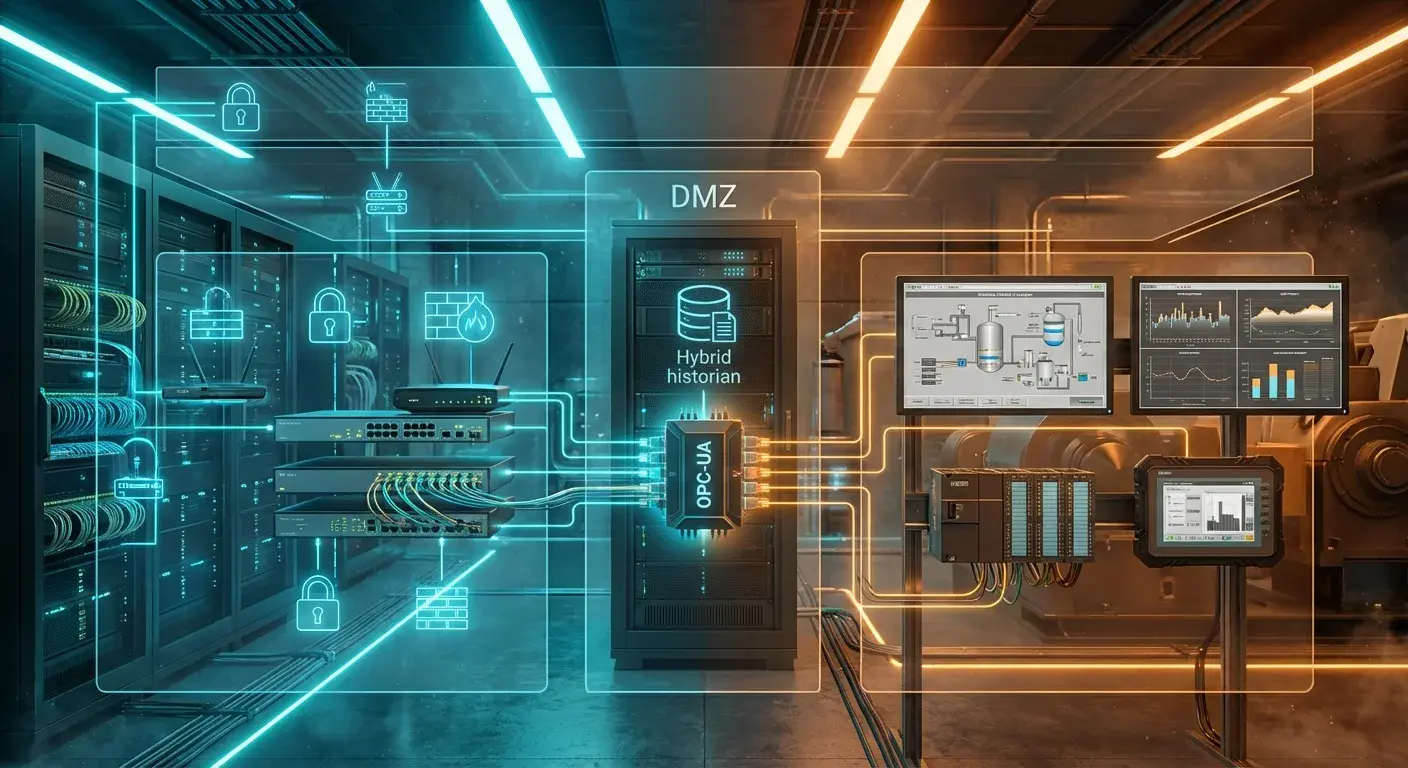
Using Edge Computing for network automation gives you a physical security barrier. The edge server cuts the direct link between your PLCs and the open internet, acting as a firewall that only allows one-way outbound transmission to your ERP.
iGromi OS: The Edge Network Orchestrator #
Implementing Edge Computing used to require a systems engineer writing Linux code for months. Today, platforms like iGromi OS let you install the infrastructure in a day. Plug in the cable, scan the sensors automatically and use Node-RED visually to route each data point where it needs to go, without writing a single line of code.
How Much Traffic Does a Plant Generate, and How Much Is Left After the Edge? #
Before talking about edge computing for network automation, do the math. Work by source type, not device by device: how many there are, how many variables each one reads, how many samples per minute it generates (not the ones you send today) and how many bytes each sample weighs. Then add protocol overhead: with MQTT and small messages, around 30 %.
An example with round numbers, in a jam plant with three line PLCs and six vibration sensors on motors such as M-204 on line 2:
| Source | Calculation | Everything raw | Aggregated every minute at the Edge |
|---|---|---|---|
| 3 line PLCs | 40 variables, 60 samples/min, 8 bytes | 57.6 kB/min | 0.96 kB/min |
| 6 vibration sensors | 3 variables, 600 samples/min, 4 bytes | 43.2 kB/min | 0.07 kB/min |
| Total with 30 % protocol overhead | 131 kB/min (about 5.7 GB a month) | 1.3 kB/min (about 58 MB a month) | |
| 8 cameras | if each one uploads 4 Mbps | 32 Mbps of continuous video | Only the verdict: a few bytes per event |
The table shows what is rarely said: telemetry on its own seldom saturates the link. 131 kB per minute is about 17 kbps. What saturates it is video. Eight cameras uploading full video need 32 Mbps of upload, and a 4G or small-business fiber link usually has far less upload than download. If the Edge processes the image inside the plant and sends only the result (a box went by, the belt stopped), the difference is three orders of magnitude. That is how production counting with the cameras the plant already has works.
The rule for reading the result: if sustained link usage goes above 70 %, telemetry starts competing with everything else. The threshold is a networking convention, not a law; with bursty traffic it is wise to lower it. This article's free spreadsheet does the math with your plant's numbers and tells you whether it fits.
Where Does a Plant Network Really Saturate? #
The math above sizes the internet uplink. But the saturation that stops a plant is almost never there. It is inside:
- An unmanaged switch shared between the new telemetry and the control network. When a camera or a server starts moving traffic, the PLC packets wait in the same queue.
- A ring or flat network with no segmentation, where a broadcast storm from a new device reaches every PLC.
- Badly configured polling: a system that queries the PLC over Modbus every 100 ms, when the value changes once a minute, steals cycles from the controller.
Industrial network automation starts with separation: the control network in its own zone, telemetry in another and a single crossing point between them, which is where the Edge or the IIoT gateway goes. The IEC 62443 standard calls this zones and conduits.
Edge Computing, Gateway or Data Logger: What Does Your Network Need? #
| If the problem is… | What solves it |
|---|---|
| Translating Modbus or S7 to MQTT and getting the data out without opening ports | An IIoT gateway |
| Logging temperature or energy with date and time, even when the internet drops | An industrial data logger |
| Many signals, video or a weak link | An Edge node that aggregates and processes inside the plant |
| Keeping new telemetry away from control | Segmenting the network before connecting anything |
Frequently Asked Questions #
What is edge computing for network automation?
It means processing plant data on a device installed next to the PLCs, instead of sending all of it to the cloud. The Edge filters, aggregates and translates telemetry, so only what changes or matters travels across the network.
Does edge computing replace the PLC or SCADA?
No. The PLC keeps controlling the machine and SCADA keeps supervising. The Edge reads read-only, stores and processes the data for analysis, without touching control.
What happens if the internet goes down?
The Edge keeps reading and storing inside the plant. The record stays in the plant and does not depend on the link being up.
How much bandwidth does a connected plant need?
It depends mostly on video. The telemetry of a mid-sized plant, aggregated at the edge, fits in a few kilobytes per minute; cameras uploading full video can need tens of Mbps. Measure upload, not download.
Topics
- edge computing industrial network
- industrial network automation
- edge computing manufacturing
- ot it network
- mqtt edge gateway
- plant bandwidth

About the author
Víctor RuzCEO
Automation and Robotics Engineer (Universidad Andrés Bello, 2012). More than twelve years in robotics and industrial automation. Founder and CEO of iGromi, where he connects machines, systems and plant people with secure industrial AI.

