Fixed stairs and handrails
Go up and down facing the stairs, with one hand on the rail and without carrying boxes that hide the steps.
Closing question: Which stairway in the plant is used with full hands?
Guide · Occupational health and safety
Informational guide, not legal advice. Check the current regulation at Ley Chile (Chile's official law library) and consult your safety professional or your mutual insurer (mutualidad).
Library
Pick this week's hazard. Swap the example for one from your plant and the talk gets better on its own.
36 topics
Go up and down facing the stairs, with one hand on the rail and without carrying boxes that hide the steps.
Closing question: Which stairway in the plant is used with full hands?
Three points of contact at all times: two hands and a foot, or two feet and a hand. Never jump from the platform.
Closing question: Where do people jump down today?
A lifted manhole cover or an unguarded pit is marked and protected before work continues, even for five minutes.
Closing question: Which opening was left unprotected this week?
The dock edge is marked and nobody walks backwards near it. Ramps are kept dry and free of debris.
Closing question: Where is there a level change that is not painted?
Where the belt meets the roller, a hand gets caught in a second. Never clean there with the belt running.
Closing question: Which pinch point on your line has no guard?
A glove can catch on a shaft or drill bit and pull the hand in. Near rotating parts, follow that machine's procedure.
Closing question: On which machine is a glove a hazard rather than protection?
Jewelry catches and does not let go. On the line you work without it, for food safety too.
Closing question: Who came onto the line wearing a ring today?
Guard in place, the right disc for the tool, face protection and nobody in the line of the sparks.
Closing question: When do we check the disc before using it?
A stopped machine can still hold compressed air, hydraulic pressure, a loaded spring or a raised part. Release it before reaching in.
Closing question: Which machine keeps moving after it is switched off?
The label pictograms tell you whether a product is corrosive, flammable or toxic. If you do not understand one, ask before using it.
Closing question: Which pictogram is on the product you use most?
Know where they are, keep the path clear and test them. After a splash, rinse first and report afterwards.
Closing question: How many steps from your station to the eyewash?
If there is a strong smell in the machine room, get out, raise the alarm and do not go back in without the right equipment and person.
Closing question: Who must know first if there is a leak?
Tanks, pits and silos may not have breathable air. Do not enter without gas testing, a permit and someone watching from outside.
Closing question: Which space in the plant looks safe but is not?
Chlorine and acids together release dangerous gases. Each product is stored according to its safety data sheet, not wherever there is room.
Closing question: Which products sit on the same shelf today?
An extension cord is temporary: it does not run under doors, the forklift does not drive over it and power strips are not daisy-chained.
Closing question: Which extension cord has been in the same place for months?
Pressurized water gets into motors and electrical boxes. Before washing, protect or de-energize what is needed.
Closing question: Which electrical equipment gets wet in the end-of-shift washdown?
Do not touch anyone still in contact with the current. Cut the power first, then help and call emergency services.
Closing question: Where is the main disconnect for your area?
Do not stack boxes or pallets in front of an electrical panel: in an emergency you must reach it and cut power without moving anything.
Closing question: Which panel has something in front of it today?
The same motion hundreds of times tires the hand and shoulder before it hurts. Breaks, rotation and reporting discomfort early.
Closing question: Which task in your shift repeats the same movement the most?
Shift your weight, use anti-fatigue mats where possible and wear firm footwear. Report leg and back discomfort.
Closing question: Where do people stand still the longest?
Push a cart or pallet jack with a straight back; pulling it while walking backwards twists the body and hides the path.
Closing question: Which cart is hard to move because of a bad wheel?
What you use often goes between waist and shoulder height. Heavy items do not go up high or on the floor.
Closing question: Which heavy box is on the top shelf?
Screen at eye level, feet supported and breaks to look into the distance. This applies to the control room too.
Closing question: Which screen workstation is badly set up?
Watch the path, lower the load when done and never use it to carry people or ride on it.
Closing question: Where are pallet jacks left in the aisle?
No truck reverses at the dock without someone guiding it from a visible spot. Nobody walks behind a reversing vehicle.
Closing question: Who guides reversing trucks on the night shift?
Forks down, brake on, engine off and key removed. Never in front of an exit or a fire extinguisher.
Closing question: Where is the forklift left at the end of the shift?
At a corner with no visibility, slow down and sound a warning. A convex mirror helps, but does not replace looking.
Closing question: Which warehouse intersection has no visibility?
Drop, cover and hold on away from racks, glass and shelving. Evacuate when it stops, along the marked route.
Closing question: What near your station could fall in an earthquake?
Know where the first-aid kit is, who on the shift is trained and what number to call. Help without putting yourself at risk.
Closing question: Who gives first aid on your shift?
Do not turn switches on or off, do not use flames, ventilate if safe and evacuate while raising the alarm.
Closing question: Where is there gas in the plant and who shuts it off?
When power returns, some machines restart on their own. During an outage, nobody reaches into a stopped machine.
Closing question: Which machine starts by itself when power comes back?
Water within reach, breaks in the shade and watch for dizziness or headache in a coworker. In summer, the risk rises near ovens and on roofs.
Closing question: Where is it hottest in the plant?
In the yard, at the dock or on the roof: hat, covering clothes, sunscreen and water. UV radiation harms even when it is cloudy.
Closing question: Which tasks are done in the midday sun?
A poorly fitted respirator does not protect. Check the seal every time you put it on; a beard prevents it from sealing.
Closing question: When do we check respirator fit?
Anyone who is not fit does not operate a machine or drive. Medication that causes drowsiness counts too: report it.
Closing question: What do you do if a coworker shows up unfit to work?
Mental fatigue also causes mistakes. Asking for help or telling your supervisor is part of working safely.
Closing question: Where can you ask for support in the company?
Looking for the classic plant topics (housekeeping, lockout, knives, forklifts, cold rooms)? They are in 20 safety talks for plants.
What the regulation requires
DS 44, Chile's preventive management decree, does not mention 5-minute talks. It requires informing, training and recording; the talk reinforces all three.
Risk information (IRL)
What it requires
Article
And the talk
Training
What it requires
Article
And the talk
PPE use
What it requires
Article
And the talk
Committee outreach
What it requires
Article
And the talk
Documentary record
What it requires
Article
And the talk
| Obligation | What it requires | Article | And the talk |
|---|---|---|---|
| Risk information (IRL) | Before work starts and when processes or substances change | Art. 15 | The talk reinforces it; it does not replace it |
| Training | At least 8 hours, never more than two years apart | Art. 16 | A talk is not the training |
| PPE use | At least one hour, refreshed every year | Art. 13 | A good talk topic, with a separate record |
| Committee outreach | Information meetings, talks or other means | Art. 47 | The joint committee can promote them |
| Documentary record | Documentary and reliable, preferably electronic | Art. 72 | Attendance is recorded |
Attendance record
The two typical failures: a talk marked "done" with no attendance list, and a list that does not say what was discussed. With these fields, the record stands on its own.
Free template
You give talks at the start of each shift, but topics repeat and attendance ends up on loose sheets.
Locked file
charlas-5-minutos-en.xlsx (82 KB)
Leave your work email to download this spreadsheet and hear about the next one.
It reinforces the risk information and training required by DS 44; it does not replace them.
In the app
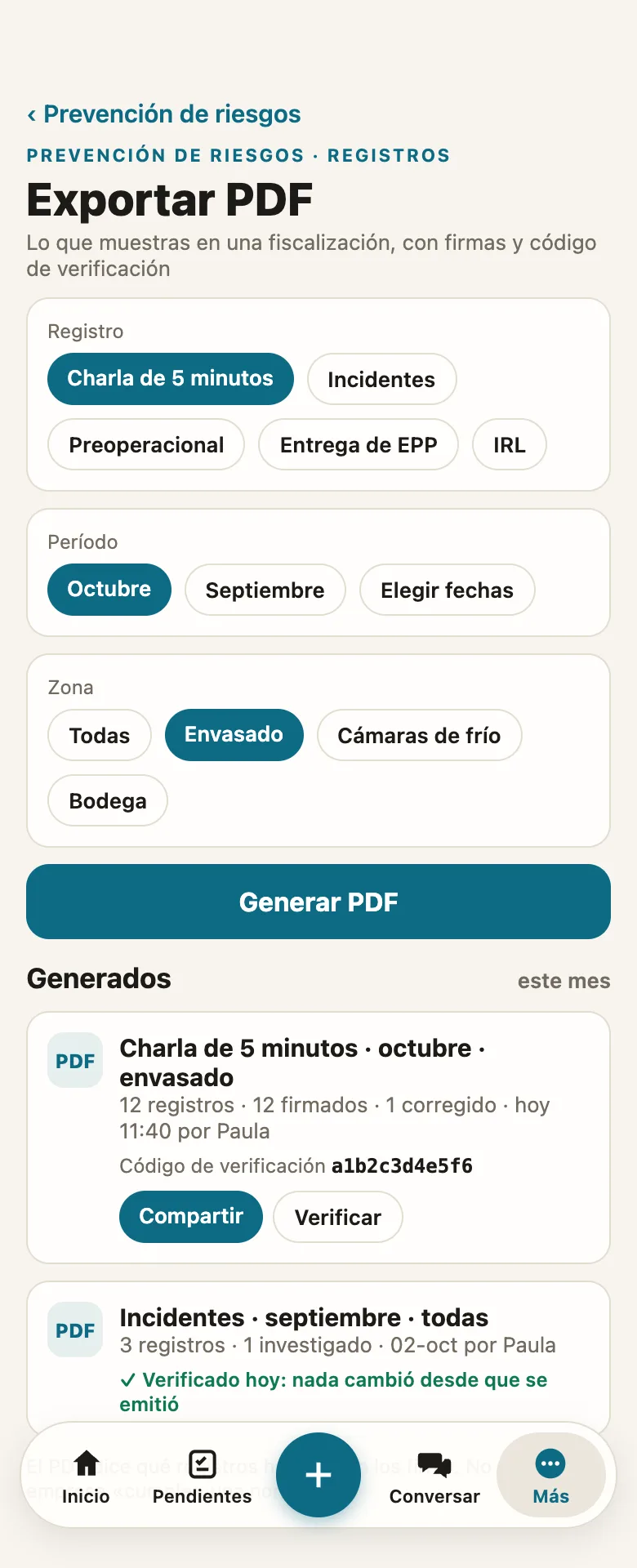
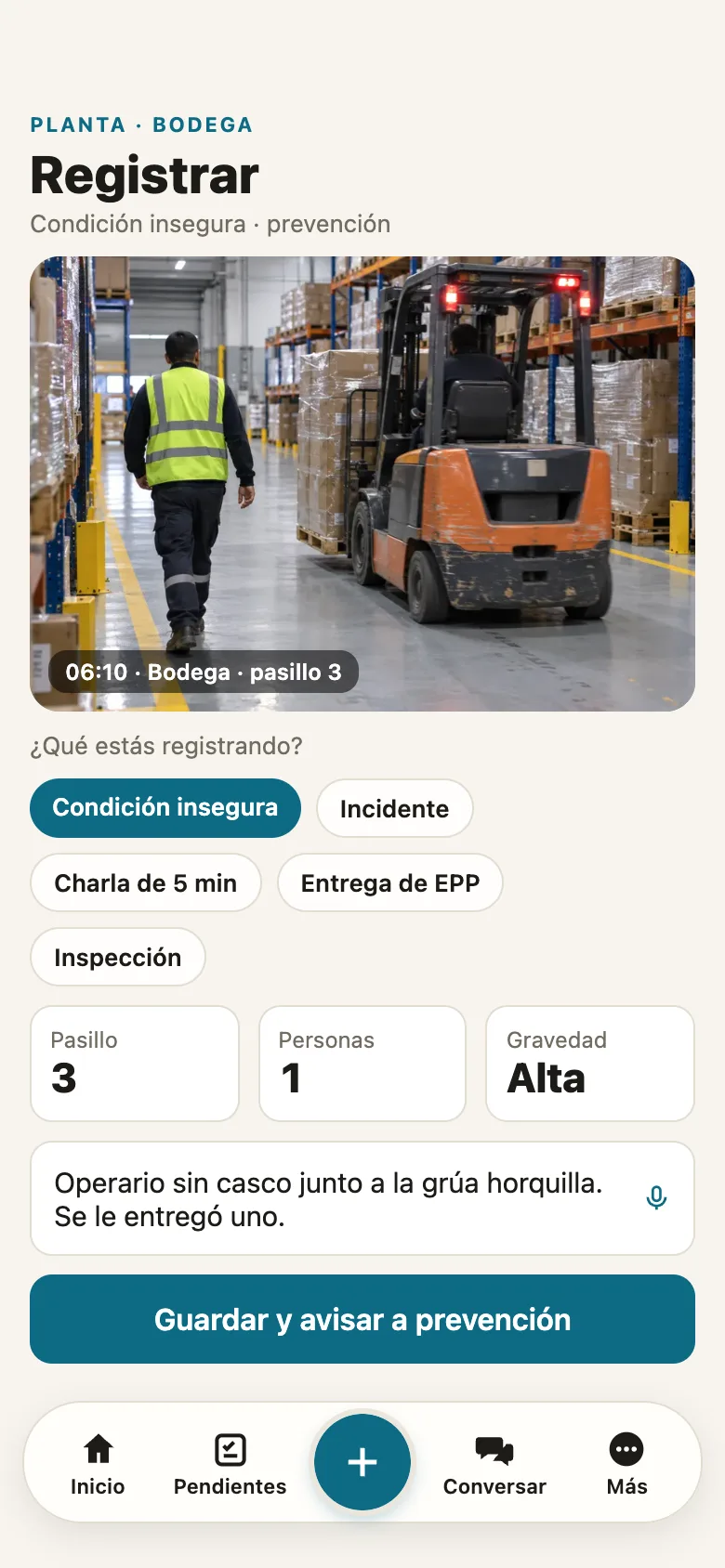
The talk is recorded during the shift, with its attendees and signatures, and the month exports to PDF ready to show.
Frequently asked questions
Sources: DS 44 on Ley Chile (BCN) · Labor Directorate, IRL under art. 15 · SUSESO circular, Annex No. 62. Reviewed on November 1, 2026.
Keep reading
No credit card. Your data stays yours.