Guide · Occupational health and safety
Safe work procedure: what it is, structure and an example
Informational guide, not legal advice. Check the current regulation at Ley Chile (Chile's official law library) and consult your safety professional or your mutual insurer (mutualidad).
Art. 7
IPER matrix
Hazards and risks by process, task and job
Art. 8
Preventive program
Measures, deadlines and owners within 30 days
Art. 9
Order of controls
Administrative measures include safe work methods
Arts. 10 and 13
SWP
How the task is done with the controls in place
Art. 15
IRL
The worker is informed before starting
What DS 44 requires
Where the safe work procedure appears in DS 44
The decree has no template, but it names the SWP in six articles. Text checked on Ley Chile.
Art. 9 No. 3
What it says
Art. 10
What it says
Art. 13
What it says
Art. 15 No. 3
What it says
Art. 46
What it says
Art. 52 No. 5
What it says
| Article | What it says |
|---|---|
| Art. 9 No. 3 | Reduce risk with organizational and administrative measures "including the development of safe work methods." The SWP is a third-level measure: it does not replace elimination or control at the source. |
| Art. 10 | Employers that use machines, equipment or tools with a risk of entrapment, cuts, injury or amputation must have a safe work procedure with an operation and maintenance program, functional checks and guarding. |
| Art. 13 | A procedure for using, maintaining, replacing and changing personal protective equipment. |
| Art. 15 No. 3 | The occupational risk information each worker receives before starting includes the safe work procedures. |
| Art. 46 | The joint safety committee may review control measures and safe work procedures. |
| Art. 52 No. 5 | The Prevention Department advises line management on designing work procedures. |
That is why the SWP starts from the risk matrix: the hazards it lists are those in the matrix, and it is delivered along with the risk information (IRL). SUSESO, Chile's Social Security Superintendency, lists safe work procedures among the forms in Annex No. 62.
Structure
The eight sections of a safe work procedure
This is the usual structure, not a legal format. Tap each section to see how it reads in the slicer example.
Example · slicer cleaning · part 1 of 8
Objective
Clean and sanitize the line 2 slicer at the end of every shift with no exposure to the blade or the chemicals.
Full example
SWP for cleaning and sanitizing a slicer
A made-up example for a food plant. Because the slicer carries a risk of cuts and entrapment, art. 10 of DS 44 requires a safe work procedure.
1. Stop the line
Hazard
Control
2. Lock out and tag out
Hazard
Control
3. Wait for full stop
Hazard
Control
4. Remove scraps
Hazard
Control
5. Remove moving parts
Hazard
Control
6. Wash and sanitize
Hazard
Control
7. Reassemble and check
Hazard
Control
8. Release the equipment
Hazard
Control
| Step | Hazard | Control |
|---|---|---|
| 1. Stop the line | Start-up while someone approaches | The shift lead authorizes and alerts the line |
| 2. Lock out and tag out | Unexpected start-up | Personal padlock on the disconnect and a named tag; test that it will not start |
| 3. Wait for full stop | Blade coasting | Check that the blade is still before opening |
| 4. Remove scraps | Cuts | Long-handled tool, with the blade guard in place |
| 5. Remove moving parts | Cuts and strain | Cut-resistant gloves; parts go on the table, not the floor |
| 6. Wash and sanitize | Chemical on skin and eyes | Dispenser, concentration per the data sheet, goggles |
| 7. Reassemble and check | Guards not refitted | Close-out checklist: guard, covers and sensors in place |
| 8. Release the equipment | Start-up with someone inside | Whoever placed the padlock removes it; the shift lead releases and signs |
PPE is issued with a record (PPE issue log) and must be free of charge to the worker (art. 53 of DS 594). If a cut occurs, the investigation follows the cause tree.
Common mistakes
Why an SWP fails on the plant floor
- Copying a generic SWP from the internet that does not name the machine, the line or the owners.
- Writing it in the office without watching the task or asking the person who does it.
- Using the SWP instead of an engineering control: a missing guard is not replaced by a written step.
- Hazards that do not match the IPER matrix, or a matrix that is not updated when the SWP changes.
- Steps so long that nobody reads them on the floor; better a few steps, each with its control.
- Not recording that the worker received and understood it (it is part of the art. 15 risk information).
- Not reviewing it after an incident or a change of equipment, process or chemical.
To turn an SWP into an induction the worker goes through and signs, see LUMYA. ACHS guide to DS 44 (in Spanish).
Free template
IPER matrix template: every SWP starts here
You have to build or update the hazard identification and risk assessment matrix required by Chile's Supreme Decree 44 and derive the preventive work program from it.
- · Probability times consequence using the method of Chile's Public Health Institute (ISP): expected loss value (VEP) and level calculated and color-coded
- · Controls in the order of article 9, from elimination to PPE, recording the highest control used
- · Owner, deadline, status and next annual review, ready for the preventive program
- · Alerts for high risks controlled only with PPE, rows without a control and overdue deadlines
Locked file
matriz-iper-ds-44-en.xlsx (40 KB)
Leave your work email to download this spreadsheet and hear about the next one.
It does not replace an expert assessment or the Chilean Ministry of Health (MINSAL) protocols.
In the app
The safe work procedure in the app
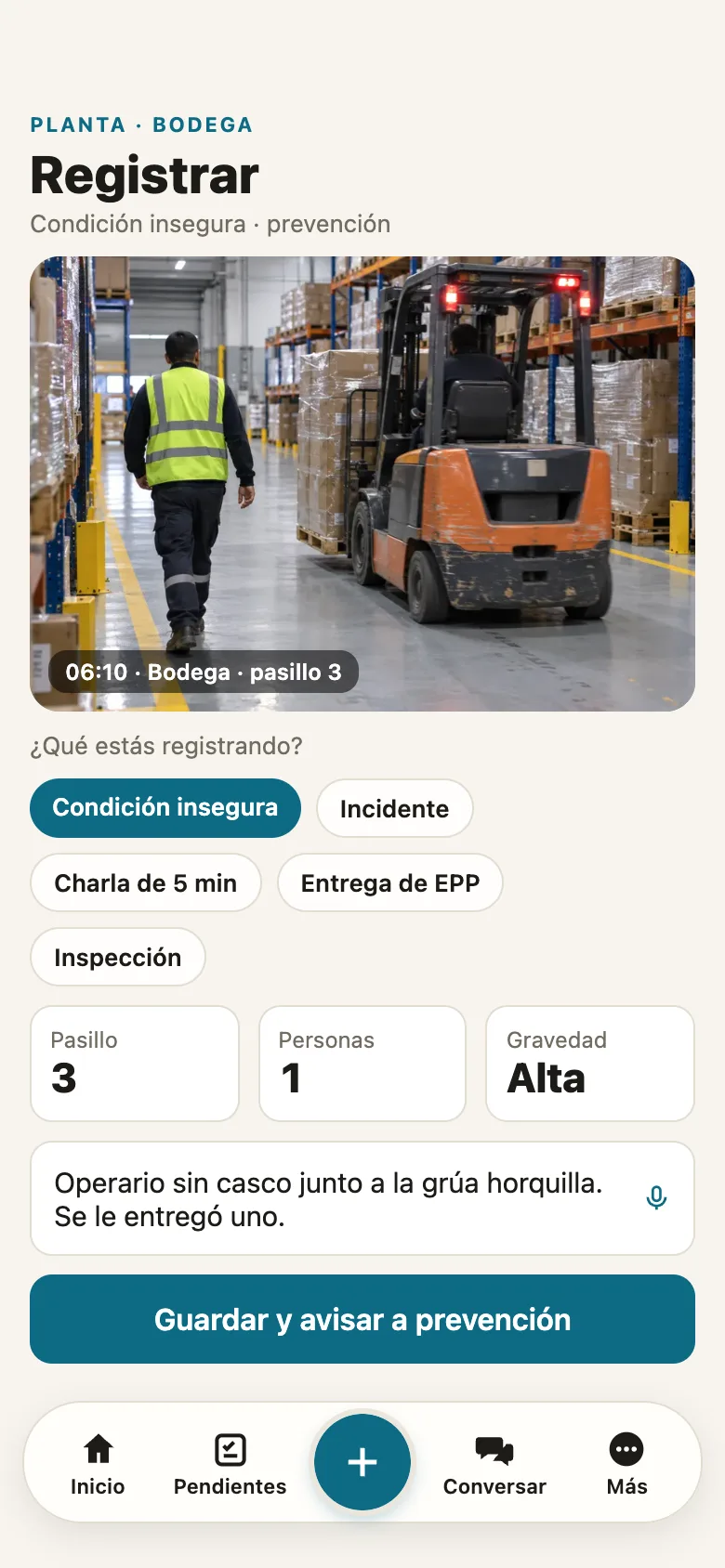
iGromi's free app keeps task observations, SWP reviews with their dates and the signed record of who received it, as a PDF.
Frequently asked questions
Safe work procedure FAQ
What is a safe work procedure?
Does DS 44 require safe work procedures?
How does the SWP relate to the IPER matrix?
What sections does a safe work procedure have?
Who writes the safe work procedure?
How often is an SWP reviewed?
What is the difference between an SWP and a work instruction?
Sources: DS 44 on Ley Chile (BCN) · SUSESO, Annex No. 62 · DS 594 on Ley Chile · ACHS, DS 44. Reviewed on November 1, 2026.
Keep reading
Occupational health and safety guides
Every shift without a record is data you lose. Start free.
- 1Request early access, free
- 2Pick your trade: maintenance, production or safety
- 3Your team starts with the chat and its trade helper
No credit card. Your data stays yours.