Guide · Occupational safety and health
DS 44 risk map what it includes and a plant example
Informational guide, not legal advice. Check the current regulation at the Chilean Labor Ministry guide (Chile's official law library) and consult your safety professional or your mutual insurer (mutualidad).
Packaging
- 6. Caught in machinery · SignificantControl: Interlocked guard and lockout during cleaning
- 7. Noise exposure · Level 3 (hygiene)Control: Acoustic enclosure; PREXOR protocol
Requirements
What DS 44 requires for the risk map
Articles 62 and 63 of DS 44 require it of every employer. The methodology is set by the Chilean Labor Ministry guide, issued through Exempt Resolution 129 of January 29, 2025.
Minimum content
Requirement
Source
Updates
Requirement
Source
Visibility
Requirement
Source
Methodology
Requirement
Source
Who prepares it
Requirement
Source
| Item | Requirement | Source |
|---|---|---|
| Minimum content | A drawing or layout of the workplace showing the main risks from the risk matrix with symbols | Art. 62 |
| Updates | Every time the risk matrix changes | Art. 62 |
| Visibility | Posted in visible spots at each workplace; its location is recorded in the prevention program | Art. 62 and guide |
| Methodology | The Chilean Labor Ministry's guide, Exempt Resolution 129 of 2025 | Art. 62 |
| Who prepares it | The prevention department or another specialized entity together with the joint health and safety committee; with no department, the mutual insurer; with no committee, the safety delegate | Art. 63 |
Symbols and colors
A caution triangle in the color of its level
Yellow background, black border and pictogram, using the symbols in Annex 1 of the guide or those from your mutual insurer. The color depends on the type of risk:
Safety, emergencies, disasters and biological
Intolerable · Significant · Moderate · Tolerable
Chemical and physical hygiene
Level 4 · Level 3 · Level 2 · Level 1
Musculoskeletal
High or critical · Medium · Low
Psychosocial
High or critical · Medium · Low
How to draw it
How to build the sketch, step by step
- 1. A clear sketch of the zones; it does not have to be exact, and an existing one works.
- 2. The main risks from the matrix, each with its symbol and the color of its level.
- 3. If an area has many, red and orange come first; psychosocial risk always goes on.
- 4. Site-wide risks top left; the legend bottom right.
Communication
Where the map goes and how to share it
In a visible spot at each workplace. The guide suggests showing it in meetings and briefings, and adding a link or a QR code.
- It is updated every time the matrix changes.
- For people with visual impairments or color blindness: text explaining each color, braille or audio.
Free template
No matrix, no map: start with the IPER risk matrix
The symbols and colors on the map are the risks and levels from the matrix. The IPER (hazard identification and risk assessment) matrix spreadsheet calculates each risk's level; the map is drawn afterwards from those results.
- · Probability times consequence using the method of Chile's Public Health Institute (ISP): expected loss value (VEP) and level calculated and color-coded
- · Controls in the order of article 9, from elimination to PPE, recording the highest control used
- · Owner, deadline, status and next annual review, ready for the preventive program
- · Alerts for high risks controlled only with PPE, rows without a control and overdue deadlines
Locked file
matriz-iper-ds-44-en.xlsx (40 KB)
Leave your work email to download this spreadsheet and hear about the next one.
It does not replace an expert assessment or the Chilean Ministry of Health (MINSAL) protocols.
In the app
How the app keeps the map up to date
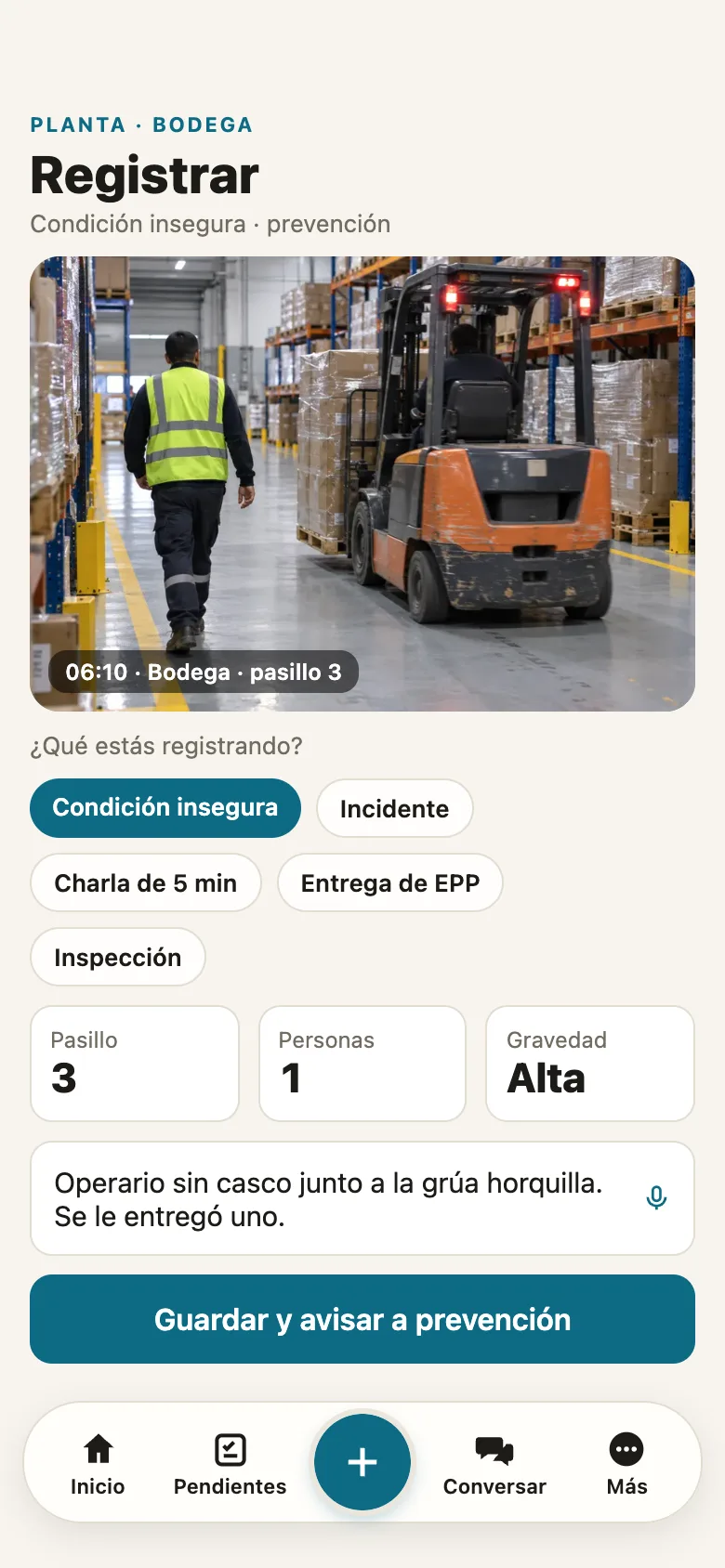
Plant changes are logged during the shift, create a pending task to update the matrix and map, and come out as a signed PDF. Free app in early access.
Frequently asked questions
Risk map FAQ
What is the DS 44 risk map?
Which companies must have a risk map?
Is there an official guide for making the risk map?
What symbols and colors does the map use?
Which risks go on the map if there are many?
Who prepares the risk map?
Sources: DS 44 on Ley Chile (BCN), arts. 62 and 63 · Guide for preparing occupational risk maps (in Spanish) · Exempt Resolution 129 of 2025 in the Diario Oficial · ISP guide, version 03. Reviewed on November 1, 2026.
Keep reading
Occupational health and safety guides
Every shift without a record is data you lose. Start free.
- 1Request early access, free
- 2Pick your trade: maintenance, production or safety
- 3Your team starts with the chat and its trade helper
No credit card. Your data stays yours.