Guide · Occupational health and safety
TMERT protocol: requirements, checklist and deadlines
Informational guide, not legal advice. Check the current regulation at Ley Chile (Chile's official law library) and consult your safety professional or your mutual insurer (mutualidad).
What it is
What the TMERT protocol requires, and from whom
Chile's DS 594, the workplace sanitary conditions decree, requires employers to assess the musculoskeletal risk factors in the tasks of their jobs according to the MINSAL standard (art. 110 a.1). Today that standard is protocol V3, approved by Exempt Resolution No. 1,697 and published in the Diario Oficial; it replaced the 2024 version.
In addition, DS 44 requires the risk matrix to consider ergonomic risks and those covered by occupational surveillance programs (art. 7): what comes out of the protocol goes into the matrix.
Micro (1 to 9) or no joint committee
Done by the employer
With the administering body
Small (10 to 49) with no committee or safety professional
Done by the employer
With the administering body
Medium and large
Done by the employer
With the administering body
| Company size | Done by the employer | With the administering body |
|---|---|---|
| Micro (1 to 9) or no joint committee | Initial identification | Advanced identification with an on-site professional from the administering body |
| Small (10 to 49) with no committee or safety professional | Initial identification | Advanced identification with an on-site professional from the administering body |
| Medium and large | Initial and advanced identification | Initial and advanced assessment, when identification comes out not acceptable |
Section 5.1 of the protocol. In every company the process is participatory and is documented with the signatures of the employer, the workers' representative on the joint committee (if there is one) and the workers in the area.
Checklist
Initial identification, question by question
This is Table 1 of the protocol and the first checklist the employer applies at each job. Try it on a real job in your plant.
1. Repetitive upper-limb work
Are there tasks using the hands and arms for one hour or more per shift and 5 or more hours per week? Assembling, cutting, tightening, packing, typing.
2. Static or awkward posture
Is the head, neck, trunk or a limb held in one posture for more than 4 seconds? Head bent, trunk twisted, shoulders forward.
3. Lifting, lowering or carrying
Is an object over 3 kg lifted, lowered or carried by hand? Boxes, bags, trays, palletizing.
4. Pushing and pulling
Is a load pushed or pulled using the whole body, with one or both hands? Carts, manual pallet jacks, wheelbarrows.
5. Manual handling of people
Is a person, or part of their body, moved or held, with or without aids? Typical in healthcare and care work.
6. Whole-body vibration
Is there noticeable vibration while standing or sitting on a machine or vehicle?
7. Hand-arm vibration
Are pneumatic, electric, impact or percussive tools used?
Answer the seven questions for this job
This stage is done by the employer itself; the next ones depend on what you mark here.
A summary of the protocol V3 questions; to apply it, use the full text and the forms from your administering body. ISL materials.
Stages
From checklist to assessment: the five stages
Each stage only happens if the previous one found risk. Tap one to see who does it and what comes out of it.
Stage 1 of 5 · The employer
Initial identification
Each job is characterized (Annex I) and the seven questions are answered. If all are NO, there is no exposure; repeat every 3 years or as soon as the task changes.
Risk levels
Green, yellow and red: what to do at each level
Level
Condition
What follows
Level
Condition
What follows
Level
Condition
What follows
| Level | Condition | What follows |
|---|---|---|
| Low · green | Controlled exposure | Periodic review of the task every 3 years, starting again from initial identification. |
| Medium · yellow | Not acceptable | Intervene within 90 days at most, reducing the highest-scoring factors first, and reassess with the same method. |
| High · red | Not acceptable | Intervene within 90 days at most and reassess. If it comes out high again, or it came out medium, it moves to advanced assessment. |
Table VIII and section 5.2 of the protocol. The task's risk is that of its worst-rated factor. Engineering measures come before administrative ones: the latter work as a temporary fix and must be documented with an owner (section 7).
Deadlines
Every deadline in the TMERT protocol
Those that apply to the employer and those that apply to its administering body, with the section of the protocol where each one is.
3 years
What
Where
Immediately
What
Where
90 days
What
Where
180 days
What
Where
30 calendar days
What
Where
5 days
What
Where
5 business days
What
Where
4 months
What
Where
6 months
What
Where
| Deadline | What | Where |
|---|---|---|
| 3 years | New initial identification if there was no risk, or review if the condition is acceptable or the risk is low | Sections 5.1.1 and 5.1.2 |
| Immediately | New identification when the task conditions or the production process change | Sections 5.1 and 5.3 |
| 90 days | Intervene a critical condition or a medium or high risk; also whatever is solved with administrative measures | Sections 5.1.3 and 5.2 |
| 180 days | Intervene whatever is solved with engineering measures after the advanced assessment | Section 5.2 |
| 30 calendar days | The administering body delivers the technical report with measures, owners and deadlines | Section 5.3 |
| 5 days | The employer informs workers and their representatives of the results after receiving the report | Section 5.3 |
| 5 business days | List of exposed workers who enter health surveillance, after a non-acceptable result | Section 6 |
| 4 months | The employer updates that list and reports it to its administering body | Section 6 |
| 6 months | Re-identification, reassessment and health evaluation for those still exposed | Section 12.1.5 |
Health surveillance
Who enters surveillance and what training is required

- Workers in jobs with a non-acceptable condition (critical or medium) enter, as do those with a linked occupational disease and their similar exposure group (section 3.2).
- The health evaluation uses the Nordic questionnaire, the Quick DASH and the Oswestry scale (Annexes IV to VI), with informed consent.
- It is repeated every 6 months while the risk remains; once the job is corrected, an exit evaluation is done (section 12.1.5).
- Training: 8 hours every 2 years for exposed workers and 16 hours every 2 years for supervisors (section 8).
To design the measures, the protocol recommends the ISP participatory ergonomics guide (Chile's Public Health Institute).
In the app
The TMERT protocol in the app
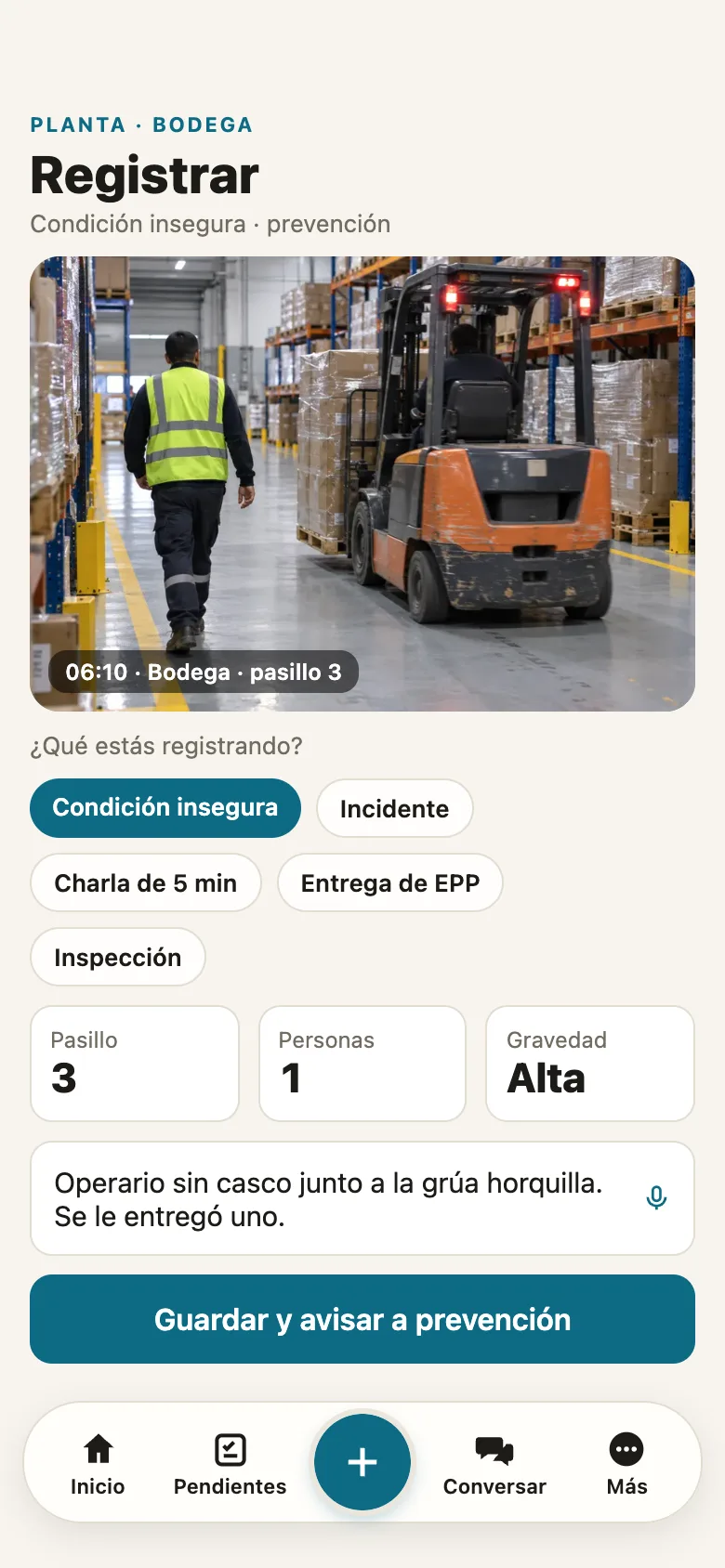
iGromi's free app keeps the protocol records: the photo of the job, each measure with its deadline and the period's PDF showing who signed. The assessment methods are applied by your safety professional or your administering body.
Frequently asked questions
TMERT protocol FAQ
What is the TMERT protocol?
Is the TMERT protocol only about the upper limbs?
Who must apply the TMERT protocol?
What is the TMERT protocol checklist?
What do green, yellow and red mean?
What deadlines does the TMERT protocol set?
Who enters health surveillance?
What training does the protocol require?
Sources: TMERT protocol V3 (MINSAL, published by the ISL) · Exempt Resolution No. 1,697 in the Diario Oficial · ISL, TMERT surveillance protocol · DS 594 on Ley Chile · DS 44 on Ley Chile · ISP, participatory ergonomics guide · IST, TMERT. Reviewed on November 1, 2026.
Keep reading
Occupational health and safety guides
Every shift without a record is data you lose. Start free.
- 1Request early access, free
- 2Pick your trade: maintenance, production or safety
- 3Your team starts with the chat and its trade helper
No credit card. Your data stays yours.