Calculator · Occupational safety and health
Accident rate calculator and formulas
Informational guide, not legal advice. Check the current regulation at Ley Chile (Chile's official law library) and consult your safety professional or your mutual insurer (mutualidad).
Accident rate
2.5
accidents per 100 workers · DS 44, art. 73
Lost-day rate
37.5
lost days per 100 workers · DS 67, art. 2
Frequency rate
12.5
injured per million hours · DS 44, art. 73
Severity rate
187.5
lost days per million hours · DS 44, art. 73
What it measures
What the accident rate is
It is the number of injured workers per hundred workers over a period of up to one year (art. 73 of DS 44). With the calculator data, 2.5 out of every hundred: the red dots.
It counts accidents, not days. To see how much they weighed, use the lost-day rate; to compare plants of different size or schedule, use frequency and severity, which are measured per million hours.
The formulas
The four rates, with their formula and article
Accident rate
Formula
Period
Source
Frequency
Formula
Period
Source
Severity
Formula
Period
Source
Temporary disability lost-day rate
Formula
Period
Source
| Rate | Formula | Period | Source |
|---|---|---|---|
| Accident rate | Work accidents ÷ workers × 100 | Defined period, never longer than one year | DS 44, art. 73 No. 1 |
| Frequency | Injured × 1,000,000 ÷ hours worked | Monthly | DS 44, art. 73 No. 2 |
| Severity | (Days absent + charged days) × 1,000,000 ÷ hours worked | Every six months | DS 44, art. 73 No. 3 |
| Temporary disability lost-day rate | Lost days ÷ average annual headcount × 100 | Annual period, July to June | DS 67, art. 2 h) |
The calculator does not add charged days to severity: they are added per the ISP charged-days guide when there are permanent disabilities or deaths. DS 67 rounds to two decimals; so does this calculator.
DS 67
Lost-day rate and the additional premium
Chile's DS 67 measures the actual accident record to set the differentiated additional premium for workplace accident insurance: exemption, discount or surcharge.
- · Annual period: July 1 to June 30.
- · Evaluation period: the three previous annual periods (two if the company has been operating for fewer than three).
- · Total rate: average temporary disability rate plus the rate for disabilities and deaths.
- · Process every two years, in odd-numbered years (ISL).
In the app
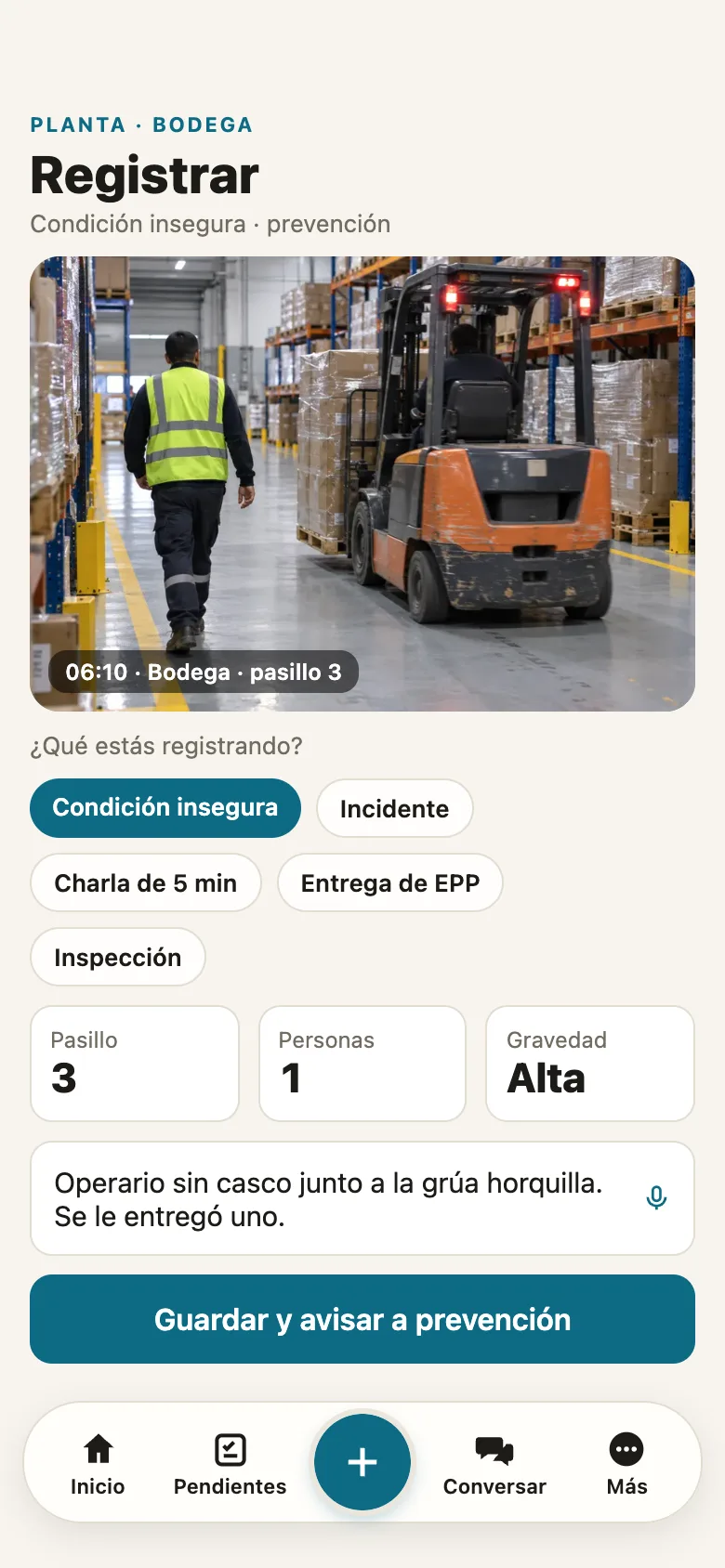
The rates come from logging every incident
If each incident is logged and signed the day it happens, the monthly count does not depend on anyone remembering.
Frequently asked questions
Accident rate FAQ
How is the accident rate calculated?
What is the difference between the accident rate and the lost-day rate?
How are the frequency and severity rates calculated?
Which companies must track these rates?
What is the DS 67 lost-day rate used for?
How often is the DS 67 evaluation done?
Sources: DS 44, arts. 73 and 75 (BCN) · DS 67, art. 2 (BCN) · SUSESO Compendium, premiums · ISL, DS 67. Reviewed on November 1, 2026.
Keep reading
Occupational health and safety guides
Every shift without a record is data you lose. Start free.
- 1Request early access, free
- 2Pick your trade: maintenance, production or safety
- 3Your team starts with the chat and its trade helper
No credit card. Your data stays yours.