Guide · Occupational health and safety
Risk matrix what it is, how it is assessed, with examples
Informational guide, not legal advice. Check the current regulation at the ISP guide (Chile's official law library) and consult your safety professional or your mutual insurer (mutualidad).
Consequence (1 · 2 · 4)
2 × 4 = VEP 8 · Significant. Do not start the work until the risk is reduced; if it is already under way, fix it before the moderate ones.
What it is
From hazard to measure, in one row
Each row starts from a hazard, what can cause harm, and assesses the risk: the likelihood of the harm happening and its severity. In Chile it is the IPER matrix of article 7 of DS 44, by process, task and job.
How it is assessed
How each risk in the matrix is assessed
DS 44 refers to the ISP guide for hazard identification and risk assessment (version 03), from Chile's Public Health Institute. The method depends on the type of risk: the VEP (expected loss value) is only for safety risks.
Probability: low 1, medium 2, high 4. Consequence: slightly harmful 1, harmful 2, extremely harmful 4.
Safety, emergencies and disasters
How it is assessed
Where
Physical and chemical hygiene (noise, silica, heat, cold)
How it is assessed
Where
Musculoskeletal
How it is assessed
Where
Psychosocial
How it is assessed
Where
| Risk type | How it is assessed | Where |
|---|---|---|
| Safety, emergencies and disasters | Expected Loss Value (VEP): probability × consequence | ISP guide, 6.3.2 |
| Physical and chemical hygiene (noise, silica, heat, cold) | DS 594 Title IV limits and MINSAL surveillance protocols | ISP guide, 6.3.1 |
| Musculoskeletal | MINSAL TMERT protocol and manual handling guide | ISP guide, 6.3.1 |
| Psychosocial | MINSAL psychosocial risk surveillance protocol | ISP guide, 6.3.1 |
Many companies use 5 × 5 matrices from their management systems. DS 44 accepts validated methods, but the reference in Chile for safety risks is the VEP; review your scale with your safety professional or your mutual insurer.
Examples
Eight plant risks, assessed and with their measures
Illustrative examples from a food plant: probability and consequence depend on each site. Tap a risk to see its level and the measures in the order of article 9.
Packaging · hazard
Unguarded sealer rollers
Risk
Hand entrapment
Probability 2 × consequence 4 = VEP 8 · Significant. Do not start the work until the risk is reduced; if it is already under way, fix it before the moderate ones.
- 1. EliminateNot applicable in this example
- 2. EngineeringFixed guard with interlock that stops the machine when opened
- 3. AdministrativeLockout/tagout before cleaning or clearing
- 4. PPENot applicable in this example
Measures
The hierarchy of controls: PPE comes last
Article 9 of DS 44 sets the order in which measures are chosen. Article 12 prefers collective over personal protection, and article 13 leaves PPE for when the risk could not be sufficiently controlled.
- Common mistake: a significant risk with a single measure, "use PPE."
- An avoidable risk is not assessed: it is eliminated (ISP guide).
Free template
IPER matrix in Excel, with the VEP already calculated
The template from the DS 44 IPER matrix guide: enter probability and consequence and the level is calculated for you, with the measures in the order of article 9.
- · Probability times consequence using the method of Chile's Public Health Institute (ISP): expected loss value (VEP) and level calculated and color-coded
- · Controls in the order of article 9, from elimination to PPE, recording the highest control used
- · Owner, deadline, status and next annual review, ready for the preventive program
- · Alerts for high risks controlled only with PPE, rows without a control and overdue deadlines
Locked file
matriz-iper-ds-44-en.xlsx (40 KB)
Leave your work email to download this spreadsheet and hear about the next one.
It does not replace an expert assessment or the Chilean Ministry of Health (MINSAL) protocols.
In the app
How the matrix carries on in the app
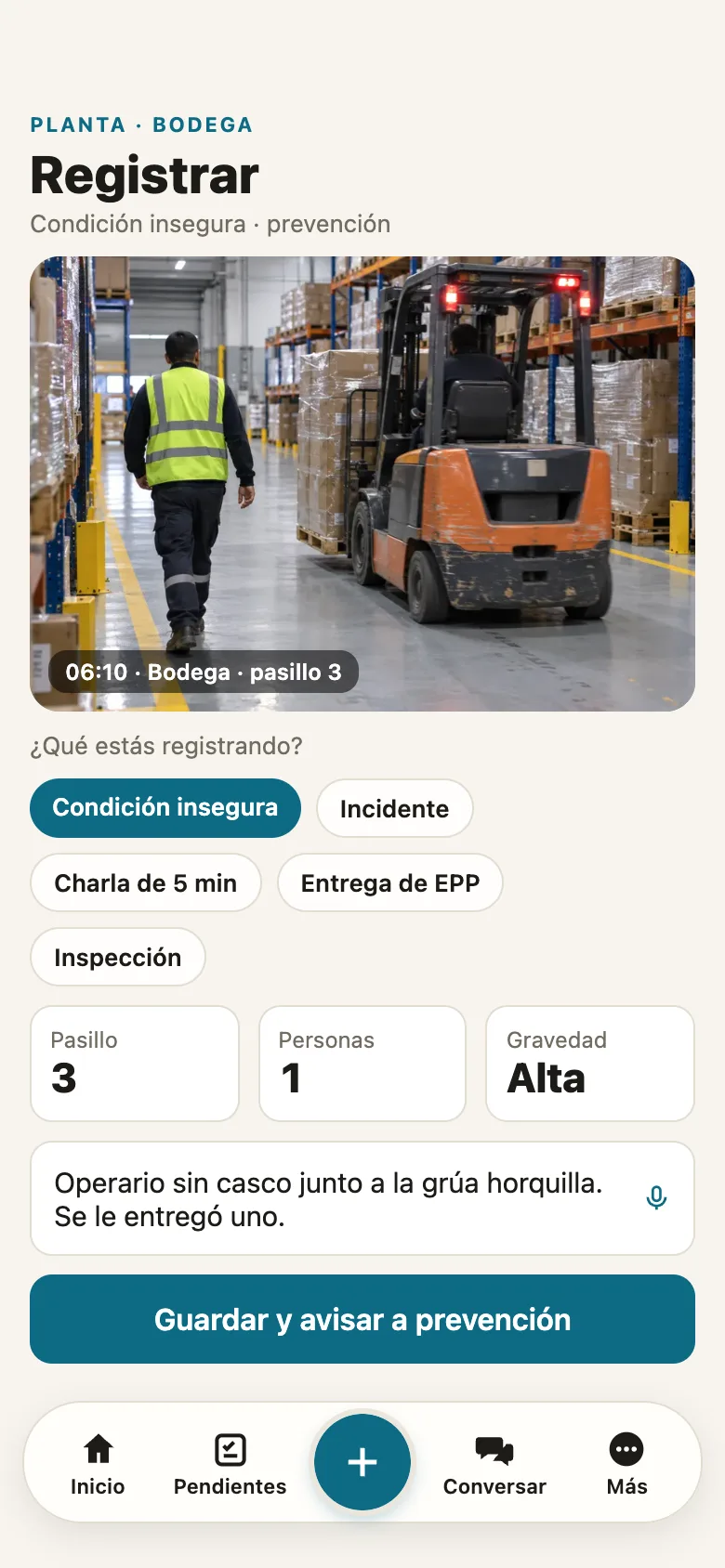
The matrix says what to do; the app records that it was done. Findings, measures and inspections are logged with photo, signature and a PDF for the period.
Frequently asked questions
Risk matrix FAQ
What is a risk matrix?
What is the difference between a hazard and a risk?
How is the risk level calculated?
Can a 5 × 5 matrix be used?
Are noise or manual handling assessed with the VEP?
How often is the risk matrix reviewed?
Is providing PPE enough to control a risk?
Sources: DS 44 on Ley Chile (BCN) · ISP guide for hazard identification and risk assessment, version 03. Reviewed on November 1, 2026.
Keep reading
Occupational health and safety guides
Every shift without a record is data you lose. Start free.
- 1Request early access, free
- 2Pick your trade: maintenance, production or safety
- 3Your team starts with the chat and its trade helper
No credit card. Your data stays yours.